
Table of contents▼
Who this is for: NEMT business startups selecting their first fleet, fleet managers scaling operations across multiple vehicles or service zones, and private operators evaluating used NEMT vans for sale as a lower-cost entry point into the market. If you're making a capital decision on NEMT vehicles in 2026, this post gives you the data and framework to make it correctly.
What Are the Best NEMT Vehicles to Buy in 2026?
Direct answer for buyers, fleet managers, and operators:
- Ford Transit 350 (high-roof, extended): Best all-round full-size NEMT van. ADA-compliant with rear or side-entry wheelchair lift. New price: $52,000–$68,000. Used (2020–2022, 60k–90k miles): $28,000–$38,000. Highest parts availability in the segment.
- Dodge Grand Caravan / Chrysler Voyager: Best-value minivan for ambulatory and light wheelchair transport. New: $34,000–$42,000 converted. Used NEMT vans for sale in this class run $14,000–$22,000 for 2018–2021 models under 80k miles.
- Toyota Sienna (AWD): Premium minivan option. Hybrid drivetrain cuts fuel costs by 25–30% over petrol-only competitors. New converted: $45,000–$55,000. Used: $26,000–$34,000.
- Ram ProMaster 2500: Strong alternative to the Transit for operators needing higher roof clearance. New: $48,000–$62,000 converted. Used: $24,000–$33,000.
- BraunAbility or AMS Vans-converted minivan: For operators buying used NEMT vehicles for sale from conversion specialists — these are the two conversion brands with the strongest resale value and parts support.
Avoid making a purchase decision based on base vehicle price alone. Conversion cost — lift, flooring, tie-downs, and compliance modifications — adds $8,000–$18,000 to any vehicle not already converted.
What to Buy: Asset Categories Broken Down
Minivans vs. Full-Size Transit Vans
The choice between a minivan and a full-size van is largely a function of passenger type, trip density, and parking environment.
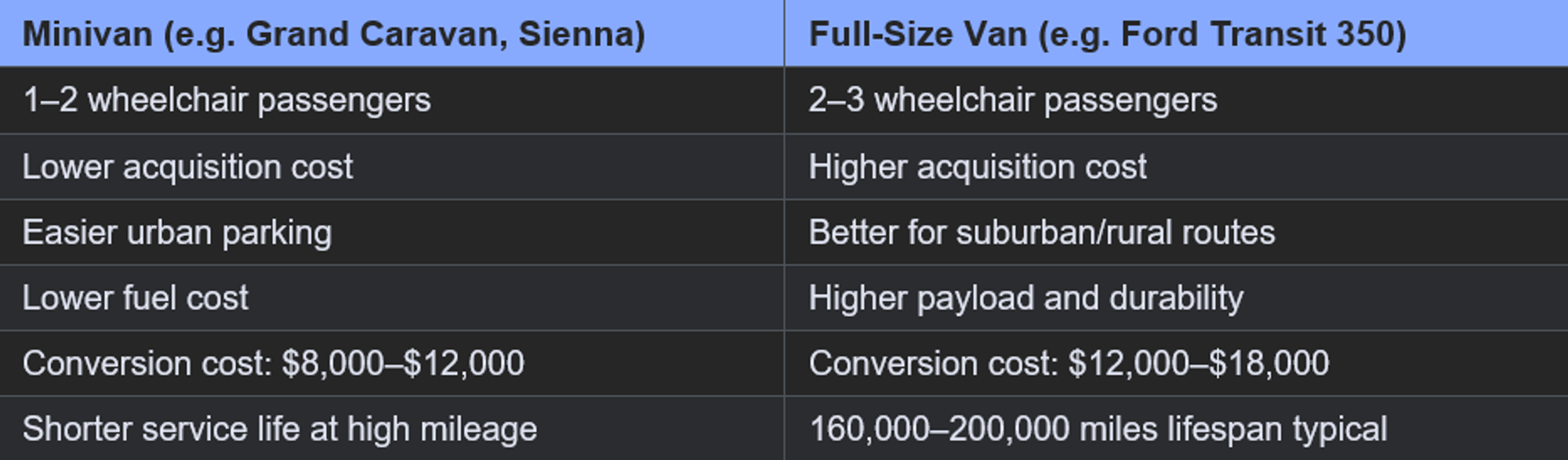
For startups running under 15 trips per day in an urban zone, a converted minivan fleet is usually the right call on cost. For operators with 20+ daily trips or rural service areas with longer routes, full-size vans deliver better per-mile economics over a three-to-five year hold.
Hydraulic Lifts vs. Ramps
This is a frequently misunderstood decision. Both meet ADA requirements for most NEMT contracts, but the operational differences are significant.
- Hydraulic lifts: Required for power wheelchair and bariatric transport. Rated up to 750–1,000 lbs. Maintenance cost: $600–$1,200 per year. Failure rate increases significantly after 100,000 cycles. Non-negotiable for Medicaid contracts serving complex mobility passengers.
- Manual ramps: Suitable for ambulatory passengers and basic manual wheelchair transport. Near-zero maintenance overhead. Many brokers will not assign power chair trips to ramp-only vehicles — check your broker contracts before specifying ramp-only fleets.
If you're scaling and want contract flexibility, spec hydraulic lifts on full-size vans from day one. Retrofitting costs $4,000–$7,000 and disrupts the vehicle for five to seven business days.
New vs. Used NEMT Vehicles for Sale
The 2026 used NEMT vehicle market is tighter than it was in 2023–2024. Post-pandemic fleet retirements and rising new vehicle lead times have pushed used converted van prices up 12–18% since 2022. That said, used assets remain the dominant acquisition path for operators under $500k in revenue.
- New vehicle advantages: OEM warranty, known service history, latest safety spec. Disadvantage: 12–20 week lead times on converted vehicles ordered from dealers.
- Used vehicle advantages: Immediate availability, 30–45% lower acquisition cost. Disadvantage: unknown lift service history, potential hidden rust or frame issues on high-mileage rust-belt vehicles.
Rule of thumb on used NEMT vans for sale: never buy above 110,000 miles without a full pre-purchase inspection (PPI) by a certified mechanic. Lift systems and tie-down tracks are expensive to replace and are the first things to deteriorate on a neglected vehicle.
What to Avoid
High-Mileage Rust-Belt Assets
NEMT vehicles purchased from the upper Midwest, New England, and parts of Canada carry a structural risk that Southern or West Coast vehicles don't. Road salt accelerates frame corrosion, rocker panel decay, and undercarriage damage. These don't always show on a standard visual inspection.
- Request a full undercarriage inspection via lift — not just a drive-over check
- Check lift mounting points specifically; corrosion here is a safety and liability issue
- Any vehicle showing frame rust beyond surface oxidation should be walked away from regardless of price
A $12,000 rust-belt van that needs $6,000 in frame work and a lift replacement is a worse asset than a $19,000 clean-title Southern vehicle. Run the actual total cost of ownership, not the sticker.
Ready to streamline your transportation workflow?
Discover how an all-in-one NEMT solution can automate scheduling, plan routes and simplify billing so you can focus on delivering exceptional care.
Non-ADA Compliant or Unverified Conversions
A significant portion of used NEMT vehicles for sale on the open market were converted by non-certified shops or to outdated specs. These vehicles are operationally dangerous and contractually problematic.
- Brokers including MTM, ModivCare, and Veyo require conversion documentation from certified converters
- Non-compliant tie-down systems void your liability insurance in the event of an incident
- Vehicles converted pre-2010 may not meet current ADA Title III transport requirements
Always request the original conversion certificate and verify the converting shop against the National Mobility Equipment Dealers Association (NMEDA) registry before purchase.
Oversized Fleets at Launch
A common mistake among NEMT startups is acquiring too many vehicles before they have trip volume to justify the fleet. Each idle van costs $800–$1,400 per month in insurance, parking, and depreciation. Start with two to three vehicles, prove volume, then scale.
Cost Breakdown in 2026
Acquisition Costs
Annual Operating Costs Per Vehicle
- Insurance: $4,800–$9,600/year (varies by state, driver history, and passenger classification)
- Fuel: $6,000–$11,000/year at 80–120 trips/week depending on route density
- Maintenance (scheduled): $1,800–$3,200/year for vehicles under 100k miles
- Lift service contract: $600–$1,200/year
- Licensing and compliance: $400–$900/year depending on state DOT requirements
Total annual operating cost per vehicle in active service: $13,600–$26,000. Build this into your per-trip pricing model before acquiring assets, not after.
Financing in 2026
Commercial vehicle loan rates for NEMT operators sit between 7.5% and 11.5% in mid-2026 for operators with two or more years of business history. First-year operators typically access financing through SBA 7(a) loans or equipment lenders at 10–13.5%. Lease-to-own arrangements are available through several NEMT-specialist fleet dealers but carry higher total cost over a five-year term.
The 2026 NEMT Vehicle Market
The U.S. NEMT market is growing at a 5.5% CAGR, driven by Medicaid expansion, value-based care contracting, and an ageing population that increasingly requires wheelchair-accessible transport. Fleet demand is rising in parallel.
New vehicle lead times for converted vans remain 14–22 weeks from major converters. Operators who waited until Q3 2025 to order vehicles are seeing Q1 2026 delivery dates. If you're planning a fleet expansion, the purchase decision needs to happen at least four to five months ahead of your intended operational start date.
The used NEMT vehicles for sale market is most active on commercial vehicle auction platforms (ADESA, Manheim), specialist NEMT resellers, and direct broker-to-operator fleet retirements. Direct fleet retirement purchases from Medicaid brokers or large regional NEMT operators typically offer the cleanest service histories.
FAQ
What is the average price of an ADA-compliant NEMT van in 2026?
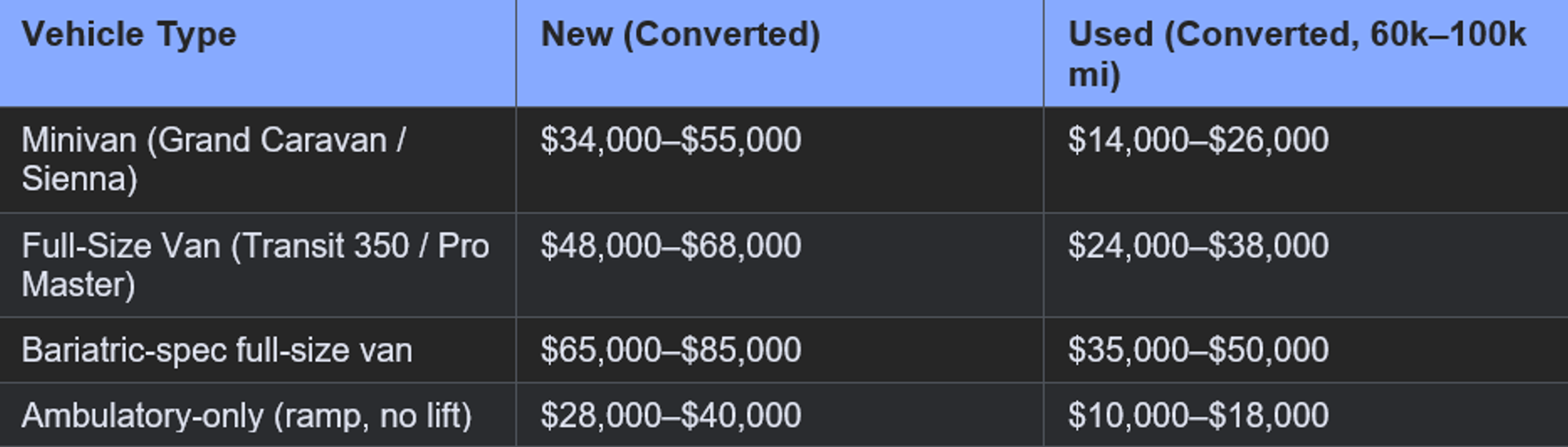
A new ADA-compliant converted minivan runs $34,000–$55,000 in 2026. A full-size van with hydraulic lift runs $48,000–$68,000. Used NEMT vehicles for sale in the 60,000–100,000 mile range typically price at 40–55% of new equivalent value, putting most used converted minivans between $14,000 and $26,000 and full-size vans between $24,000 and $38,000.
What mileage limit should I apply when buying used NEMT vans?
110,000 miles is the practical ceiling for most used NEMT van purchases without significant risk. Lift systems see accelerated wear above that threshold. Full-size vans with documented preventive maintenance histories can run to 140,000–160,000 miles, but require a specialist pre-purchase inspection and lift cycle count before acquisition.
Is a Ford Transit or Dodge Grand Caravan better for a new NEMT fleet?
Depends on your trip mix. If you're running primarily ambulatory or light wheelchair transport in an urban area with under 15 daily trips, the Grand Caravan's lower acquisition cost and better fuel economy make it the right call. If you're running complex mobility passengers, rural routes, or more than 20 trips per day, the Ford Transit 350's payload, durability, and lift capacity justify the higher upfront cost over a three-to-five year hold.
What are the biggest hidden costs in NEMT vehicle ownership?
Lift maintenance and failure repair is the most underestimated cost — operators consistently budget too low here. Rust-belt vehicle repairs, non-covered insurance claims on non-compliant conversions, and fleet idle cost (insurance and depreciation on underutilised vehicles) are the three other categories that catch new operators off guard. Budget $1,800–$3,200 per vehicle per year in maintenance and $600–$1,200 for lift-specific servicing.
How can NEMT Platform assist in managing a new or used NEMT fleet?
NEMT Platform connects directly to your fleet operations through three functions that directly protect ROI on expensive vehicle assets.
First, the AI Auto Route Planner assigns trips by vehicle capacity and mobility classification — meaning a power chair trip never gets routed to a ramp-only van and ambulatory trips aren't consuming your highest-cost lift-equipped vehicles unnecessarily. That cuts per-vehicle wear and maximises asset utilisation.
Second, NEMT Max, the driver mobile app, captures per-trip mileage, fuel use, and operational data at the vehicle level. Fleet managers get a real-time view of which vehicles are approaching maintenance thresholds rather than discovering problems reactively.
Third, because billing flows through verified trip data rather than manual logs, operators see accurate per-vehicle revenue contribution. That means you can identify which assets are producing positive margins and which are underperforming before they become a liability. Most operators using NEMT Platform report measurable improvement in fleet ROI within the first 90 days of deployment.
NEMT vehicles are capital assets with meaningful acquisition, operating, and compliance costs. Buy to your trip volume, not your aspirations. Verify conversion credentials before purchasing used assets. Build operating costs into your per-trip pricing from day one.
Disclaimer: The information provided in this article, including vehicle pricing benchmarks, regulatory compliance standards, and market data, is gathered from digitally available data on the internet and is for general informational and educational purposes only. Vehicle costs, state Medicaid mandates, and ADA compliance rules vary widely by location. NEMT Platform does not guarantee the mechanical condition, prices, or compliance of any vehicle mentioned. Readers should perform independent inspections and consult local transportation authorities before purchasing fleet assets.
Related Articles
How to Do Long Trips and Make More Money in NEMT
Long-distance NEMT trips are the fastest way to increase per-trip revenue. This guide shows you how to build a long-trip business model, where to find the contracts, and how to structure your operations so distance runs stay profitable.
How to Start a Profitable NEMT Business
Profitability in NEMT comes from three things: controlled startup costs, consistent broker contracts, and operational efficiency. Miss any one and you'll spend the first 18 months losing money. This guide walks you through the steps and shows you where the real money leaks happen.
NEMT vs. Uber Health vs. Lyft Healthcare: What's the Difference and When to Use Each
NEMT, Uber Health, and Lyft cover different patient needs. Use specialised NEMT for wheelchair, bariatric, or Medicaid trips. Use rideshare only for ambulatory, low-acuity rides.
How to Buy an Existing NEMT Business: Due Diligence Checklist
Buying an NEMT business? Check finances, fleet, Medicaid IDs, and broker contracts. California buyers must verify Medi-Cal enrollment and CHP inspections before close.