
Medi-Cal NEMT vs Uber/Lyft: California CalHHS Policy Guide
Medi-Cal pays for Uber and Lyft rides under the NMT benefit for ambulatory members, but wheelchair and gurney patients require a certified NEMT provider.
Read more
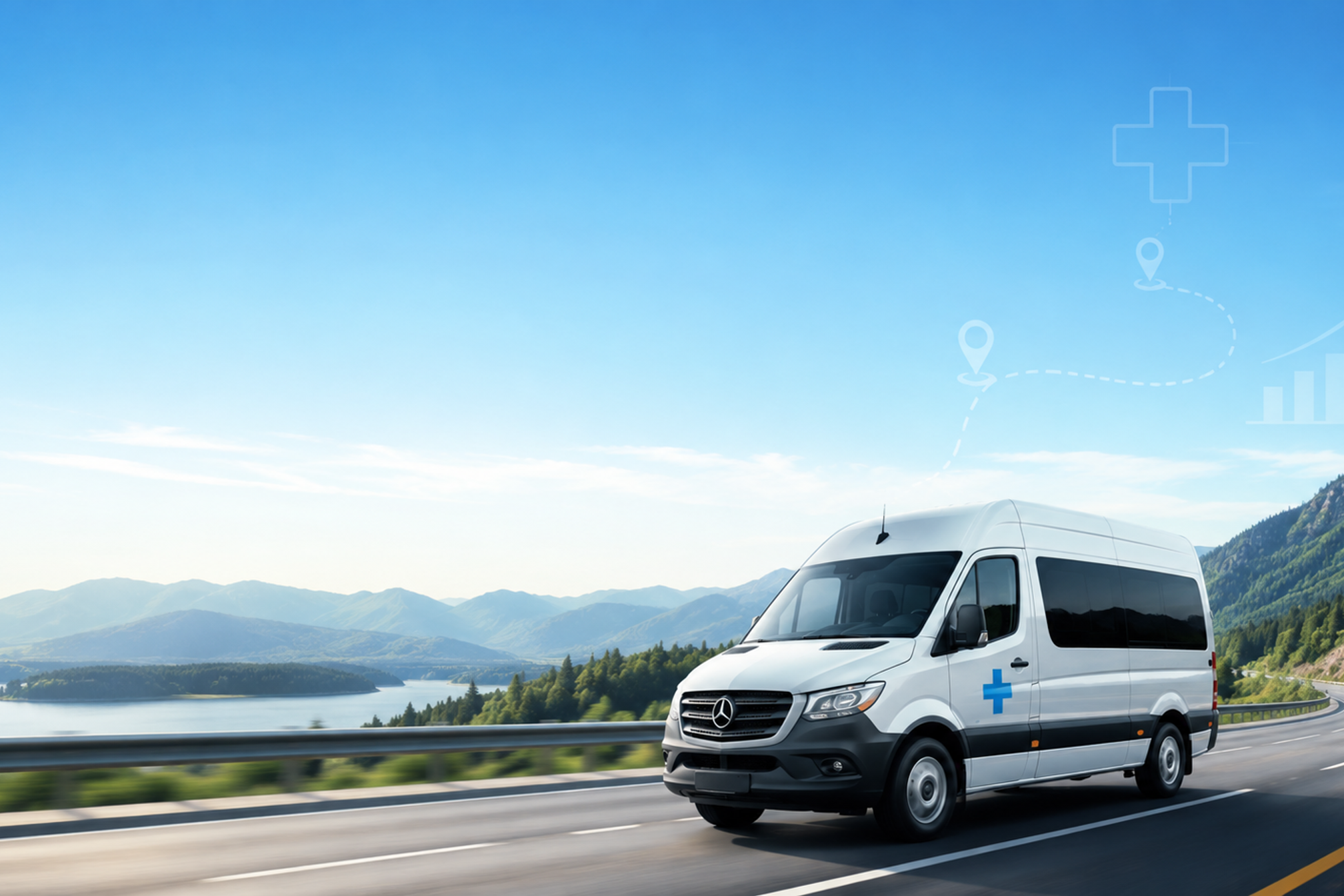
Long-distance NEMT trips are the fastest way to increase per-trip revenue. A single 200-mile dialysis or cancer treatment run can generate more profit than five local trips combined.
Most NEMT operators stay local because they don't understand the math. They think distance trips are complicated. They're not. They're actually simpler operationally and far more profitable.
This guide shows you how to build a long-trip business model, where to find the contracts, and how to structure your operations so distance runs stay profitable.
You're an NEMT operator with 1-5 vehicles looking to increase revenue per vehicle. You've optimized your local broker volume and want to grow margins without adding more vehicles. Or you're considering a dedicated long-trip model as your primary business. You need to know where the money is and how to capture it safely and profitably.
Medicaid reimbursement is mileage-based. A local trip might be 10 miles at $1.50 per mile plus a base fee. A 200-mile trip pays the same base fee plus 200 times the mileage rate.
Here's the real math:
Your fuel and driver costs for a 200-mile trip don't scale linearly. You burn more fuel, but your fixed costs (insurance, vehicle depreciation, software) are spread across one large payment instead of five small ones.
A single long-trip WAV can generate $150K-$250K annually if you're moving 15-20 distance runs per month.
Not all distance trips are equal. Some are predictable and repeatable. Others are scattered and sporadic. Build your business around the predictable ones.
Dialysis transport between facilities
Cancer treatment runs
Specialized surgery and procedures
Hospital discharge and transfers
Regional rehabilitation center placement
Long trips come from specific sources. Most NEMT operators don't pursue them because they don't know where to look.
Medicaid brokers
Dialysis centers
Discover how an all-in-one NEMT solution can automate scheduling, plan routes and simplify billing so you can focus on delivering exceptional care.
Regional cancer centers
Healthcare logistics companies
Managed care organizations
This is where most operators lose money. They assume distance trips work the same way local trips do. They don't.
Medicaid pays mileage-based rates. But you have additional costs that local trips don't:
Here's how to calculate profit on a 200-mile trip:
That seems thin. But that's one trip. Run 15 of these per month and you're making $855 in profit on that vehicle beyond your fixed costs (insurance, software, vehicle payment). Over a year, that's an additional $10K-$12K in margin per vehicle.
Pair long trips with local trips. One vehicle doing 8 local trips and 4 long trips monthly generates 50 percent more profit than local-only.
Long trips require slightly different operations than local NEMT. Set this up before you take your first distance run.
Driver requirements
Vehicle maintenance
Tracking and communication
Member communication before the trip
Insurance for out-of-state trips
Long trips are where dispatch software actually pays for itself.
Manual dispatch on a 200-mile trip means phone calls to confirm, paper maps, manual billing, and no real-time tracking. You lose control and visibility. One missed handoff or documentation gap costs you the entire trip payment.
Software does this:
A quality dispatch platform like NEMT Platform doesn't just manage trips. It protects your revenue on every long-distance run.
Discover how an all-in-one NEMT solution can automate scheduling, plan routes and simplify billing so you can focus on delivering exceptional care.
Are long trips more profitable than local trips?
Yes, significantly. A 200-mile trip pays $300-$400. Five local trips might pay $150-$200 combined. Distance trips have higher absolute costs, but lower cost per mile, which means better margins.
What happens if a patient cancels a long trip?
You lose the full revenue but not the full cost. You've still committed driver time and prepared the vehicle. This is why pre-trip confirmation and real-time member reminders are critical. They reduce cancellations by 10-20 percent.
Can a single driver handle multiple long trips per week?
Physically yes, but not safely. A 200-mile trip takes 4-6 hours of driving plus wait time. Back-to-back long trips mean fatigue and mistakes. Limit drivers to one long trip per 24 hours. This is also a safety and insurance requirement.
Do I need special insurance for out-of-state trips?
Check your policy. Many NEMT insurers cover multi-state travel automatically. Some charge extra. A few exclude it entirely. Clarify this before you accept out-of-state contracts. Most brokers require you to handle long-distance work.
What's the minimum distance trip worth doing?
50 miles minimum. Below 50 miles, you're better off taking multiple local trips with the same vehicle and driver. Above 100 miles, distance trips become very profitable. Your sweet spot is 100-300 miles.
How do I get brokers to send me long trips?
Update your provider profile to indicate you accept long-distance trips. Confirm with your broker contact that you're available for distance work. Deliver reliability on every long trip you take. Brokers route high-value trips to providers with clean track records.
Long trips aren't a side business. They're a separate revenue stream that requires different planning and execution.
Start by identifying demand in your region. Are there dialysis centers more than 50 miles away? Cancer treatment centers that need transport? Regional hospitals that discharge patients long distances? Once you know what trips exist, target the providers who authorize them.
Then build the operational foundation. Get the right driver. Set up proper dispatch software. Ensure your insurance covers distance work. Test the model with a few trips. Measure costs and revenue carefully.
Most NEMT operators doing 15-20 long trips monthly see 30-50 percent higher margins than local-only operators. You don't need more vehicles. You need smarter deployment of the ones you have.
The operators scaling fastest understand this. They're not trying to do more local trips. They're capturing the high-value long-distance work that most competitors ignore.
Medi-Cal pays for Uber and Lyft rides under the NMT benefit for ambulatory members, but wheelchair and gurney patients require a certified NEMT provider.
How NEMT billing really works in 2026: the claim lifecycle, why claims get denied, EVV and compliance, and how the right billing software gets you paid faster.
For NEMT leadership: why margins are compressing, the three exposures the C-suite owns, and how technology decisions protect the P&L at enterprise scale.
NEMT operators in 2026 can reach 20-35% margins via hospital discharge contracts, stretcher and bariatric transport, long-distance trips, and private concierge accounts beyond standard broker rides.
See NEMT Platform in Action
Get a free, personalized walkthrough of dispatch, billing & scheduling built for NEMT providers.