


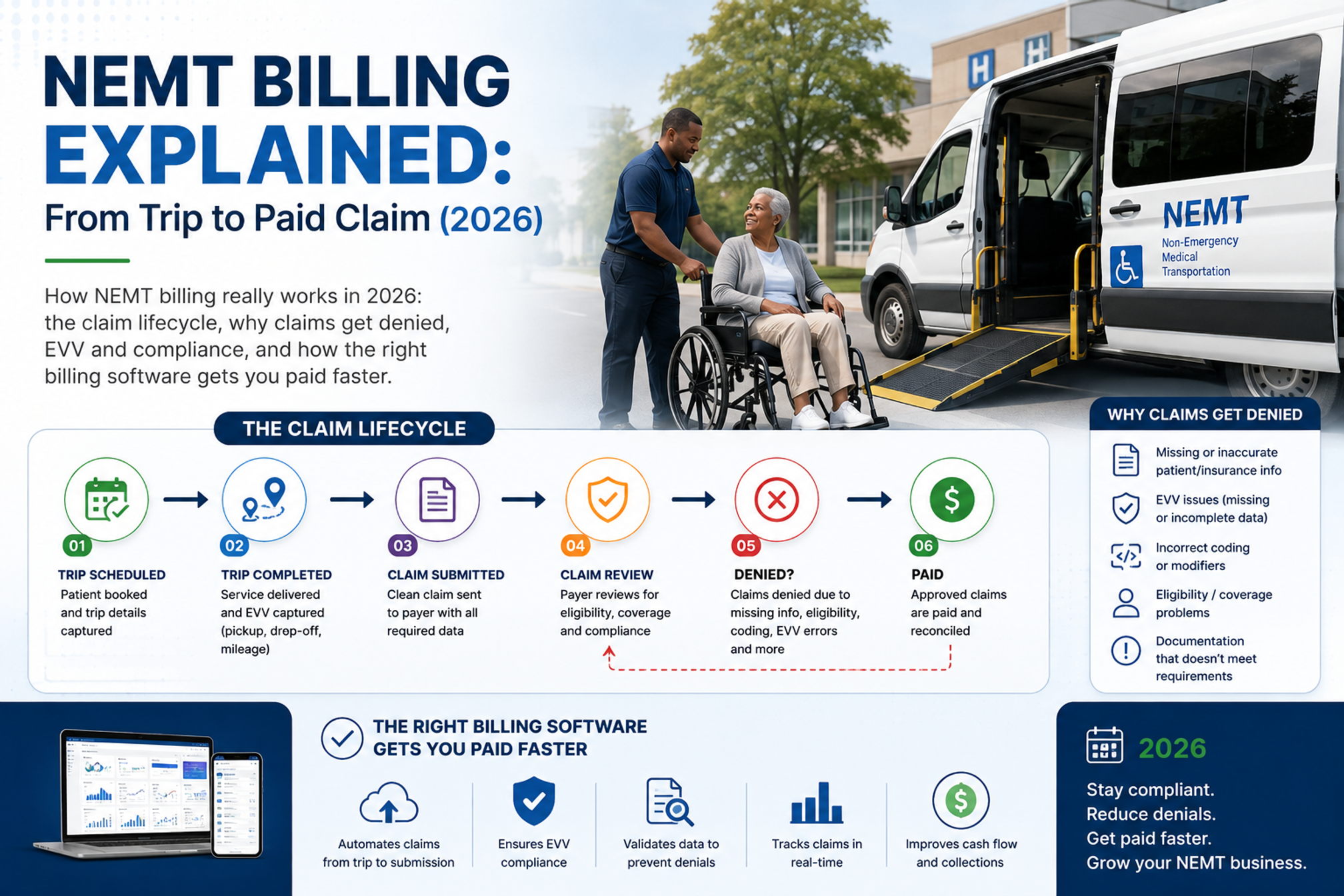
The short answer: NEMT billing is the process of converting a completed trip into a paid claim. It runs through five stages: capturing verified trip data, coding the claim in the payer's required format, validating it before submission, submitting to the broker or Medicaid, and reconciling the payment. Most denied claims fail at the data and validation stages, which is exactly where billing software earns its keep.
NEMT billing is where a lot of providers quietly lose money. The trip happened, the service was delivered, and yet the claim gets denied, delayed, or written off over a formatting error or a missing data point. At scale, those small failures add up to a serious dent in cash flow. This guide explains how NEMT billing actually works end to end, why claims get denied, what compliance requires in 2026, and how the right billing software closes the gaps that cost you revenue.
How does NEMT billing work?
NEMT billing works by turning each completed trip into a claim, submitting that claim to the responsible payer, and reconciling the payment that comes back. The payer is usually a Medicaid broker such as ModivCare or MTM, a managed care organization, or a state Medicaid program directly. Each has its own rules for what a valid claim looks like, and that variation is the root of most billing difficulty.
The core challenge is that billing is not one step at the end. It depends on everything that happened during the trip. If the pickup time was not captured, the GPS trail is missing, or the electronic visit verification was never recorded, the claim is already compromised before anyone tries to submit it. Good billing starts at dispatch and rides along with the trip, not at the back office afterward.
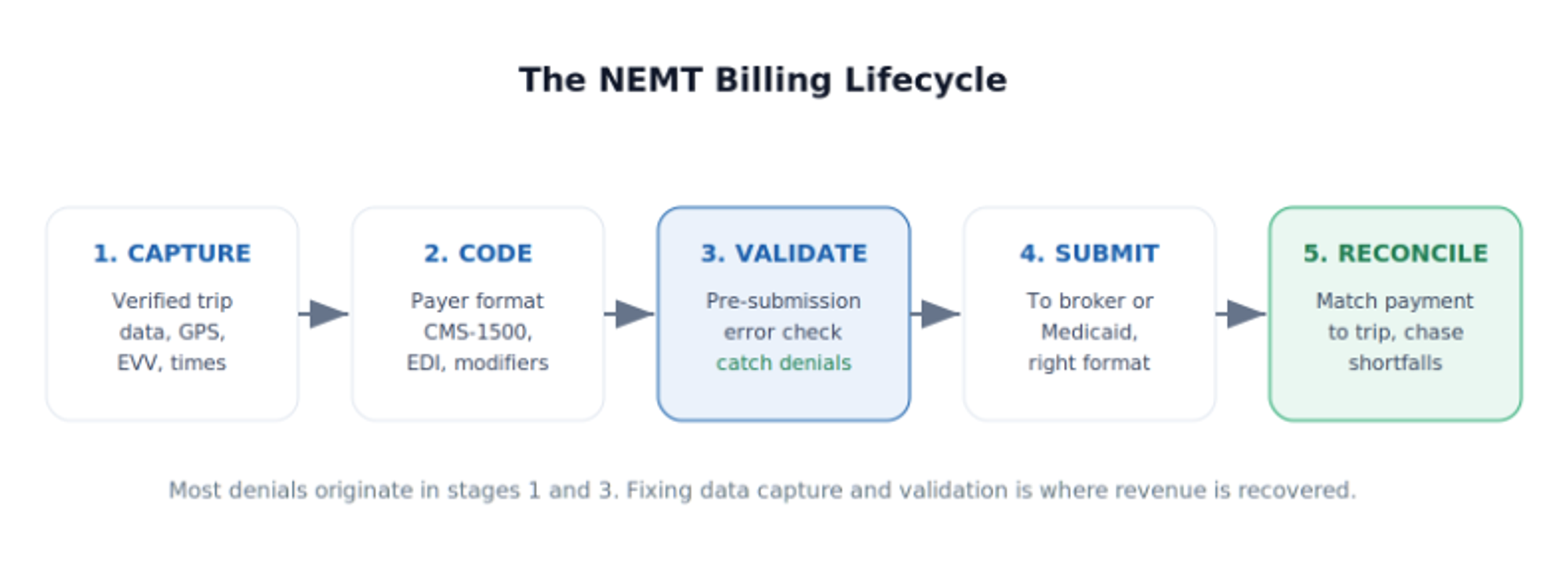
Figure 1: NEMT billing is a five-stage lifecycle. The claim's fate is largely decided at capture and validation, long before submission.
The NEMT claim lifecycle, stage by stage
Every NEMT claim moves through the same five stages, and understanding each one shows you where money leaks.
1. Capture verified trip data
Billing begins the moment a trip is dispatched and continues until it is completed. The data that a clean claim needs, pickup and dropoff times, GPS trail, mileage, the vehicle and driver, and electronic visit verification, is captured during the trip itself. When this data is collected digitally and automatically, the claim is built on solid ground. When it is reconstructed later from memory or paper, errors are inevitable.
2. Code the claim to the payer's format
Each payer requires a specific claim format. That may mean a CMS-1500 form, an electronic EDI 837 file, or a broker-specific format, each with its own required fields, procedure codes, and modifiers. A wheelchair trip, an ambulatory trip, and a stretcher trip are coded differently. Getting the codes and modifiers right for the specific payer is where manual billing frequently goes wrong.
3. Validate before submission
This is the single most valuable stage and the one manual processes skip. Before a claim ever reaches the payer, it should be checked for missing fields, mismatched data, EVV gaps, and format errors. Catching a problem here means fixing it in seconds. Catching it after submission means a denial, a rework cycle, and weeks of delay. Validation is where good billing software pays for itself.
4. Submit to the broker or Medicaid
The validated claim is submitted through the correct channel in the correct format. For multi-broker providers, this means routing each claim to the right destination with that destination's rules applied. Submission is mostly mechanical once capture, coding, and validation are done correctly.
5. Reconcile the payment
When payment arrives, it has to be matched back to the trip and the claim. Underpayments, partial denials, and missing remittances all surface here. Reconciliation is how you find out whether you were actually paid what you were owed, and it is where providers without good systems simply lose track and leave money uncollected.
Why do NEMT claims get denied?
NEMT claims are denied primarily for preventable data and documentation failures, not for the service itself being invalid. The trip usually happened and was legitimate. The claim fails on a technicality that a validation step would have caught. Understanding the common denial reasons is the fastest way to protect your revenue.
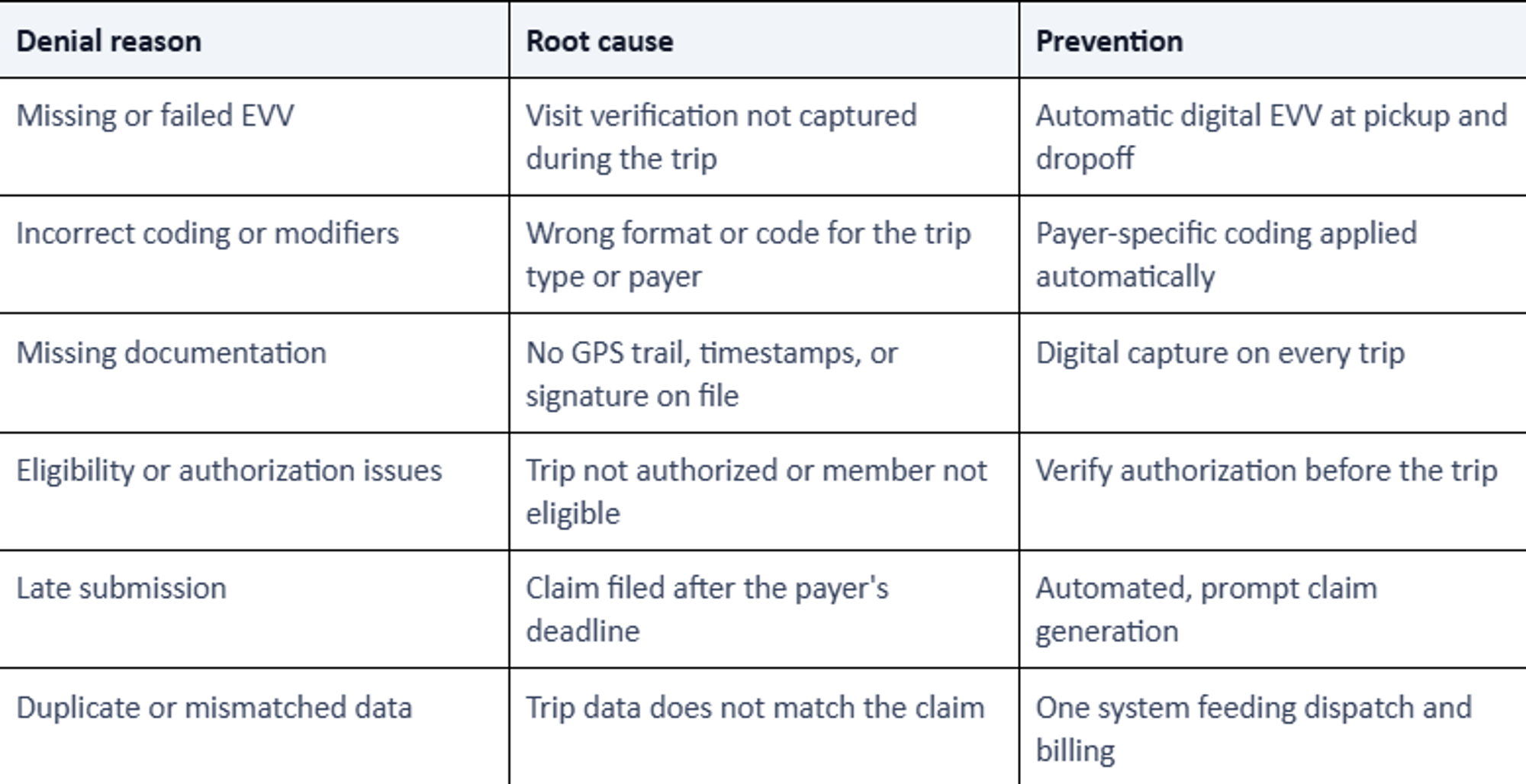
The pattern across every row is the same. Denials come from broken or missing data and from the gap between what happened on the trip and what reached the claim. Close that gap and denials fall.
NEMT billing compliance and EVV in 2026
Compliance is now inseparable from billing, because payers increasingly require verifiable proof that a trip occurred as claimed. Electronic visit verification, mandated under the 21st Century Cures Act, requires capturing six data points for each service: the type of service, the individual receiving it, the date, the location, the caregiver, and the exact start and end times. State enforcement thresholds are rising in 2026, with some states requiring EVV compliance rates well into the majority of trips.
For billing, the implication is direct. A claim without proper EVV is increasingly a denied claim. The providers who handle this well capture EVV automatically as part of the trip, through a driver app with timestamped GPS and digital verification, so the compliance data and the billing data are the same data. The providers who struggle treat compliance as a separate paperwork burden layered on after the fact, which is slower and far more error-prone.
Note: EVV mandates, state thresholds, and payer requirements change. Confirm current rules for your state and payers before relying on any specific figure. This guide is general information, not billing or legal advice.
Manual billing versus billing software
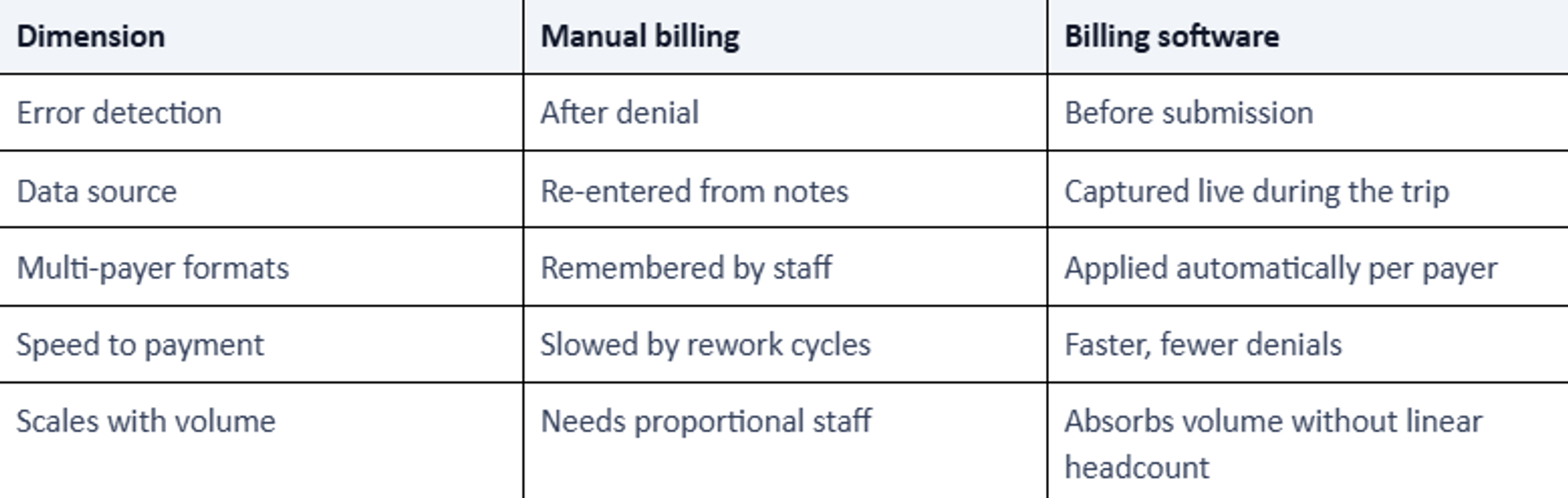
The difference between manual billing and software-driven billing is the difference between catching errors before submission and discovering them after denial. Manual billing can work at low volume, but it scales badly. Every trip is a chance for a transcription error, a missed modifier, or a forgotten EVV capture, and every error is found only after the payer rejects it.
Billing software changes the economics by moving error-catching to before submission and by connecting billing directly to the trip data. When dispatch, the driver app, and billing all write to one record, the claim is built from verified data automatically, validated before it goes out, and routed to the right payer in the right format. This is why claim approval rates and billing speed improve so sharply when providers move off manual processes.
How multi-broker billing works for NEMT providers
Multi-broker billing means running several different sets of billing rules at once, and it is where large providers lose the most revenue to complexity. A provider serving ModivCare, MTM, and a state Medicaid program is not running one billing process. It is running three, each with its own authorization requirements, claim formats, submission channels, and payment timelines. Held in staff memory, this is a constant source of error, because the rule that applies to one broker's claim will quietly sink another's.
The way strong providers handle this is to let the system carry the broker rules instead of the staff. When a trip is imported from a specific broker, the platform already knows which format, codes, and validation rules apply to that broker's claims, and it applies them automatically. This breaks the link between adding brokers and adding billing errors. The NEMT Platform integrates directly with the major brokers, including ModivCare, MTM, Saferide, Call the Car, VectorCare, and Kaiser Permanente, so each broker's claims are handled by that broker's rules from import through reconciliation.
How to get paid faster and protect cash flow
Getting paid faster in NEMT comes down to reducing denials and shortening the time between a completed trip and a submitted, clean claim. Cash flow is not just about how much you bill. It is about how quickly and how completely that billing converts to cash. Every denied claim, every rework cycle, and every day a claim sits unsubmitted is working capital tied up in trips you have already paid to deliver.
Three levers move billing speed the most. First, submit clean the first time, because a claim approved on first submission pays far faster than one that bounces, gets reworked, and resubmits weeks later. Second, submit promptly, because a claim generated automatically the day a trip completes beats one that waits for a manual batch. Third, reconcile actively, because underpayments and partial denials that go unchased are simply lost revenue. A provider that tightens all three turns billing from a lagging, leaky process into a predictable revenue engine.
On the NEMT Platform, a 99.2 percent first-submission claim approval rate is what that compression looks like in practice. Fewer denials and faster clean submissions mean cash arrives sooner and more completely.
What to look for in NEMT billing software
The right NEMT billing software is the one that connects billing to the trip and catches errors before they become denials. Feature lists all look similar, so evaluate against the failure points this guide has described.
- Pre-submission validation. Does it check claims for errors and EVV gaps before they go to the payer? This is the highest-value capability.
- Unified trip and billing data. Does billing pull from the same record as dispatch and the driver app, or does data get re-entered?
- Multi-payer and broker support. Does it handle CMS-1500, EDI, and each broker's specific format automatically?
- Automatic EVV capture. Is compliance data collected during the trip, not reconstructed afterward?
- Reconciliation tools. Does it match payments back to trips and surface underpayments?
- Broker integrations. Does it connect directly to your actual brokers, such as ModivCare, MTM, and Saferide?
On the NEMT Platform, billing is built into the operation rather than bolted on. Trip data captured through dispatch and the driver app flows straight into claims, validation runs before submission, and each payer's format is applied automatically. Verified platform benchmarks: 99.2 percent first-submission claim approval and 66 percent reduction in manual workload. Those numbers come from closing exactly the data and validation gaps this guide describes.
See the 99.2% claim flow
Watch a completed trip become a clean, validated claim without manual rework, routed to the right payer in the right format.
What software do NEMT companies use for billing?
NEMT companies use billing software that connects trip data to claims, validates before submission, and supports multiple payer formats like CMS-1500 and EDI. The most effective options unify dispatch, the driver app, and billing so claims are built from verified trip data automatically.
Why do NEMT claims get denied?
Most NEMT denials come from preventable data failures: missing or failed EVV, incorrect coding or modifiers, missing documentation, authorization issues, or late submission. The service itself is usually valid; the claim fails on a technicality that pre-submission validation would catch.
What is EVV in NEMT billing?
Electronic visit verification captures proof that a trip occurred as claimed, including the service type, individual, date, location, caregiver, and exact start and end times. Mandated under the 21st Century Cures Act, it is increasingly required for a claim to be paid.
How can NEMT providers reduce claim denials?
By capturing verified trip data automatically, validating claims before submission, applying the correct payer-specific format, and reconciling payments. In practice this means using billing software that connects directly to trip data rather than re-entering it manually.
What is the difference between CMS-1500 and EDI billing?
CMS-1500 is a standardized paper-style claim form, while EDI 837 is the electronic file format for submitting claims data. Different payers require different formats, which is why billing software that applies the correct format automatically reduces errors.
Related Articles
Best NEMT Software for California Transportation Providers: Medi-Cal, Multi-Broker, and Fleet Automation
Discover why NEMT Platform is the best NEMT software in California, offering live OVERSIGHT dispatch, multi-broker auto-billing, and a 24/7 multilingual AI receptionist.
Medi-Cal NEMT vs Uber/Lyft: California CalHHS Policy Guide
Medi-Cal pays for Uber and Lyft rides under the NMT benefit for ambulatory members, but wheelchair and gurney patients require a certified NEMT provider.
Executive Guide to NEMT: Margin, Risk & Technology
For NEMT leadership: why margins are compressing, the three exposures the C-suite owns, and how technology decisions protect the P&L at enterprise scale.
Starting an NEMT Business in 2026: Where the Real Profit Comes From
NEMT operators in 2026 can reach 20-35% margins via hospital discharge contracts, stretcher and bariatric transport, long-distance trips, and private concierge accounts beyond standard broker rides.