

NEMT Billing Explained: From Trip to Paid Claim (2026)
How NEMT billing really works in 2026: the claim lifecycle, why claims get denied, EVV and compliance, and how the right billing software gets you paid faster.
Read more

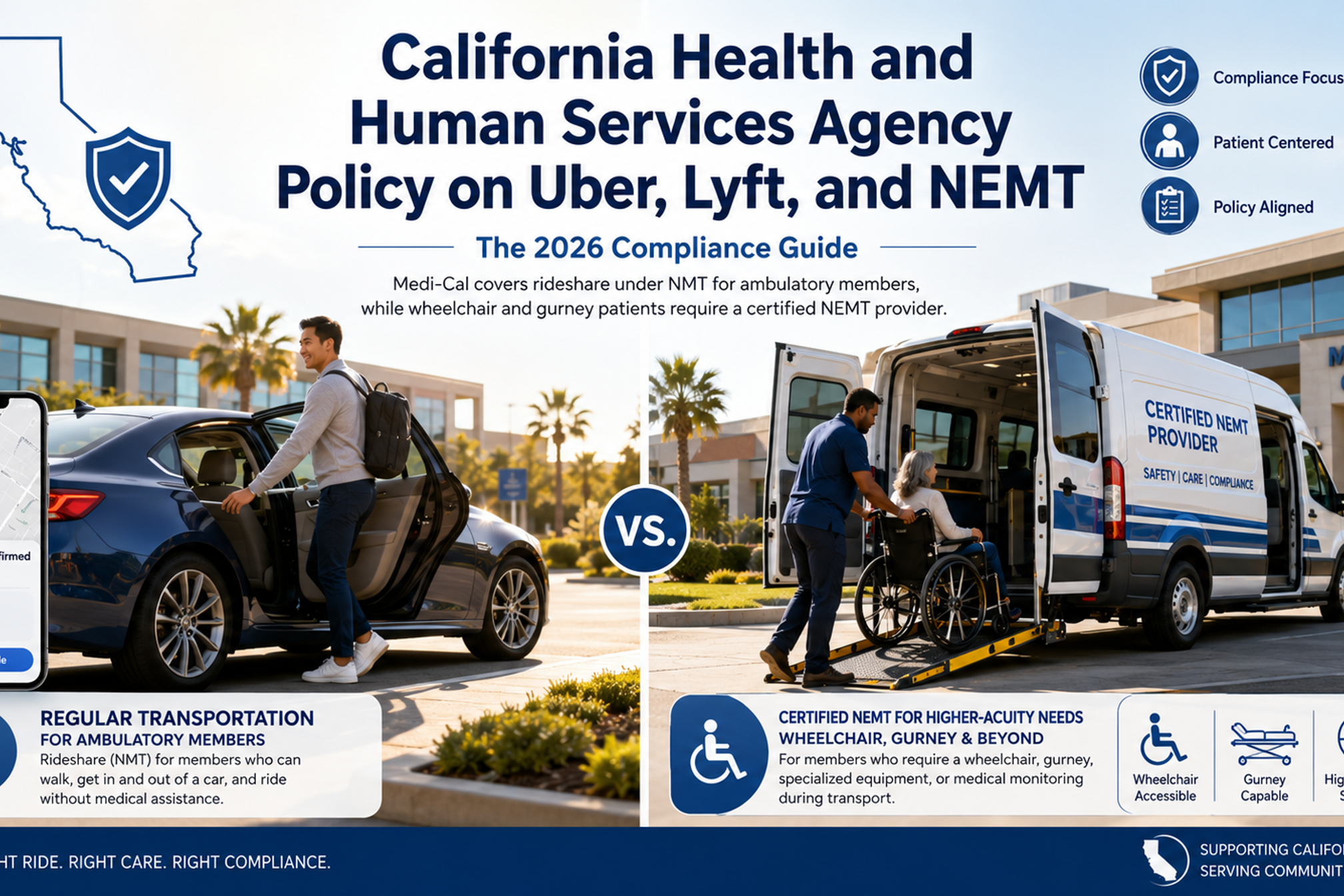
This guide is written for three types of reader. California NEMT fleet owners navigating Medi-Cal Managed Care Plan contracts who need clarity on where their service model fits within DHCS policy. Hospital discharge planners coordinating patient transit under CalAIM who must route each patient to the correct transportation benefit. Transportation brokers evaluating TNC rideshare compliance who need to know precisely where Uber and Lyft can legally operate within the Medi-Cal transportation framework, and where they cannot.
Yes, but only within the Non-Medical Transportation (NMT) benefit, and only for ambulatory members. Medi-Cal Managed Care Plans can pay for Uber and Lyft rides under specific conditions:
The member is ambulatory and has no physical or cognitive impairment requiring hands-on assistance.
No physician prescription or Physician Certification Statement (PCS) is required to authorise the ride.
The trip is to a covered Medi-Cal service, including medical, dental, mental health, or substance use disorder appointments, or to pick up a prescription.
The MCP has an active commercial agreement with the TNC; L.A. Care and other plans already operate Lyft-based NMT benefits this way.
Uber and Lyft cannot be used for NEMT-level trips involving wheelchair, gurney, or ambulance transport, since drivers are not PASS or CPR certified and vehicles are not equipped for hands-on assistance.
The distinction is structural, not a matter of MCP preference. A member requiring wheelchair securement or door-through-door assistance falls outside what a standard TNC vehicle and driver are certified or equipped to provide, regardless of which Managed Care Plan administers the benefit.
DHCS defines two separate transportation benefits under the Medi-Cal program, and the difference determines which providers, vehicles, and authorisation processes apply.
Non-Medical Transportation covers members who are ambulatory and have no impairment requiring hands-on care. Since July 2017, all Medi-Cal Managed Care Plans have been required to offer NMT for medically necessary services, and since October 2017, for services delivered through the Medi-Cal fee-for-service system as well. No physician prescription is required, and no PCS form is filed. This is the benefit tier where Uber Health and Lyft Healthcare operate, through commercial agreements directly with MCPs such as L.A. Care, which already lists Lyft as an approved NMT transportation option alongside passenger car and taxi service. The member requests a ride, the TNC transports them curb-to-curb, and the MCP reimburses the trip under its NMT benefit structure.
Non-Emergency Medical Transportation covers members whose medical or physical condition prevents them from travelling by bus, passenger car, taxicab, or standard TNC vehicle. This includes wheelchair users, gurney or litter patients, and bariatric care cases. NEMT requires a Physician Certification Statement documenting the member's functional limitations, the appropriate transport modality, and an authorisation period of up to 12 months. Once DHCS approves the PCS, the MCP cannot modify the authorised level of service.
TNCs cannot legally or operationally substitute for NEMT providers here. Uber and Lyft drivers are not PASS certified, are not trained in wheelchair securement or gurney handling, and their standard vehicles are not equipped for door-through-door assistance. This is not a policy gap that a future TNC partnership is likely to close; it reflects a fundamental difference in vehicle equipment, driver training, and liability structure between a rideshare platform and a licensed medical transport provider.
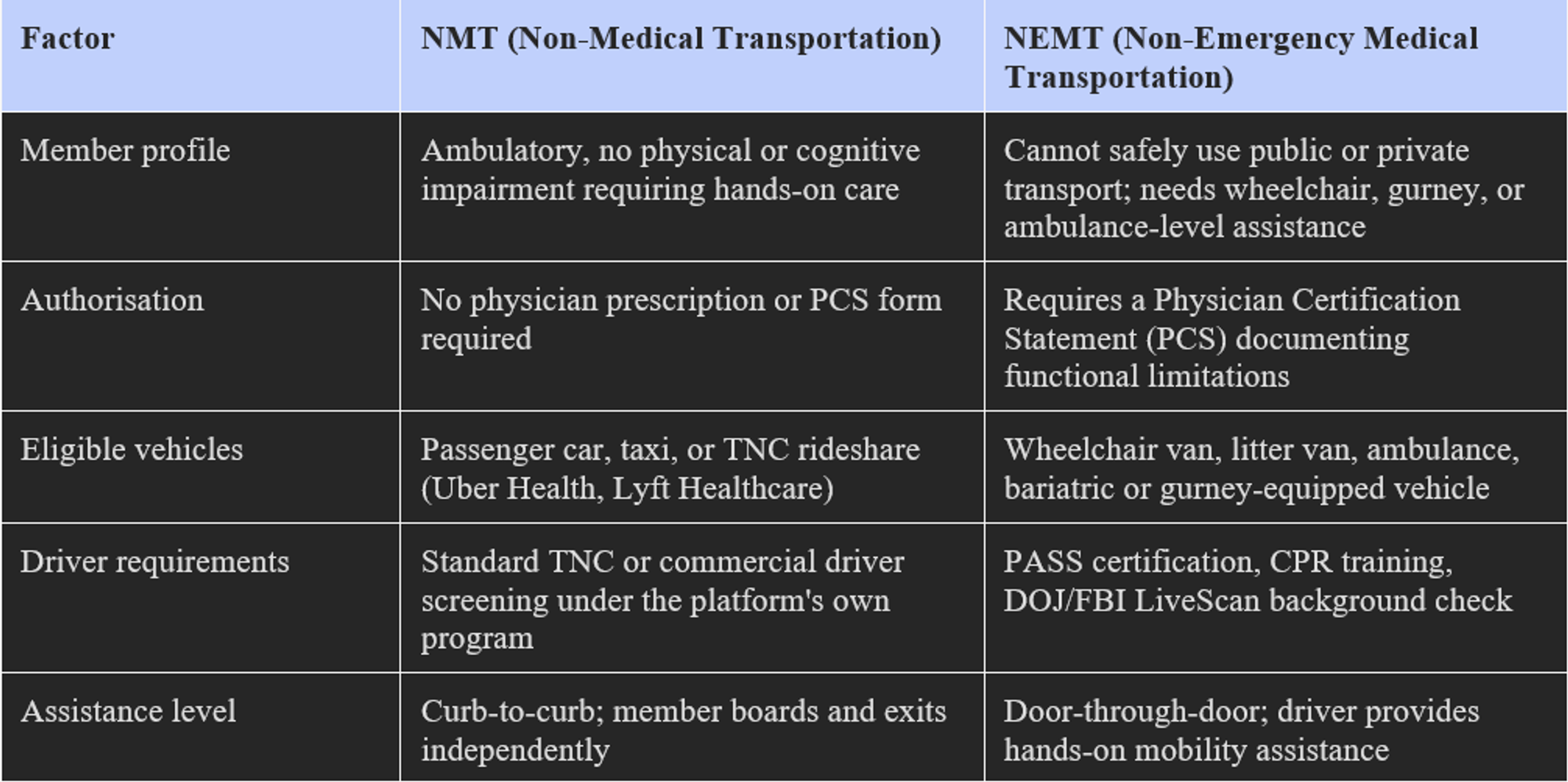
NMT and NEMT are governed by different authorisation rules, vehicle standards, and driver certifications under DHCS policy.
Discover how an all-in-one NEMT solution can automate scheduling, plan routes and simplify billing so you can focus on delivering exceptional care.
California's CalAIM (California Advancing and Innovating Medi-Cal) initiative, overseen by the California Health and Human Services Agency, treats transportation access as a Social Determinant of Health (SDOH) rather than a purely administrative benefit. Under CalAIM transportation guidelines, Managed Care Plans, including Anthem Blue Cross, L.A. Care, and Blue Shield Promise, are held accountable for identifying members with high appointment non-adherence and connecting them to the correct transportation benefit before missed care becomes a downstream cost to the system.
The federal basis for this accountability sits in 42 CFR 440.170, which establishes non-emergency transportation as a required Medicaid benefit for accessing medically necessary services, alongside 42 CFR 441.62 and 431.53, which extend the obligation to Early and Periodic Screening, Diagnostic, and Treatment (EPSDT) services. DHCS translated these federal requirements into state policy through All Plan Letters such as APL 17-010, which clarified MCP obligations to provide and coordinate both NEMT and NMT. Under this framework, an MCP that fails to route a wheelchair-dependent member into a properly authorised NEMT trip, or that fails to offer an NMT option to an ambulatory member without transport, is out of compliance with both federal and state requirements, not merely underperforming on a customer service metric.
For NEMT operators, this SDOH framing matters commercially as well as legally. MCPs are now evaluated on transportation-linked outcomes, which increases the value of a compliant, well-documented NEMT partner relative to an uncredentialed alternative.
Operators asking how to become a NEMT provider in California must satisfy requirements from three separate regulatory bodies before they can bill Medi-Cal: the DMV, the CPUC, and DHCS itself.
Obtain a Carrier Identification (CA) number from the California Highway Patrol, then apply for a Motor Carrier Permit (MCP) from the DMV, required for every NEMT provider regardless of whether they serve Medi-Cal or private-pay clients.
Secure a California Public Utilities Commission (CPUC) Transportation Charter Party (TCP) permit, mandatory for any vehicle transporting passengers for hire.
Complete Passenger Assistance Safety and Sensitivity (PASS) certification for all drivers, alongside CPR training and a DOJ/FBI LiveScan background check.
Pass a Vehicle Safety Systems Inspection (VSSI) through a BAR-certified station, with CHP Biennial Inspection of Terminals (BIT) enrolment required for vehicles over 10,001 lbs GVWR.
Enrol as a Medi-Cal provider through the DHCS PAVE portal, and maintain county-specific credentialing where individual Managed Care Plans impose additional requirements.
Execute an active Business Associate Agreement (BAA) with every Managed Care Plan and broker partner, since PCS forms and trip data constitute protected health information under HIPAA.
Providers who skip the CPUC TCP permit or let PASS certifications lapse are among the most common findings in DHCS and MCP program integrity audits, alongside billing anomalies and expired driver credentials.
NEMT is transportation by wheelchair van, litter van, or ambulance for members who cannot safely use standard transportation and requires a Physician Certification Statement. NMT is transportation by passenger car, taxi, or approved rideshare platform for ambulatory members who simply lack another way to reach a covered appointment, and it requires no physician authorisation. The two benefits sit under the same Medi-Cal transportation umbrella but follow entirely separate authorisation, vehicle, and driver certification rules.
Becoming a NEMT provider in California requires a DMV Motor Carrier Permit obtained after receiving a CA number from the CHP, a CPUC Transportation Charter Party permit, PASS-certified and CPR-trained drivers who have passed DOJ/FBI LiveScan background checks, a vehicle that has passed VSSI inspection, and Medi-Cal enrolment through the DHCS PAVE portal. Most operators also need signed BAAs with each Managed Care Plan or broker they contract with before they can legally handle PCS forms and trip data.
Vehicles must match the certified service level: wheelchair-equipped vans need functioning lifts and securement systems, litter vans must accommodate stretcher patients safely, and any vehicle over 10,001 lbs GVWR requires CHP Biennial Inspection of Terminals enrolment in addition to the standard VSSI inspection. Vehicle standards are enforced separately from driver certification, and a compliant driver in a non-compliant vehicle still fails a DHCS or MCP audit.
CalAIM transportation guidelines require Managed Care Plans, including Anthem Blue Cross, L.A. Care, and Blue Shield Promise, to treat transportation access as a Social Determinant of Health, actively identify members with high rates of missed appointments, and ensure each member is routed to the correct benefit, NMT or NEMT, based on their documented functional need. This obligation flows from federal requirements under 42 CFR 440.170 and was clarified in state policy through DHCS All Plan Letters such as APL 17-010.
NEMT Platform supports California compliance through a single-screen dispatching system that automates PCS and authorisation tracking, so trips are never dispatched against an expired or unauthorised certification. It manages driver PASS and CPR credential expiry dates directly in the platform, reducing the audit risk created by lapsed certifications. It separates NMT and NEMT rate cards within the same system, preventing the billing errors that occur when the two benefit types are mixed on a single fee schedule. It also streamlines Medi-Cal broker billing and documentation, giving operators an organised, audit-ready record when DHCS or an MCP requests trip-level documentation.
Disclaimer:
This guide provides general information on California Medi-Cal transportation policy as of 2026. It is not legal advice and does not replace guidance from the Department of Health Care Services (DHCS), the California Health and Human Services Agency, or a qualified healthcare attorney. Regulations, All Plan Letters, and Managed Care Plan requirements change without notice. Confirm current requirements directly with DHCS, the relevant MCP, or the DMV and CPUC before making credentialing, billing, or compliance decisions. NEMT Platform is not a government agency and does not issue or interpret official DHCS policy.
How NEMT billing really works in 2026: the claim lifecycle, why claims get denied, EVV and compliance, and how the right billing software gets you paid faster.
For NEMT leadership: why margins are compressing, the three exposures the C-suite owns, and how technology decisions protect the P&L at enterprise scale.
NEMT operators in 2026 can reach 20-35% margins via hospital discharge contracts, stretcher and bariatric transport, long-distance trips, and private concierge accounts beyond standard broker rides.
Learn how NEMT providers secure private pay contracts in 2026 through local SEO, facility partnerships, and referrals, bypassing low-margin Medicaid brokers.
See NEMT Platform in Action
Get a free, personalized walkthrough of dispatch, billing & scheduling built for NEMT providers.