


Medi-Cal NEMT vs Uber/Lyft: California CalHHS Policy Guide
Medi-Cal pays for Uber and Lyft rides under the NMT benefit for ambulatory members, but wheelchair and gurney patients require a certified NEMT provider.
Read more
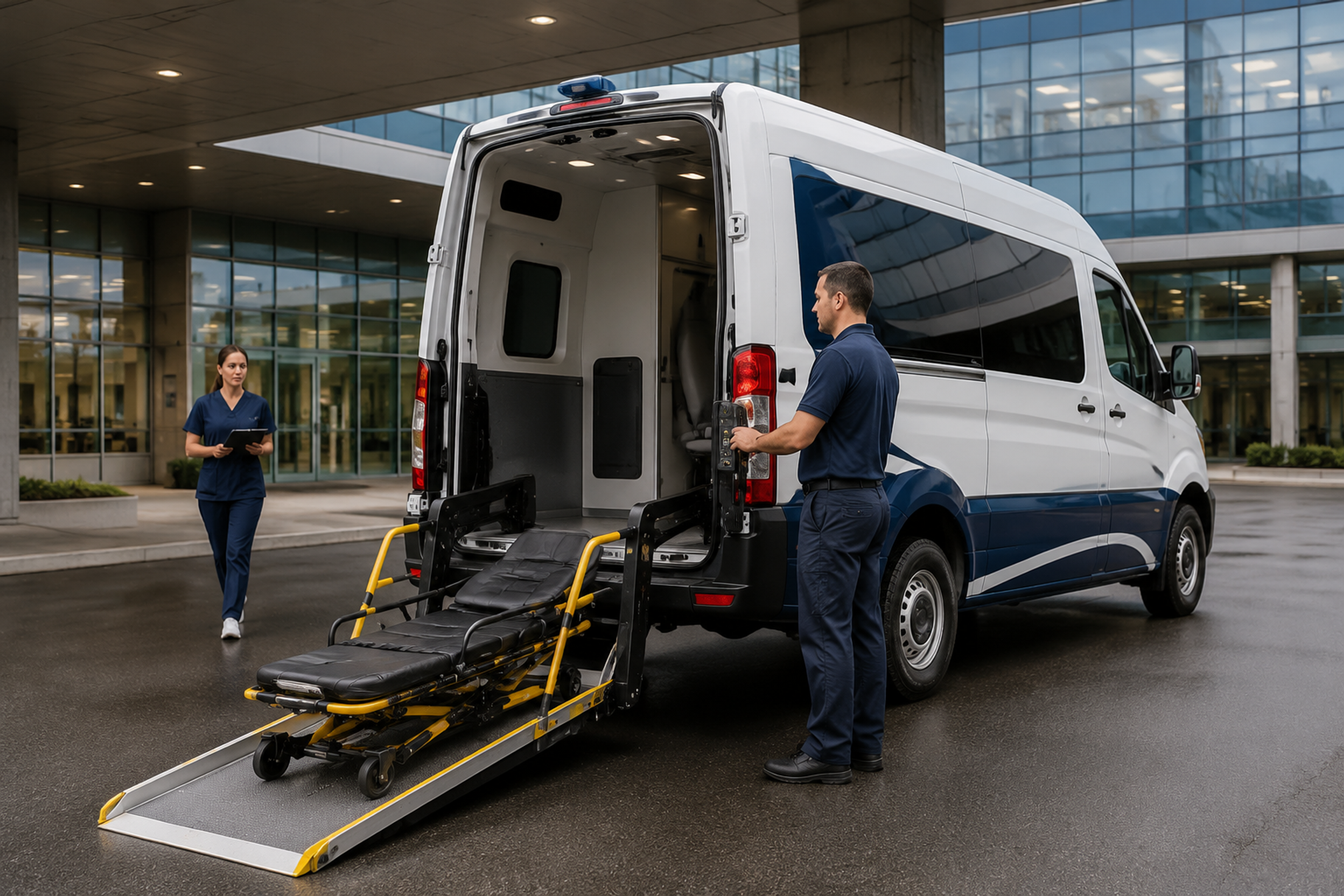
This guide is written for three specific audiences. First, new NEMT operators trapped in low-margin broker cycles who are billing 30 to 50 ambulatory trips per week and watching 85 cents of every dollar absorbed by fuel, labour, and insurance before profit appears. Second, fleet managers holding two or more vehicles who want to replace broker-dependent revenue with direct facility contracts and private-pay accounts that carry 20% to 35% net margins. Third, healthcare logistics founders building for scale who need a clear map of which high-margin NEMT niches carry defensible volume, pricing power, and low competitive density in 2026.
The US NEMT market reached approximately $12.5 billion in 2025 and is projected to grow at a 6.4% to 7.9% compound annual rate through 2030, driven by an ageing population, expanding Medicaid managed care enrollment, and a structural shortage of transport capacity in rural and semi-rural markets. The volume is real. The problem is where that volume concentrates.
The majority of NEMT operators enter the market through broker networks: MTM, LogistiCare (now Modivcare), Southeastrans, and state-administered transport contracts. These channels provide immediate trip volume but compress margins to 8% to 15% net on standard ambulatory rides. At $25 to $40 per trip with a 10% net margin, a vehicle running eight trips per day generates $20 to $32 in profit before vehicle depreciation is factored in. That is not a business model; it is a deferred vehicle replacement cycle.
The operators who build profitable, durable NEMT companies in 2026 are not running more broker trips. They are identifying the specific service categories where reimbursement rates are high, competition is thin, and the operational barrier to entry protects their position once established. Those categories are the five niches covered below.
Direct answer: The highest-margin NEMT services in 2026 are same-day hospital discharges billed direct to facility, stretcher and bariatric transport, long-distance out-of-county runs, private concierge transport for assisted living communities, and recurring standing-order contracts with dialysis and behavioural health clinics.
The rate differential between a standard broker ambulatory trip and any of the five categories above is not incremental. It is structural. Understanding why requires looking at each niche in detail.
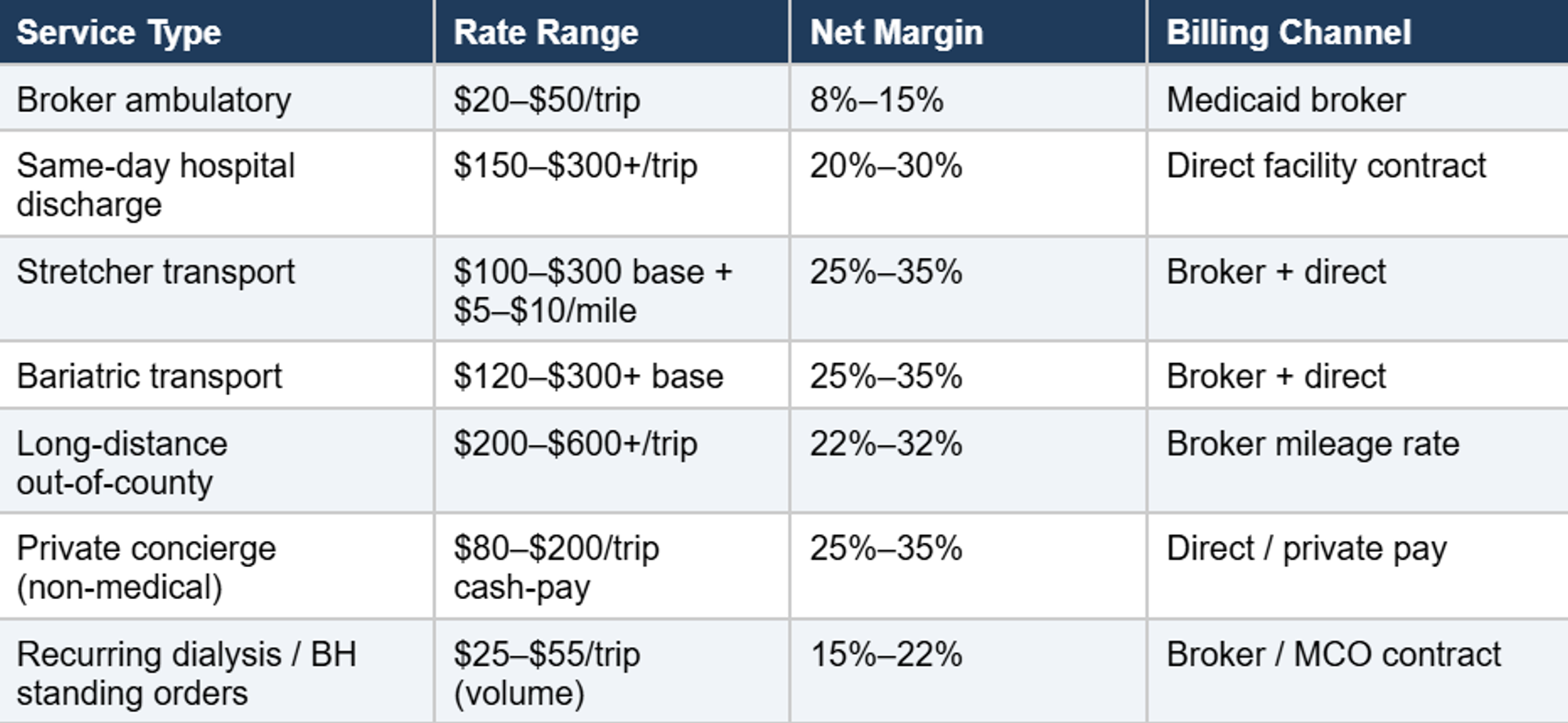
Hospital discharge coordinators operate under a specific financial pressure that most NEMT operators do not fully understand. Every occupied inpatient bed costs a hospital between $1,500 and $3,000 per day in operational overhead. When a patient is medically cleared for discharge but transport is unavailable, the bed stays occupied, the cost continues to accrue, and the next patient waiting for that bed remains in the emergency department or a step-down unit. The downstream cost of a delayed discharge, known in hospital finance as a boarding day, compounds across the facility's throughput metrics.
An NEMT operator who can guarantee a 30 to 45 minute response window on same-day discharge requests is not competing on price. The hospital's alternative is an occupied bed generating cost with no revenue. A $200 to $300 discharge transport is a direct cost offset against $1,500 to $3,000 in daily bed cost. This is why direct facility contracts for discharge transport price at a premium and why those rates hold even when standard broker rates in the same market are declining.
Building this niche requires three things: a reliable 30 to 45 minute response SLA, a direct contract relationship with the hospital's discharge planning or patient transport department, and a dispatch system that can accept and confirm an urgent trip within minutes of the request. Operators who position on response speed rather than rate compete in a separate category from broker networks entirely. The inquiry channel is the hospital social worker or discharge nurse, and the first operator to establish a reliable track record at a facility tends to hold that account.
In markets with multiple competing hospital systems, a single discharge contract with a 50 to 80 bed facility generating four to six discharges per week produces $40,000 to $100,000 in annual revenue at premium rates. Scaling to three to five facility contracts within a metro area converts a one-vehicle operation into a contract-backed fleet.
The rate contrast between standard ambulatory broker trips and stretcher or bariatric transport is the single clearest illustration of how specialisation changes the NEMT economics. A standard ambulatory broker ride in most markets pays $20 to $50 per trip. A stretcher transport starts at $100 to $150 base and runs $5 to $10 per loaded mile on top. A bariatric transport in a heavy-duty accessible van carries similar base rates. On a 30-mile trip, the difference between an ambulatory broker trip and a stretcher run is $180 to $250 in additional revenue per trip.
The supply constraint is structural. Stretcher transport requires a vehicle with a certified stretcher mount, securement hardware, and interior clearance. Bariatric transport requires reinforced floor plating, a heavy-duty lift rated above standard weight limits, and interior dimensions that accommodate a wider chair or bed. The upfit cost for either vehicle type runs $15,000 to $35,000 above the base vehicle cost, depending on specification. Most small operators running standard WAVs do not have this equipment, which means supply in most markets is thin relative to demand.
The two-person crew requirement for stretcher transport adds a second barrier. The non-driving attendant must hold current CPR certification and PASS training. Coordinating crew scheduling around stretcher availability reduces the competitor pool further. For operators who clear both barriers, the result is consistent access to stretcher and bariatric NEMT rates that are three to six times higher per trip than the ambulatory runs filling the same vehicles on non-specialised days.
Hospitals, skilled nursing facilities, and long-term acute care units generate the majority of stretcher demand. Dialysis centres and wound care clinics generate secondary demand for patients who cannot transfer to a standard wheelchair position. Building direct relationships with the clinical staff who place these orders, specifically charge nurses and patient transport coordinators, replaces broker intermediation with a direct billing relationship and a higher rate per trip.
Discover how an all-in-one NEMT solution can automate scheduling, plan routes and simplify billing so you can focus on delivering exceptional care.
Long-distance NEMT runs are underserved in most state transport markets because broker networks price them poorly relative to their true cost, and most small operators decline them in favour of shorter local trips. The operators who accept long-haul runs discover that high loaded mileage payouts on a single trip can generate more revenue than a full local shift of eight to ten short trips.
The Maryland Eastern Shore to Baltimore corridor illustrates the pattern clearly. A patient in Salisbury or Cambridge requiring specialised care at Johns Hopkins or the University of Maryland Medical Center faces a 90 to 120 mile transport each way. At a mileage reimbursement rate of $2.50 to $3.50 per loaded mile under a Medicaid broker contract, a single round trip generates $450 to $840 in mileage revenue before the base rate. A driver running two round trips on a long-haul shift earns the vehicle more gross revenue than a standard local vehicle running eight hours of short ambulatory trips.
The operational benefits compound. Long-distance trips improve driver shift predictability because the trip structure is known hours in advance. Fuel cost is offset by the loaded mileage rate. Vehicle utilisation per dollar of revenue is higher because idle time between trips is eliminated. The patient load per trip is typically one, which simplifies scheduling and eliminates the coordination overhead of multi-stop manifests.
Finding long-haul volume requires direct outreach to hospital case managers, oncology clinic coordinators, and discharge planners at academic medical centres, who regularly place transport orders for patients returning to rural home addresses. Operators who establish a reputation for reliable long-distance coverage in a corridor often become the default choice by referral, because competition in this category is thin.
Assisted living communities have a resident population with consistent transport demand for non-clinical trips: medical appointments, family visits, religious services, shopping, restaurants, and social events. This demand exists outside Medicaid reimbursement because most of these trips do not qualify as medically necessary transport. Residents or their families pay directly, or the facility bundles transport as a service included in the monthly fee and contracts with an NEMT operator to provide it.
The margin profile on private concierge transport is the best available to a small NEMT operator. Cash-pay rates of $80 to $200 per trip carry 25% to 35% net margins because there is no Medicaid billing lag, no broker deduction, and no remittance reconciliation. The operator invoices the facility or the resident, collects payment within 15 to 30 days, and retains the full commercial rate.
The sales process is relationship-based. The decision-maker is the activities director or executive director at the facility. An operator who provides reliable, professional transport for a facility's residents becomes the preferred vendor by default, because facilities do not want to manage multiple transport relationships. A single assisted living facility with 60 to 80 residents generating 20 to 30 transport requests per month represents $2,000 to $6,000 in monthly revenue at no broker deduction.
Marketing to this niche requires a professional presentation: a clean vehicle, a uniformed driver, and a simple booking process. Facilities evaluate transport providers on resident experience and reliability, not on rate competition. An operator competing on service quality rather than price in this market rarely faces a competitive bid process once the initial relationship is established.
Recurring standing-order contracts with dialysis centres, physical therapy clinics, and behavioural health programmes are the stability foundation for a NEMT fleet. A dialysis patient on a three-times-per-week schedule generates 156 round trips per year. A behavioural health clinic serving 30 patients with weekly transport needs generates 1,560 trip events per year from a single facility contract. These volumes are predictable, schedulable weeks in advance, and concentrated in specific time windows that allow tight route optimisation.
The per-trip rate on dialysis and behavioural health runs under broker contracts is not the highest in the market: $25 to $55 per trip depending on the state rate schedule. The margin advantage comes from volume density and scheduling efficiency. A vehicle running a tight dialysis route of six to eight patients in a defined geographic zone can complete a shift with minimal dead miles and near-zero scheduling overhead, because the manifest repeats three times per week with minor variation.
The operational requirement is reliability. Dialysis patients cannot miss scheduled sessions without medical consequences, which means the clinical staff and the broker who places the orders prioritise transport operators with low cancellation and no-show rates above almost all other factors. An operator who builds a record of 98% or higher on-time performance on dialysis routes becomes effectively embedded in that facility's transport programme and rarely faces displacement.
Behavioural health transport carries an additional credential requirement in many states: drivers must complete mental health first aid or equivalent sensitivity training. This credential barrier, similar to the two-person crew requirement for stretcher transport, limits the competitor pool and protects the position of operators who meet the standard.
The transition starts with identifying which of the five niches above has the lowest barrier to entry given your current fleet and credentials. For most operators, recurring standing orders with dialysis or behavioural health clinics are the most accessible entry point because they use existing vehicles and require only credentialing upgrades rather than vehicle upfits. Bariatric and stretcher transport require capital investment but pay back quickly at a 25% to 35% net margin. Hospital discharge contracts require a sales conversation with a discharge planning department but no equipment change if your vehicles are already WAV-configured. The key operational shift is replacing broker dependency with at least one direct billing relationship before the end of the quarter.
Stretcher transport in 2026 starts at $100 to $150 per trip as a base rate, with a loaded mileage add-on of $5 to $10 per mile. A 30-mile stretcher trip generates $250 to $450 in gross revenue per event. Bariatric transport in a heavy-duty accessible vehicle runs $120 to $300 per base trip depending on the state rate schedule and the billing channel; direct facility contracts price above broker rates in most markets. Two-person crew requirements are standard for stretcher runs and are typically reimbursed as a flat add-on of $30 to $75 per trip in states that recognise the attendant fee.
Contact the hospital's patient transport coordinator or discharge planning department directly. Do not approach through billing or procurement. The decision-maker is the nurse or social worker who physically places transport orders, and their primary concern is response time and reliability, not rate. Lead with your SLA commitment: a guaranteed 30 to 45 minute response on confirmed discharge orders. Follow with proof of insurance, driver credentials, and vehicle certifications. Offer a 30-day pilot at your standard rate with weekly performance reporting. Most facilities that run a pilot with a reliable operator convert to an ongoing contract without a competitive bid process.
Yes, for operators with a vehicle that can handle 200-mile round trips without breakdown risk. The loaded mileage rate on a 90 to 120 mile one-way trip under most state Medicaid broker contracts generates more gross revenue than a full local shift of short ambulatory runs. The operational complexity is lower than it appears: the trip is pre-scheduled, the route is fixed, and driver shift planning is simplified because the day structure is known in advance. The key risk is vehicle reliability; a breakdown on a long-haul run generates a late or missed trip that damages the broker relationship. Operators running long-distance volume maintain a second vehicle at sufficient mechanical standard to serve as a backup.
NEMT Platform is built for exactly the operational requirements that high-margin niches create. Same-day hospital discharge dispatching requires a system that can accept an urgent trip, assign the nearest available vehicle, and confirm the booking to the facility within two to three minutes. NEMT Platform's single-screen dispatch view gives the dispatcher full fleet visibility in real time, so urgent discharge orders are assigned and confirmed without a phone-based back-and-forth.
For stretcher and bariatric transport, NEMT Platform supports custom rate cards per vehicle type and per billing channel. A stretcher run bills at a different base rate and mileage rate than an ambulatory broker trip, and NEMT Platform handles that rate separation in the same billing workflow without manual rate entry per trip.
Out-of-county mileage tracking is automated. The system records loaded miles from point of pickup to destination and applies the correct mileage rate to the trip record for broker reconciliation or direct invoice generation. For private concierge and direct-pay accounts, NEMT Platform generates invoices to the facility or patient directly, bypassing broker billing entirely and collecting payment on the operator's schedule rather than the broker's remittance cycle.
Medi-Cal pays for Uber and Lyft rides under the NMT benefit for ambulatory members, but wheelchair and gurney patients require a certified NEMT provider.
How NEMT billing really works in 2026: the claim lifecycle, why claims get denied, EVV and compliance, and how the right billing software gets you paid faster.
For NEMT leadership: why margins are compressing, the three exposures the C-suite owns, and how technology decisions protect the P&L at enterprise scale.
California is the largest Medi-Cal market in the country, with more than 14 million enrollees and a county-based managed care model that routes all NEMT trips through contracted transportation brokers, not the state directly. To run a compliant NEMT business in California, you need a CPUC Charter-Party Carrier (TCP) permit, Medi-Cal enrolment through the DHCS PAVE portal, and credentialing with the brokers serving your target counties, primarily ModivCare, MTM and SafeRide Health. Our 2026 guide covers California-specific insurance requirements under CPUC General Order 115, the Physician Certification Statement (PCS) compliance framework, the 180-day Medi-Cal FFS timely filing limit, and how to build a multi-county operation across California's fragmented broker landscape.
See NEMT Platform in Action
Get a free, personalized walkthrough of dispatch, billing & scheduling built for NEMT providers.