


Table of contents▼

California is the largest Medicaid market in the United States. Medi-Cal covers more than 14 million residents, and the Non-Emergency Medical Transportation benefit sits inside every one of the state's managed care plan contracts. That scale creates genuine opportunity for NEMT providers. It also creates genuine complexity. California does not run a single statewide broker like some states. Instead, it operates a county-level managed care model in which each health plan contracts with its own transportation broker, and the rules that govern those trips are enforced by the California Department of Health Care Services through one of the strictest compliance frameworks in the country.
For a fleet operator, breaking into the California market means understanding three overlapping layers: the state's unique licensing requirement through the California Public Utilities Commission, the DHCS PAVE portal enrollment process, and the specific broker relationships that determine which trips you actually receive. Get any of these wrong and you will not run a billable Medi-Cal trip, regardless of fleet quality or driver credentials.
This guide walks through the California NEMT broker ecosystem in full, covering the state's major brokers, the managed care plans that fund the trips, the step-by-step compliance path, and the billing rules that protect your revenue.
Understanding the California Medi-Cal NEMT Ecosystem
The California Department of Health Care Services (DHCS) administers Medi-Cal NEMT under its Medical Transportation program, governed by All Plan Letter 22-008, which sets the compliance framework for every managed care plan in the state. Roughly 90 percent of California's Medi-Cal members are enrolled in a managed care plan. Those plans carve NEMT in as a covered benefit and contract with transportation brokers to handle authorisation, scheduling and provider network management.
California distinguishes between two transport benefits, and the difference matters for billing. Non-Emergency Medical Transportation (NEMT) covers members who cannot safely use a standard vehicle due to a physical or cognitive limitation. It requires prior authorisation in the form of a Physician Certification Statement (PCS), signed by the member's treating physician, before any trip can be scheduled or billed. The PCS documents functional limitations, specifies the required transport modality, and remains valid for up to 12 months. Non-Medical Transportation (NMT) covers members who can travel independently but lack access to a vehicle, and it does not require a PCS.
For fleet operators, the NEMT tier carries higher reimbursement and covers wheelchair, litter van and ambulette transport. It is also the tier that draws the most compliance scrutiny. DHCS requires brokers to verify that every NEMT trip aligns with the modality specified in the PCS form. Brokers cannot downgrade the prescribed modality to a cheaper option, and the PCS cannot be changed once issued. Providers who bill trips without a valid PCS on file face claim denial and potential programme exclusion.
The Major NEMT Brokers Operating in California
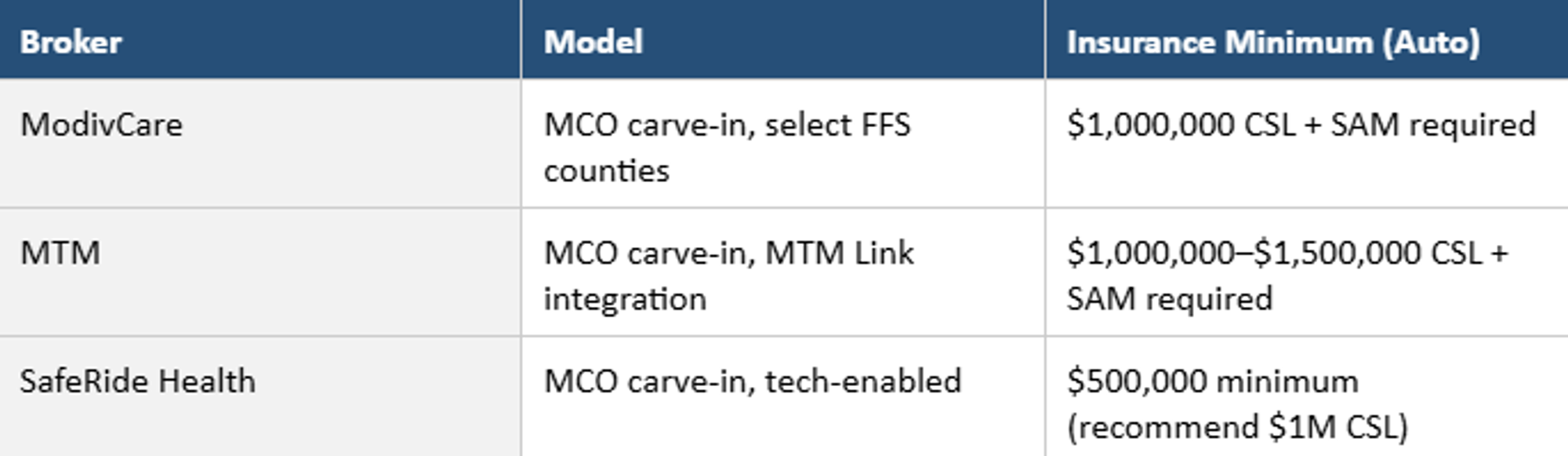
California does not designate a single statewide NEMT broker. Each managed care plan selects its own transportation broker, and broker assignments vary across the state's 58 counties and multiple plan models. As of 2026, the brokers with the largest footprint in Medi-Cal transportation are ModivCare, MTM and SafeRide Health. Providers credentialing for the first time should verify which broker operates in their target county and health plan before submitting any application, since the answer determines your entire onboarding path.
1. ModivCare
ModivCare (formerly LogistiCare) is the largest NEMT broker in the United States and maintains a significant presence across California's county-based managed care markets. It operates across multiple plan relationships and has historically managed Fee-for-Service (FFS) Medi-Cal trip coordination in several regions. ModivCare runs a standardised network performance model, managing high trip volumes with strict reporting requirements and GPS-verified electronic ride receipts. Learn more about ModivCare's provider network.
For providers, a ModivCare contract offers consistent trip demand but comes with demanding operational expectations. ModivCare requires real-time dispatch integration, digital signature capture on every trip leg, and on-time performance benchmarks that trigger de-fleeting if not met. The company also mandates Sexual Abuse and Molestation (SAM) coverage as part of its insurance requirements, a requirement that catches many new California operators off-guard.
In terms of insurance, ModivCare requires a minimum of $1,000,000 Combined Single Limit (CSL) for commercial auto liability, plus a $1,000,000 per occurrence / $2,000,000 aggregate Commercial General Liability policy, with ModivCare listed as an additional insured on both. SAM coverage must be explicitly endorsed on the policy.
Ready to streamline your transportation workflow?
Discover how an all-in-one NEMT solution can automate scheduling, plan routes and simplify billing so you can focus on delivering exceptional care.
2. MTM (Medical Transportation Management)
MTM is one of the largest privately held NEMT brokers in the country, managing more than 25 million trips annually. In California, MTM operates primarily through managed care plan contracts, providing NEMT and Non-Medical Transportation coordination through its MTM Link platform, which provides real-time trip data synchronisation. MTM's reach in California expanded through its acquisition of Veyo, which previously held significant managed care broker relationships in the state.
MTM requires a $1,000,000 to $1,500,000 CSL for commercial auto liability, a $1,000,000 per occurrence / $2,000,000 to $3,000,000 aggregate for Commercial General Liability, and mandates SAM coverage as a condition of credentialing. MTM's portal-based onboarding process, MTM Link, requires providers to integrate dispatch data directly with their system, which means your scheduling software must support the integration before you can go live on any MTM contract.
3. SafeRide Health
SafeRide Health has grown rapidly as a technology-driven NEMT benefit coordinator in California, operating as a broker for a number of Medi-Cal managed care plans, particularly those pursuing member-experience improvements and real-time trip visibility. SafeRide Health emphasises real-time tracking, member notifications and plan-facing analytics dashboards. The company applies a lighter insurance floor than ModivCare or MTM, requiring a minimum of $500,000 in commercial auto liability in most contracts, though providers are encouraged to carry $1,000,000 CSL to remain eligible for the full range of plan contracts in the state.
SafeRide's onboarding process is largely digital, with credentialing through its provider portal. Providers entering the California market through SafeRide should confirm which specific managed care plans SafeRide is contracted with in their target county before applying, since plan assignments shift with each DHCS contract cycle.
Understanding the Medi-Cal Managed Care Landscape
California's managed care structure is more complex than any other state in the country. DHCS administers Medi-Cal through five distinct county delivery models, and the managed care plan available to a member depends entirely on which county they live in. All Medi-Cal Managed Care Plan contracts have been formally amended through December 31, 2026, so the current plan landscape is stable for the remainder of this year.
The major commercial managed care plans operating in California as of 2026, each of which carves in NEMT and contracts with a transportation broker, include:
- Anthem Blue Cross Partnership Plan (Two-Plan model counties)
- Blue Shield of California Promise Health Plan
- CalOptima Health (Orange County)
- Contra Costa Health Plan
- Health Net Community Solutions
- Kaiser Permanente (direct contract counties under SB 510)
- L.A. Care Health Plan (Los Angeles County)
- Molina Healthcare of California
- Partnership HealthPlan of California (Northern California counties)
- San Francisco Health Plan
Each plan selects its own transportation broker, and broker assignments are not uniform across plans or counties. A provider operating in Los Angeles County may credential through ModivCare for one plan and MTM for another, with different rate schedules, dispatch portals and compliance requirements for each. This is the central operational challenge the California market presents that Texas and Florida, with their more consolidated broker structures, do not.
Step-by-Step Provider Requirements and Enrolment
California's compliance path is more layered than most states because it combines a state-level transport licensing requirement, a separate Medi-Cal enrolment system, and individual broker credentialing. None of these can be bypassed or sequenced out of order.
Step 1: Baseline Business Infrastructure
Register your business entity with the California Secretary of State. The filing fee for an LLC is $70, plus an annual minimum franchise tax of $800. Obtain a Federal Employer Identification Number (EIN) and open a commercial bank account set up for electronic funds transfer. Secure a Type 2 NPI for your entity through the National Plan and Provider Enumeration System (NPPES).
California imposes one additional infrastructure requirement that no other major NEMT state matches: every for-hire passenger carrier must obtain a Charter-Party Carrier (TCP) permit from the California Public Utilities Commission (CPUC) before operating commercially. The TCP permit is mandatory even if you never run a Medi-Cal trip. Vehicles transporting passengers for compensation on California roads require this authority, and it must be in place before DHCS will accept your PAVE enrolment application.
To apply for a TCP permit, submit an application through the CPUC's TCPortal with proof of commercial insurance meeting CPUC's General Order 115 requirements, vehicle information for your fleet, proof of participation in the California DMV's Employer Pull-Notice (EPN) driver monitoring system, and a completed motor carrier profile with the California Highway Patrol if your fleet includes vehicles seating more than ten passengers including the driver. The CPUC application fee and TCP processing typically takes 30 to 60 days.
Ready to streamline your transportation workflow?
Discover how an all-in-one NEMT solution can automate scheduling, plan routes and simplify billing so you can focus on delivering exceptional care.
Step 2: Commercial Insurance Procurement
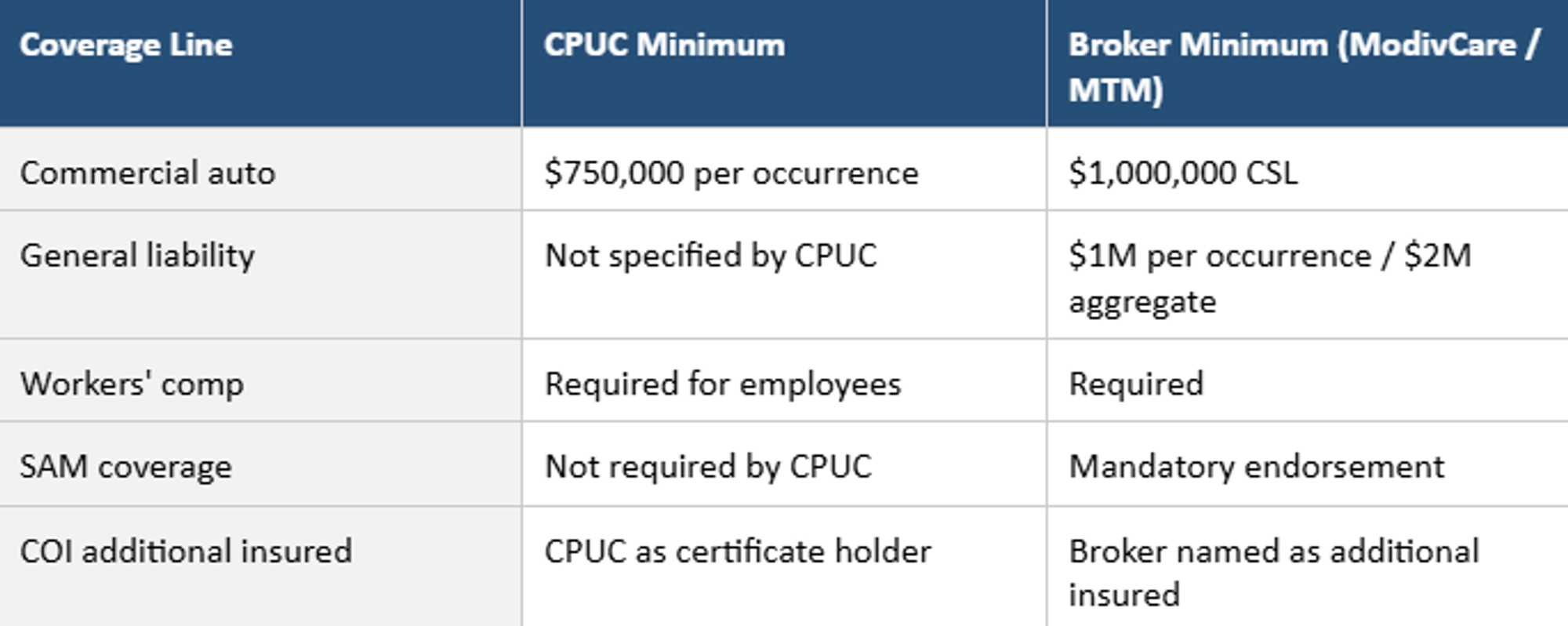
California sets its own mandatory insurance floor for for-hire carriers, separate from any Medicaid requirement. Under CPUC General Order 115, NEMT operators carrying fewer than ten passengers must maintain commercial auto liability of at least $750,000 per occurrence. This is a CPUC licence condition, not a broker preference, and the policy must be filed electronically with the CPUC directly by your insurance carrier or an authorised surplus lines broker.
Broker requirements sit above the CPUC floor. To credential with ModivCare or MTM, you need at least $1,000,000 CSL on commercial auto liability, a $1,000,000 per occurrence / $2,000,000 aggregate Commercial General Liability policy, workers' compensation insurance covering all employees, and an explicit Sexual Abuse and Molestation (SAM) endorsement. Your Certificate of Insurance must name the broker as an additional insured and must include primary and non-contributory language with a 30-day cancellation notice provision.
California's litigation environment pushes commercial NEMT insurance costs above the national average. Providers should budget $7,500 to $12,500 per vehicle per year for a compliant policy package covering auto liability at $1,000,000 CSL, general liability, workers' compensation and SAM coverage. Obtain quotes from carriers with at least an A-rating from AM Best and with demonstrated experience in California CPUC-regulated transportation, since non-specialist carriers frequently exclude loading and unloading liability, which is the single highest-risk exposure in NEMT.
Step 3: Enrolment via the DHCS PAVE Portal
Once your TCP permit is issued and your insurance is bound, enrol as a Medi-Cal provider through the DHCS Provider Application and Validation for Enrolment (PAVE) portal. PAVE is the mandatory, centralised gateway for all Medi-Cal provider enrolment in California. No managed care plan in the state can issue a network contract until your PAVE profile is approved and active.
The PAVE application for medical transportation providers requires your NPI, EIN, TCP permit number, proof of commercial insurance, DMV vehicle registration for every vehicle in your fleet, and vehicle inspection documentation. DHCS charges a non-refundable application fee of $730 (as of 2025; verify the current amount on the DHCS provider enrolment page before submitting). DHCS may take up to 180 days to process and approve a PAVE application, so submitting as early as possible in your credentialing sequence is critical. Adding new vehicles to an active enrolment is handled through a Supplemental Change request in PAVE, which requires a copy of the DMV registration and commercial insurance certificate for each new vehicle.
Providers operating in New Orleans Parish equivalents, specifically operators based in incorporated areas with local permit requirements, should confirm whether their city or county imposes an additional municipal transportation permit on top of the TCP and PAVE requirements. Los Angeles and San Francisco, for example, have their own local vehicle-for-hire ordinances that may apply.
Step 4: Broker Credentialing and Network Integration
With your TCP permit in hand and your PAVE enrolment active, apply to the broker networks serving your target counties. The documentation package you will need to submit to each broker includes:
- Your DHCS Medi-Cal Provider ID (issued through PAVE)
- TCP permit number and a copy of the CPUC-issued certificate
- Certificates of Insurance naming the broker as additional insured
- Driver qualification files: valid California driver's licences, current DMV motor vehicle records pulled through the EPN system, background check results and drug screening clearances
- Vehicle inspection reports and DMV registration for every vehicle
- Completed compliance training for all drivers: HIPAA, ADA passenger assistance and securement, CPR and First Aid, and defensive driving
California state law requires that criminal background checks for drivers who transport Medi-Cal members be conducted through the Department of Justice (DOJ) or the FBI, not through third-party commercial services. Brokers will require evidence that checks were run through an approved channel. Once credentialing is complete, typically four to eight weeks after you submit a complete file, you will sign a provider agreement and integrate your dispatch system with the broker's portal.
The full timeline from entity registration to a first billable Medi-Cal trip is 90 to 150 days for California operators, longer than most states, because the TCP permit and the PAVE portal each run independently and neither can be fast-tracked by a broker or a health plan.
NEMT Billing, Rates and Timely Filing in California
California pays NEMT providers on a base fee plus loaded mileage model: a flat per-trip base rate combined with a per-mile rate for miles driven with the patient on board. Deadhead miles, the distance driven to reach a pickup, are not reimbursed, which means route efficiency directly determines your net margin. California's ambulatory rates rank among the higher in the country, typically running $28 to $45 per trip in most counties for standard sedan transport, with wheelchair and litter van rates set separately.
Brokers may negotiate rates above the Medi-Cal fee schedule published by DHCS but cannot pay below it. Urban county operators in Los Angeles, San Francisco, Orange and San Diego have historically been able to negotiate marginally higher rates due to the cost of operations in those markets. Rural Central Valley counties tend to sit close to the published floor, with higher loaded mileage rates compensating for the longer distances between pickups and destinations.
The timely filing limit for Medi-Cal Fee-for-Service claims is 180 days from the date of service, established under California Welfare and Institutions Code Section 14104.3. That is one of the shorter windows among large Medicaid states. Texas gives providers 95 days; Louisiana allows 12 months. In California's managed care model, which covers approximately 90 percent of Medi-Cal members, each plan sets its own timely filing window in its provider agreement. Anthem Blue Cross Partnership Plan enforces a 180-day limit for participating providers. Other plans vary. Read your signed provider agreement, not the FFS rule, to determine the deadline that governs the bulk of your trips.
For corrected claims, Medi-Cal FFS allows resubmission up to 12 months with supporting documentation justifying the delay, such as retroactive eligibility determination. For managed care plans, corrected claims typically must be submitted within 60 days of the original denial. Missing that window means the revenue is gone regardless of whether the original claim was valid.
One compliance issue specific to California that operators frequently underestimate is the PCS audit exposure. Because every Medi-Cal NEMT trip must link to a valid Physician Certification Statement, brokers conduct periodic audits of provider trip logs against PCS records on file. If your documentation does not show a valid, in-date PCS for each trip billed, the claim can be reversed and repayment demanded. Your dispatch system must maintain PCS reference numbers against every trip record, not just driver logs and GPS data.
Ready to streamline your transportation workflow?
Discover how an all-in-one NEMT solution can automate scheduling, plan routes and simplify billing so you can focus on delivering exceptional care.
Q&A: Navigating NEMT Brokers in California
Q: Do I need a TCP permit from the CPUC even if I only plan to run private-pay trips initially?
A: Yes. The California Public Utilities Commission requires a Charter-Party Carrier (TCP) permit for any entity transporting passengers for compensation on California roads, regardless of payer. This covers both private-pay and Medi-Cal trips. Operating without a TCP permit exposes your business to CPUC enforcement and disqualifies your PAVE application. Secure the TCP permit before doing anything else.
Q: Do I bill DHCS directly for Medi-Cal NEMT trips?
A: Not for managed care trips, which represent roughly 90 percent of Medi-Cal members. You bill the transportation broker that authorised and dispatched the trip. The broker acts as the intermediary between your business and the managed care plan. For the small remaining population in Fee-for-Service Medi-Cal, you bill through the Medi-Cal FFS claims system once your PAVE enrolment is active.
Q: Can I operate with the CPUC's minimum auto liability of $750,000?
A: You can satisfy the CPUC licence requirement with $750,000, but you cannot credential with ModivCare or MTM at that level. Both brokers require at least $1,000,000 CSL on commercial auto liability, plus a mandatory Sexual Abuse and Molestation endorsement that many standard commercial policies exclude. Build your insurance package around the broker minimum, not the CPUC floor, or you will face a gap between being legally permitted to operate and actually qualifying for any Medi-Cal trip volume.
Q: What is the timely filing limit for California Medi-Cal NEMT claims?
A: The Medi-Cal Fee-for-Service limit is 180 days from the date of service, under Welfare and Institutions Code Section 14104.3. However, the large majority of California's Medi-Cal members are in managed care, and each managed care plan sets its own contractual claims deadline. Anthem Blue Cross Partnership Plan enforces 180 days for participating providers; other plans vary. Check your signed provider agreement for the exact window that applies to each plan you are credentialed with.
Q: How can NEMT Platform help me operate an NEMT business in California?
A: California's broker landscape is fragmented by county and plan, which means your dispatchers are managing multiple broker portals, rate schedules and compliance requirements simultaneously. NEMT Platform consolidates that into one interface. Real-time GPS mileage logging supports California's loaded-mile billing model. PCS reference tracking links trip records to physician certification data, which protects you in broker audits. Automated ride receipts and digital driver signatures produce the documentation ModivCare, MTM and SafeRide Health all require for clean claims. And centralised driver and vehicle records keep your PAVE enrolment files current as your fleet grows across counties.
Quick Summary
This guide covers the Non-Emergency Medical Transportation broker structure in California for 2026, including the state's CPUC TCP permit requirement, the DHCS PAVE enrolment process, the three major brokers (ModivCare, MTM and SafeRide Health), the county-based managed care landscape, California-specific insurance requirements under CPUC General Order 115, the Physician Certification Statement compliance framework, and the billing and timely filing rules that govern Medi-Cal claims.
Who This Blog Post Is For
This guide is designed for current NEMT fleet operators, aspiring California providers and dispatch managers seeking to credential with Medi-Cal managed care brokers, understand CPUC licensing, and build a compliant, profitable operation across one or more California counties.
Disclaimer
The information in this guide is for general informational and educational purposes only and does not constitute legal, financial or professional business advice. NEMT regulations, CPUC licensing requirements, Medi-Cal policies, broker requirements and insurance minimums in California are subject to frequent change. Providers are strongly encouraged to verify all credentialing requirements directly with DHCS, the California Public Utilities Commission, and their respective brokers before making operational or financial decisions.
Related Articles
Starting an NEMT Business in 2026: Where the Real Profit Comes From
NEMT operators in 2026 can reach 20-35% margins via hospital discharge contracts, stretcher and bariatric transport, long-distance trips, and private concierge accounts beyond standard broker rides.
How to Market Your NEMT Business Effectively
Discover proven NEMT marketing strategies for 2026, from local SEO to facility contracts, that help providers win high-value institutional healthcare business.
How to Find Clients for Your NEMT Business: The 2026 Growth Playbook
Learn how NEMT providers secure private pay contracts in 2026 through local SEO, facility partnerships, and referrals, bypassing low-margin Medicaid brokers.
NEMT Brokers in LOUISIANA
This guide breaks down the Non-Emergency Medical Transportation broker structure in Louisiana for 2026, covering the state's two-broker model of MediTrans and Verida, the five Healthy Louisiana managed care organisations, provider enrolment through the Louisiana Medicaid Provider Enrollment Portal, and the billing and timely filing rules that govern claims.