
Table of contents▼
This guide is written for three types of reader. Active NEMT owner-operators looking to reduce dependence on digital brokers and build a marketing engine that generates direct trip volume. Medical transit fleet marketers responsible for building a recognisable regional brand across multiple service areas. Healthcare logistics founders whose priority is securing long-term commercial contracts with hospitals, dialysis centres, and senior care networks rather than one-off broker-assigned trips.
What is the most effective way to market an NEMT business?
The most effective way to market an NEMT business is to combine local search dominance with direct institutional outreach, rather than relying on broker assignment or general consumer advertising. Three actions produce the fastest, most durable results:
- Claim and fully optimize your Google Business Profile with geo-tagged vehicle imagery to win the local map pack for “non-emergency medical transportation near me” searches.
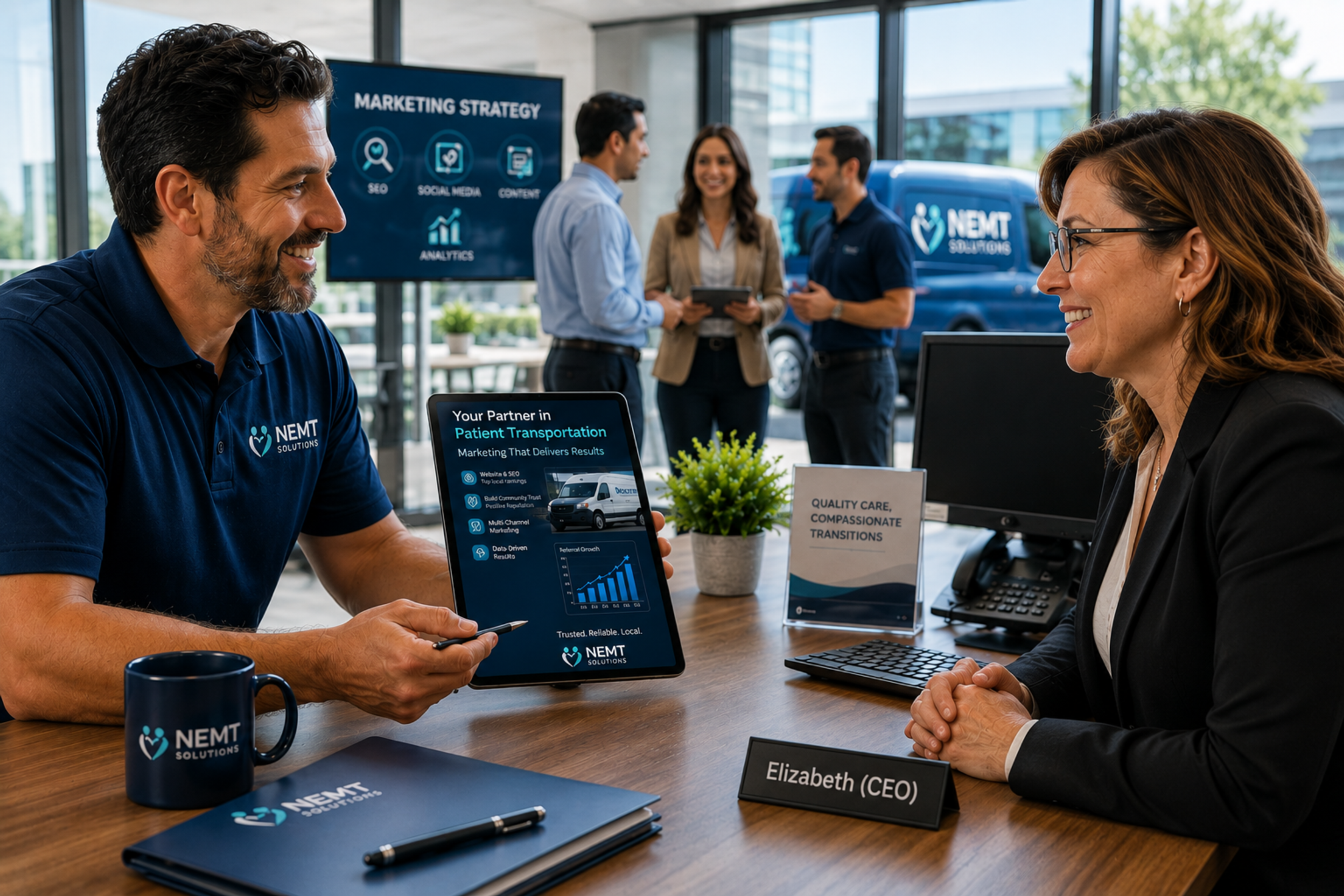
- Build a professional pitch deck and digital brochure targeting hospital discharge boards, dialysis centres, and senior care networks, and present it directly to facility decision-makers.
- Publish case studies and on-time performance data that establish digital authority, which converts both private-pay families researching providers and enterprise brokers evaluating network additions.
This combination outperforms consumer advertising because NEMT demand is not impulse-driven. Facility coordinators and family members research providers before committing a patient, which makes trust signals and searchability more valuable than ad reach.
Ready to streamline your transportation workflow?
Discover how an all-in-one NEMT solution can automate scheduling, plan routes and simplify billing so you can focus on delivering exceptional care.
Market Dynamics: Why Digital Authority Beats Consumer Advertising
Independent market research firms put the US non-emergency medical transportation market at roughly $12.5 to $12.8 billion in 2026, with most analysts projecting high single-digit compound annual growth through the early 2030s, driven by an ageing population and rising chronic disease management needs. That growth is structural rather than cyclical. Medicaid transportation benefits, Medicare Advantage supplemental coverage, and value-based care contracts are all expanding the pool of covered trips, independent of any single provider's marketing spend.
This matters for where you put your marketing budget. A growing, structurally-funded market rewards providers who are visible and credible when a decision-maker searches or asks for a referral. It does not reward providers who rely on broad consumer advertising, because the buyer is rarely the end passenger. The buyer is a discharge planner, a case manager, or a facility administrator making a contracting decision on behalf of dozens or hundreds of patients at once.
Local organic visibility and paid search solve different problems and cost differently over time. The comparison below explains why organic should be the foundation of your NEMT marketing budget, with paid search as a short-term supplement rather than a primary channel.
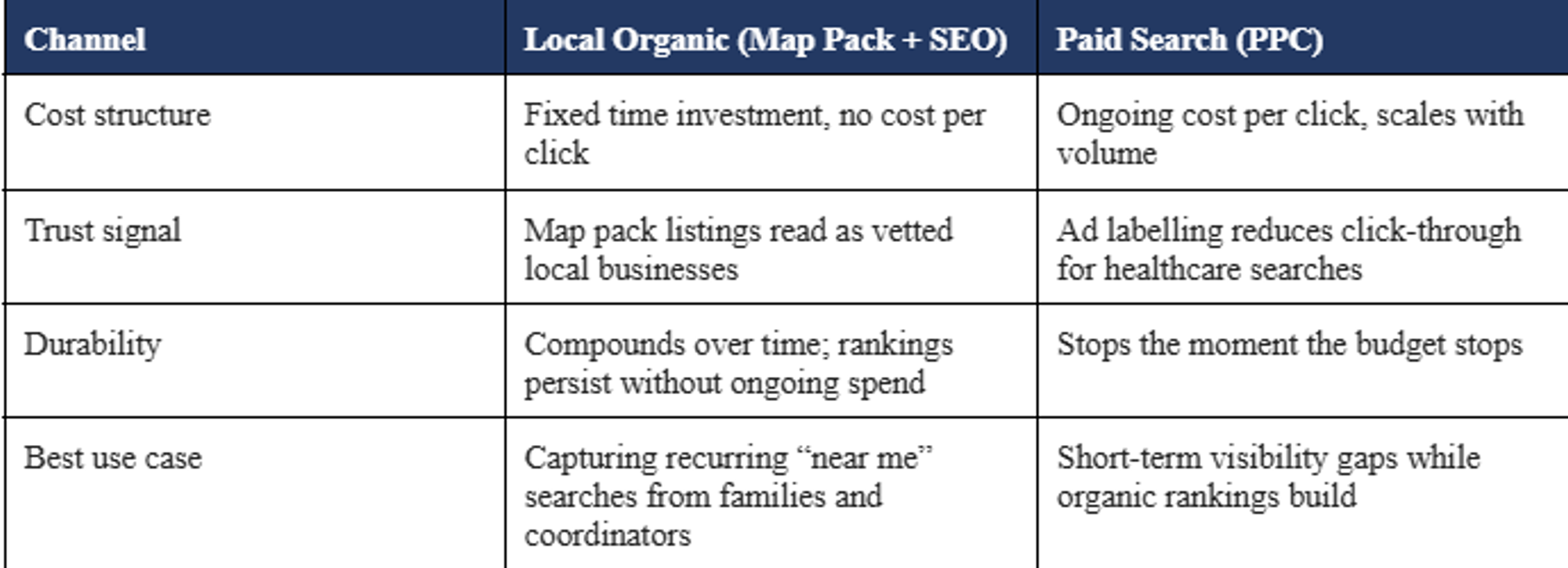
Local organic visibility compounds and persists. Paid search is useful for filling short-term gaps but stops producing the moment spend stops.
Digital authority and contract-focused marketing outperform basic consumer advertising for one structural reason: NEMT revenue is concentrated in institutional relationships, not individual bookings. A single dialysis centre or skilled nursing facility contract can generate more predictable annual trip volume than hundreds of individually-acquired consumer bookings, and that contract is won through credibility assets and direct outreach, not display ads.
Three Pillars of a High-Performance NEMT Marketing Machine
1. Hyper-Local Search Optimisation
Winning the local map pack is the highest-leverage, lowest-cost move available to an NEMT provider. Families and facility coordinators searching “non-emergency medical transportation near me” or “wheelchair van [city]” see map pack results before organic listings, especially on mobile.
- Claim your Google Business Profile and complete every field: service area, vehicle types, hours, and a direct phone line.
- Upload geo-tagged imagery of your actual vehicles and drivers rather than stock photography, which strengthens both local ranking signals and buyer trust.
- Implement local service schema markup on your website so search engines and AI answer engines can parse your service area, vehicle types, and contact details programmatically.
- Build separate, genuinely distinct landing pages for each city or county you serve rather than duplicating one page with a swapped place name.
This pillar requires no media spend, which makes it the correct starting point regardless of budget size.
2. B2B Institutional Positioning
Facility contracts are won through credibility assets, not cold calls alone. A discharge planner or dialysis centre administrator needs to see professional, specific proof that you can perform before they commit patient volume to you.
- Build a digital brochure covering vehicle types, coverage area, insurance limits, response times, and compliance certifications in a single scannable document.
- Develop a short pitch deck for in-person or video meetings with hospital discharge boards, dialysis centre administrators, and senior living coordinators.
- Lead with reliability metrics, on-time percentage, no-show rate, and average response time, since these are the numbers facility decision-makers use to compare providers.
- Target facilities with recurring, high-frequency transport needs first, since one contract there replaces dozens of individually-marketed consumer trips.
This pillar takes longer to close than local SEO, but it produces the highest-value, most durable revenue relationships in NEMT.
Ready to streamline your transportation workflow?
Discover how an all-in-one NEMT solution can automate scheduling, plan routes and simplify billing so you can focus on delivering exceptional care.
3. Digital Brand and Authority Building
Case studies and professional fleet presentation build the kind of trust that converts two very different buyers: private-pay families researching options online, and enterprise brokers deciding which providers to add to their network.
- Publish short case studies showing specific outcomes, a facility partnership that reduced missed appointments, or a route optimisation that improved on-time performance.
- Maintain a consistent visual brand across your website, vehicles, and driver uniforms, since inconsistency reads as a lack of operational maturity to both families and facility evaluators.
- Collect and display reviews systematically, since review volume and recency influence both local search ranking and buyer trust at the point of decision.
- Keep your digital brochure and case studies current, since facility contracts are typically reviewed and renewed annually, and outdated proof points weaken your renewal position.
Authority-building work compounds. A case study written once continues to support every future facility pitch and every organic search result indefinitely.
Frequently Asked Questions
How much should an NEMT business budget for marketing?
There is no fixed industry benchmark, but a useful starting principle is to weight budget toward owned assets, your Google Business Profile, website, and pitch materials, over paid media. Local SEO and institutional outreach cost primarily time rather than ad spend, which makes them accessible to new operators with limited marketing budgets. Reserve paid search for short-term visibility gaps rather than as your primary channel.
How long does it take to see results from NEMT marketing?
Local SEO improvements typically show measurable map pack movement within 60 to 90 days of consistent optimisation. Institutional contracts move on a longer, relationship-driven timeline, often four to eight weeks from first outreach to a signed agreement, sometimes longer for hospital systems with formal procurement processes. Expect local search and institutional outreach to compound together rather than produce results independently.
What is the difference between marketing to consumers and marketing to facilities in NEMT?
Consumer marketing targets the passenger or their family, who typically make a single booking decision and respond to trust signals like reviews and local visibility. Facility marketing targets a discharge planner or care coordinator making a contracting decision on behalf of many patients at once, who respond to credibility assets like pitch decks, reliability data, and compliance documentation. Both matter, but facility marketing produces higher-value, more durable revenue per relationship.
Do I need a website if most of my NEMT business comes from broker assignments?
Yes. A website is the foundation that supports your Google Business Profile ranking, hosts the case studies and credibility content facility evaluators expect to see, and gives private-pay families and referral sources a place to verify you before booking. Reducing broker dependence specifically requires a direct channel for facilities and private-pay clients to find and vet you, and a website is that channel.
How can NEMT Platform assist in marketing and scaling an NEMT business?
NEMT Platform strengthens your marketing position in three specific ways. Its OVERSIGHT real-time tracking feature gives facility case managers direct visibility into every trip, which is exactly the reliability proof discharge planners and dialysis centre administrators look for before signing a contract. Automated dispatching efficiency improves your on-time percentage, the single metric most facility evaluators use to compare providers, which strengthens both your pitch materials and your contract renewals. A professional passenger booking tool lets private-pay families and facility coordinators book directly with you, which supports the digital authority and direct-booking capability that institutional and consumer marketing both depend on.
Related Articles
Executive Guide to NEMT: Margin, Risk & Technology
For NEMT leadership: why margins are compressing, the three exposures the C-suite owns, and how technology decisions protect the P&L at enterprise scale.
Starting an NEMT Business in 2026: Where the Real Profit Comes From
NEMT operators in 2026 can reach 20-35% margins via hospital discharge contracts, stretcher and bariatric transport, long-distance trips, and private concierge accounts beyond standard broker rides.
NEMT Brokers in California
California is the largest Medi-Cal market in the country, with more than 14 million enrollees and a county-based managed care model that routes all NEMT trips through contracted transportation brokers, not the state directly. To run a compliant NEMT business in California, you need a CPUC Charter-Party Carrier (TCP) permit, Medi-Cal enrolment through the DHCS PAVE portal, and credentialing with the brokers serving your target counties, primarily ModivCare, MTM and SafeRide Health. Our 2026 guide covers California-specific insurance requirements under CPUC General Order 115, the Physician Certification Statement (PCS) compliance framework, the 180-day Medi-Cal FFS timely filing limit, and how to build a multi-county operation across California's fragmented broker landscape.
How to Find Clients for Your NEMT Business: The 2026 Growth Playbook
Learn how NEMT providers secure private pay contracts in 2026 through local SEO, facility partnerships, and referrals, bypassing low-margin Medicaid brokers.