


Table of contents▼

The short answer: NEMT leadership faces a structural squeeze. Reimbursement rates are largely fixed while labor, insurance, and fleet costs keep rising, and traditional Medicaid trips already run on gross margins of roughly 10 to 15 percent. At enterprise volume, protecting margin is not an operations detail. It is a technology and governance decision that belongs on the executive agenda.
Most NEMT content is written for dispatchers and new operators. This briefing is for the people who own the P&L: the executives of large transportation providers and the health plan leaders who depend on them. It covers the three exposures that sit at the leadership level, the operational levers that actually move an enterprise income statement, and the questions a serious executive team should ask before committing to any technology decision.
Why NEMT economics are now a leadership problem
The margin math of NEMT has tightened to the point where operational efficiency is a strategic issue, not a back-office one. Industry benchmarks put gross margins on traditional Medicaid trips at roughly 10 to 15 percent. Your reimbursement rates are set by contracts and state programs and move slowly, while your three largest cost lines, labor, insurance, and vehicles, move against you every year. Nothing about that equation improves on its own.
At enterprise volume, this structure has a specific consequence: small percentage changes produce large absolute dollars. A single point of claim approval, a few percent of dispatcher labor, a modest reduction in denied-claim rework, each of these is a rounding error for a five-vehicle operator and a material line item for an organization running hundreds of thousands of trips a year. This is why margin protection at scale is fundamentally about systems. The levers big enough to matter, automation rate, claims accuracy, compliance discipline, are all technology-dependent, which places the decision squarely at the executive table.
There is also a market-timing dimension. The U.S. NEMT market is growing at roughly 5.5 percent annually, and payers are simultaneously tightening oversight. Medicare's RSNAT prior-authorization pilot cut improper transports by 58 percent and costs by 67 percent, a clear signal of where payer scrutiny is heading. Growth plus scrutiny rewards operators who can prove clean, efficient operations and penalizes those who cannot.
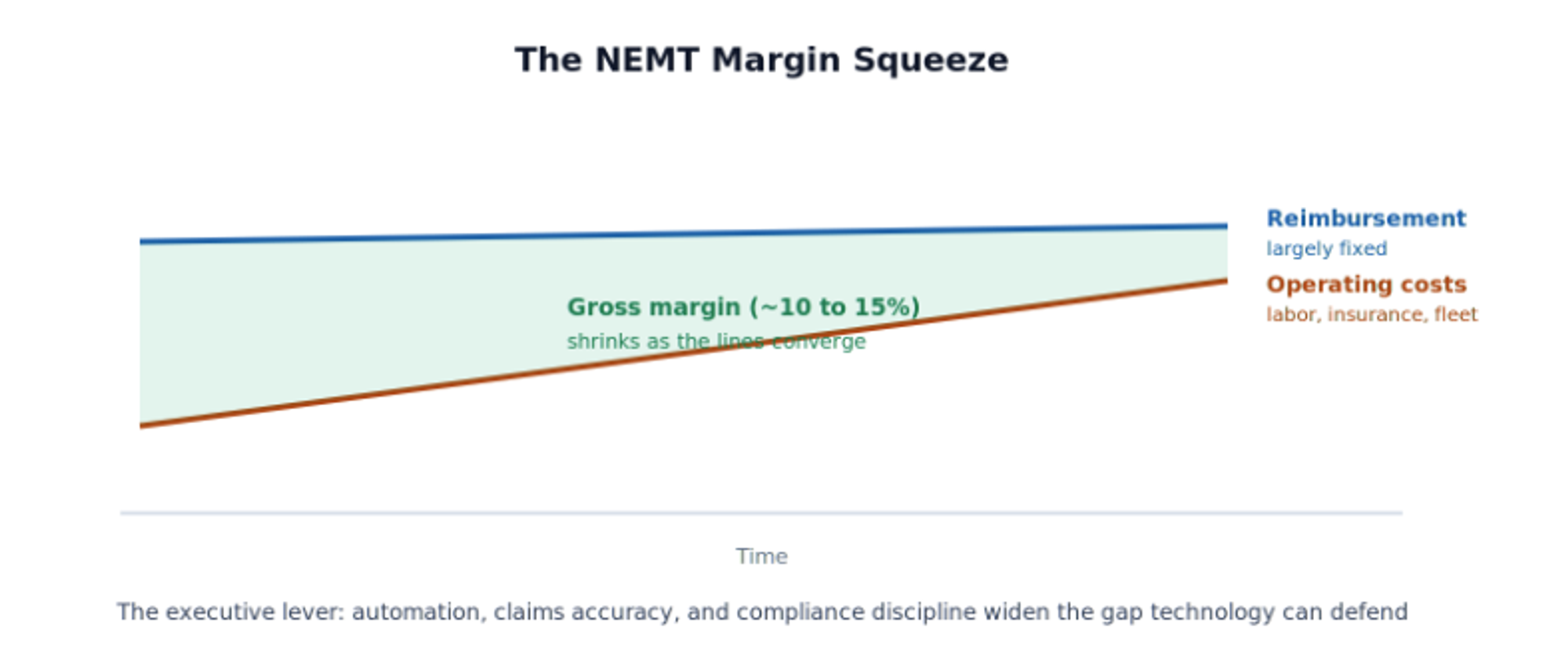
Figure 1: Reimbursement moves slowly while costs rise. At enterprise volume, the levers big enough to defend the margin are systemic, which makes them executive decisions.
The three exposures the C-suite owns
Three risks in a large NEMT operation cannot be delegated below the executive level, because each one is systemic, compounding, and capable of moving the enterprise's value.
1. Margin erosion you cannot see per trip
Margin leaks at scale are invisible at the trip level and enormous in aggregate. Denied claims that get written off instead of reworked, deadhead miles across a large fleet, dispatcher hours spent on work automation should absorb, reconciliation labor between disconnected systems. None of these appears as a line item called “waste.” They appear as a gross margin that is two or three points lower than it should be, and at your volume those points are the difference between a healthy business and a fragile one.
2. Compliance exposure that scales with you
At enterprise volume, a systemic compliance gap is not a mistake, it is a pattern, and auditors treat patterns differently. EVV mandates under the 21st Century Cures Act are now enforced with state compliance thresholds reaching 50 to 80 percent in 2026, and payer audit activity is rising. A documentation weakness that exists across every location and thousands of monthly trips creates clawback and contract risk that belongs on a board-level risk register. The defense is structural: verifiable GPS, timestamps, and EVV captured automatically on every trip, so the record defends itself.
3. Revenue concentration in broker contracts
For most large providers, a handful of broker relationships underwrite the business, and those relationships are governed by performance data. On-time rates, complaint volume, claim accuracy, and compliance scores feed the scorecards that decide renewals. Losing a major contract over measurable underperformance is the single fastest way a large NEMT operation shrinks. Which means the systems that produce those metrics, and prove them, are not operational plumbing. They are revenue protection.
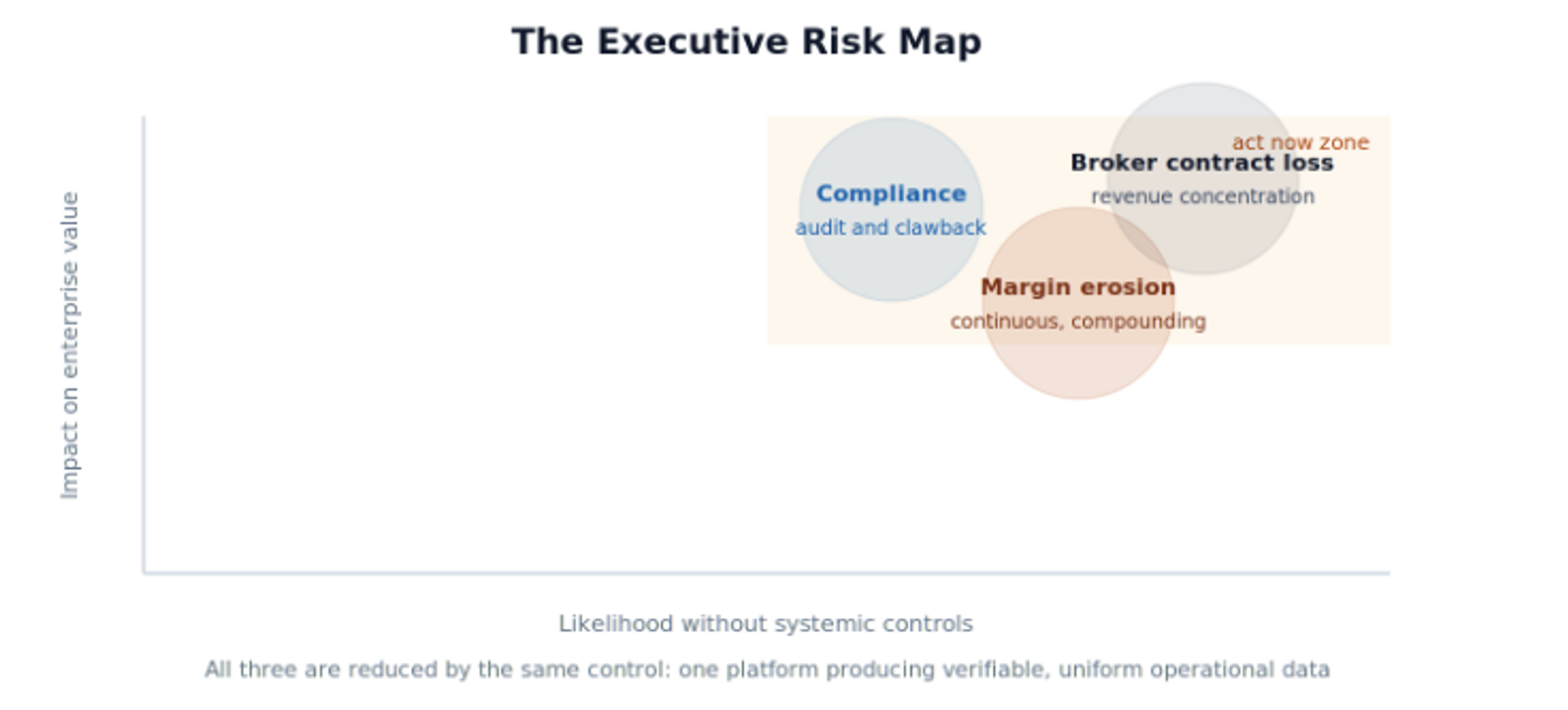
Figure 2: The three leadership-level exposures cluster in the high-likelihood, high-impact zone when controls are manual and fragmented. One systemic fix addresses all three.
The levers that actually move an enterprise P&L
Only a few operational metrics are large enough at scale to change the income statement, and each one is technology-dependent. This is where the executive conversation should focus, because these are the numbers where a platform decision translates directly into financial performance.
Claims accuracy. First-submission approval is the cleanest revenue lever in the business. Every rejected claim is revenue delayed, reworked at cost, or written off. Verified platform benchmark: 99.2 percent first-submission claim approval. At hundreds of thousands of trips a year, the gap between that figure and a typical manual operation is a seven-figure conversation.
Labor productivity. Dispatch labor is one of your largest controllable costs, and most of it goes to work automation handles. Verified benchmarks: 88 percent of trips assigned automatically, 4 to 5 hours saved per dispatcher per day, and a 66 percent reduction in manual workload overall. For leadership, this is headcount leverage: the ability to grow trip volume without growing administrative staff at the same rate.
Call load. Inbound phone volume is a hidden staffing cost and a service-quality risk. A voice AI layer that resolves routine calls changes both. Verified benchmarks: up to 90 percent of routine calls handled automatically and a 40 percent reduction in call center load.
Compliance yield. Audit-ready documentation on every trip protects both revenue and contracts. Verified case example: Helping Hands Transportation reached 100 percent compliance with an 80 percent reduction in paperwork. The financial value is partly the paperwork saved and mostly the contract risk retired.
Scale credibility matters here, because these numbers only matter if the system produces them at your volume. The NEMT Platform runs more than one million trips per month across 300 plus providers and 40 plus broker and healthcare integrations. For an executive evaluating vendor claims, throughput at that level is the difference between a demo and a track record.
The decision framework: status quo, patchwork, or platform
Leadership effectively has three options, and the honest comparison includes the cost of doing nothing. The status quo is not free. It is the compounding sum of every leak described above, paid quietly every month.
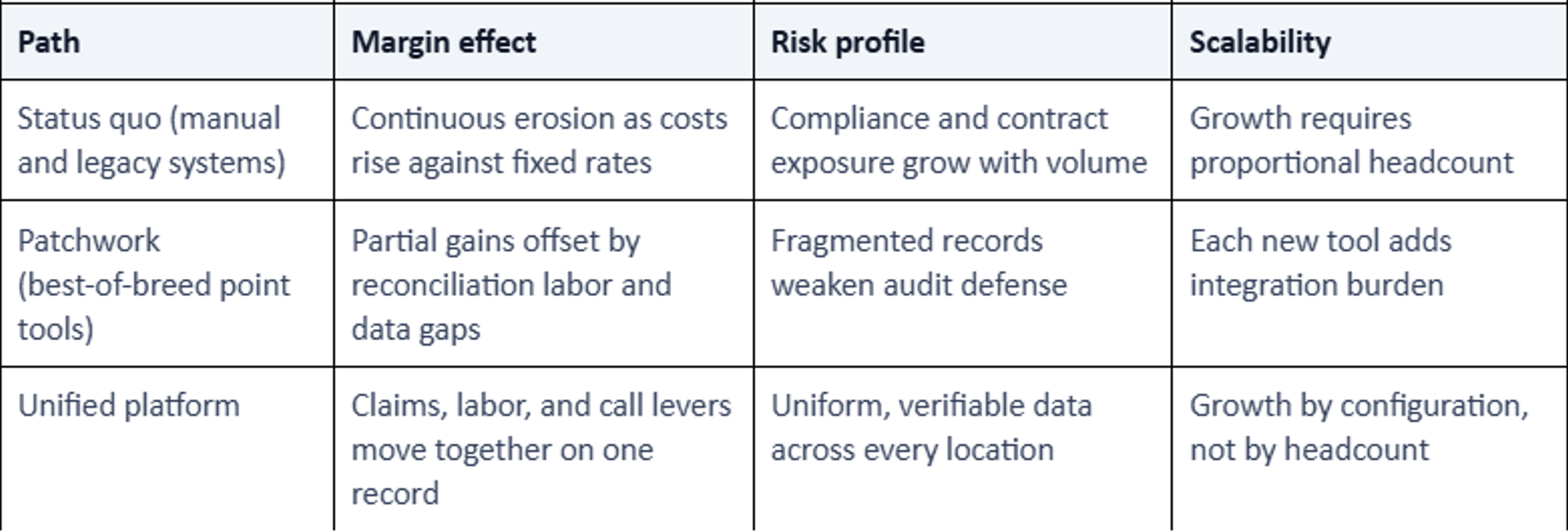
The strategic logic favors consolidation for a reason that has nothing to do with software preference: every lever in the previous section depends on clean, unified data. Claims accuracy requires trip data that flows straight into billing. Compliance defense requires every location writing to the same verifiable record. Automation requires the system to see the whole operation. A fragmented stack caps how far any of those levers can move.
Due diligence: what the executive table should ask
A platform decision at enterprise scale deserves the same rigor as any major vendor commitment. These are the questions that separate marketing from operational reality.
- Prove it at our volume. Show throughput and case studies at a scale comparable to ours, not small-operator success stories. A system that works at 3,000 trips a month has not yet proven anything about 100,000.
- Show the claims math. What is your first-submission approval rate across the installed base, and what drives it. Ask how the platform validates claims before submission, per broker format.
- Walk us through the audit story. If a state auditor or broker requests documentation for six months of trips tomorrow, what exactly do we produce, and how fast.
- Map our broker mix. Which of our specific brokers integrate directly today, and what happens operationally when we add a new contract.
- Explain the migration path. How do we move a live, multi-location operation without service interruption, and what does the first 90 days look like.
- Address security and privacy directly. Patient data demands HIPAA compliance and independent certification. The platform's voice AI, for example, is HIPAA compliant and SOC 2 Type II certified, and every component touching member data should meet that bar.
Where the industry is heading, and why timing matters
The direction of travel is unambiguous: payers and states are tightening verification, and operational proof is becoming the price of participation. EVV enforcement thresholds are rising, prior-authorization models like RSNAT have demonstrated dramatic reductions in improper utilization, and brokers are managing networks on performance data. In that environment, the operators who can demonstrate clean, automated, verifiable operations will take share from those who cannot, in a market still growing at roughly 5.5 percent a year.
For leadership, the timing question is straightforward. The organizations that consolidate early set their cost structure below the market and build the compliance record before scrutiny arrives. The organizations that wait pay the status quo tax in the meantime and face the transition later under pressure. The technology decision is the same either way. The economics of when you make it are not.
See The Platform Through A Leadership Lens
Your margin levers, your broker mix, and the operational data your board will ask about.
Frequently asked questions
What gross margin do NEMT companies typically make?
Industry benchmarks put gross margins on traditional Medicaid NEMT trips at roughly 10 to 15 percent. Margins compress further when denied claims, manual labor, and compliance rework go unmanaged, which is why operational efficiency is a leadership-level concern at scale.
How does technology improve NEMT profitability at enterprise scale?
By moving the few metrics large enough to matter: first-submission claim approval, automated dispatch rate, dispatcher labor, and call load. At high trip volume, small percentage improvements in these levers translate into significant absolute revenue and cost effects.
What compliance risks should NEMT executives monitor in 2026?
EVV enforcement under the 21st Century Cures Act with state thresholds reaching 50 to 80 percent, rising payer audit activity, and broker performance scorecards. Systemic gaps multiplied across locations and trip volume create clawback and contract risk that belongs on the executive risk register.
Is a platform decision a cost or an investment?
Evaluated correctly, it is a margin decision. The honest comparison includes the cost of the status quo: ongoing claim losses, reconciliation labor, and compliance exposure. Model the levers against your own volume rather than accepting any vendor's headline figures, including ours.
Disclaimer: Statistics reflect platform data and industry sources at time of publication. External figures may change, and results vary by operation.
Related Articles
Medi-Cal NEMT vs Uber/Lyft: California CalHHS Policy Guide
Medi-Cal pays for Uber and Lyft rides under the NMT benefit for ambulatory members, but wheelchair and gurney patients require a certified NEMT provider.
NEMT Billing Explained: From Trip to Paid Claim (2026)
How NEMT billing really works in 2026: the claim lifecycle, why claims get denied, EVV and compliance, and how the right billing software gets you paid faster.
Starting an NEMT Business in 2026: Where the Real Profit Comes From
NEMT operators in 2026 can reach 20-35% margins via hospital discharge contracts, stretcher and bariatric transport, long-distance trips, and private concierge accounts beyond standard broker rides.
How to Market Your NEMT Business Effectively
Discover proven NEMT marketing strategies for 2026, from local SEO to facility contracts, that help providers win high-value institutional healthcare business.