

Table of contents▼

This guide is written for three types of NEMT operators. New NEMT startup founders who need their first reliable stream of trip volume without waiting months for broker credentialing. Independent owner-operators currently dependent on Modivcare or MTM who want to reduce broker exposure and raise their average trip value. Established fleet managers ready to build a structured, high-margin private pay client acquisition funnel around facility partnerships rather than broker dispatch.
How do you get private pay NEMT clients without relying on brokers?
You get private pay NEMT clients by building direct relationships with the referral sources that control patient transport decisions, rather than waiting for broker-assigned trips. The fastest path combines four actions:
- Optimise your Google Business Profile to rank in the local map pack for “wheelchair transport near me” and similar high-intent searches.
- Approach hospital discharge planners, dialysis social workers, and senior living coordinators directly with a written Master Service Agreement (MSA).
- Target facilities with predictable, recurring transport needs, such as dialysis centres and skilled nursing facilities, where one contract replaces dozens of one-off broker trips.
- Convert existing patients into referral sources through consistent, on-time service and a simple word-of-mouth ask at the point of drop-off.
None of these four actions require broker credentialing, and none are subject to broker rate schedules. That is the structural difference between broker-dependent growth and private pay growth.
The Real Economics: Broker CAC vs Facility Partnership LTV
Client acquisition cost (CAC) and lifetime value (LTV) explain why private pay clients are worth pursuing even though they take longer to close than a broker trip assignment.
Broker trips have a low CAC because Modivcare and MTM assign them to you automatically once you are credentialed. But the trade-off is a capped rate. Ambulatory broker trips typically pay between $25 and $60, often 10 to 30% below what the state pays on direct Medicaid fee-for-service. Brokers retain the spread between the state rate and your rate as their margin. Nationally, brokers now coordinate roughly 70% of all Medicaid NEMT trips, which means most providers are structurally dependent on a small number of companies for the bulk of their revenue. That dependency carries real risk. ModivCare, the largest NEMT broker in the country, filed for Chapter 11 bankruptcy in August 2025 after years of margin compression under capitated contracts.
Facility partnerships have a higher CAC because they require direct outreach, a signed MSA, and a sales cycle measured in weeks rather than days. But the LTV is substantially higher, because the relationship generates recurring, contract-based volume at a rate you set.
Dialysis transport illustrates the LTV gap clearly. Nearly 555,000 Americans are currently on dialysis, and the large majority attend three sessions a week for years at a time. Three round trips a week works out to roughly 312 one-way legs a year for a single patient. A single dialysis centre partnership covering even 15 to 20 patients on a rotating schedule can generate more predictable annual trip volume than a broker relationship built one authorisation at a time, and at a rate you negotiate rather than one set by a broker fee schedule. Medicare Advantage transportation benefits, which cover some of these patients, commonly cap out at 24 to 60 one-way trips a year. For a dialysis patient needing over 300 legs annually, that benefit runs out within the first few months, which is exactly the gap a private pay or facility-billed arrangement fills.
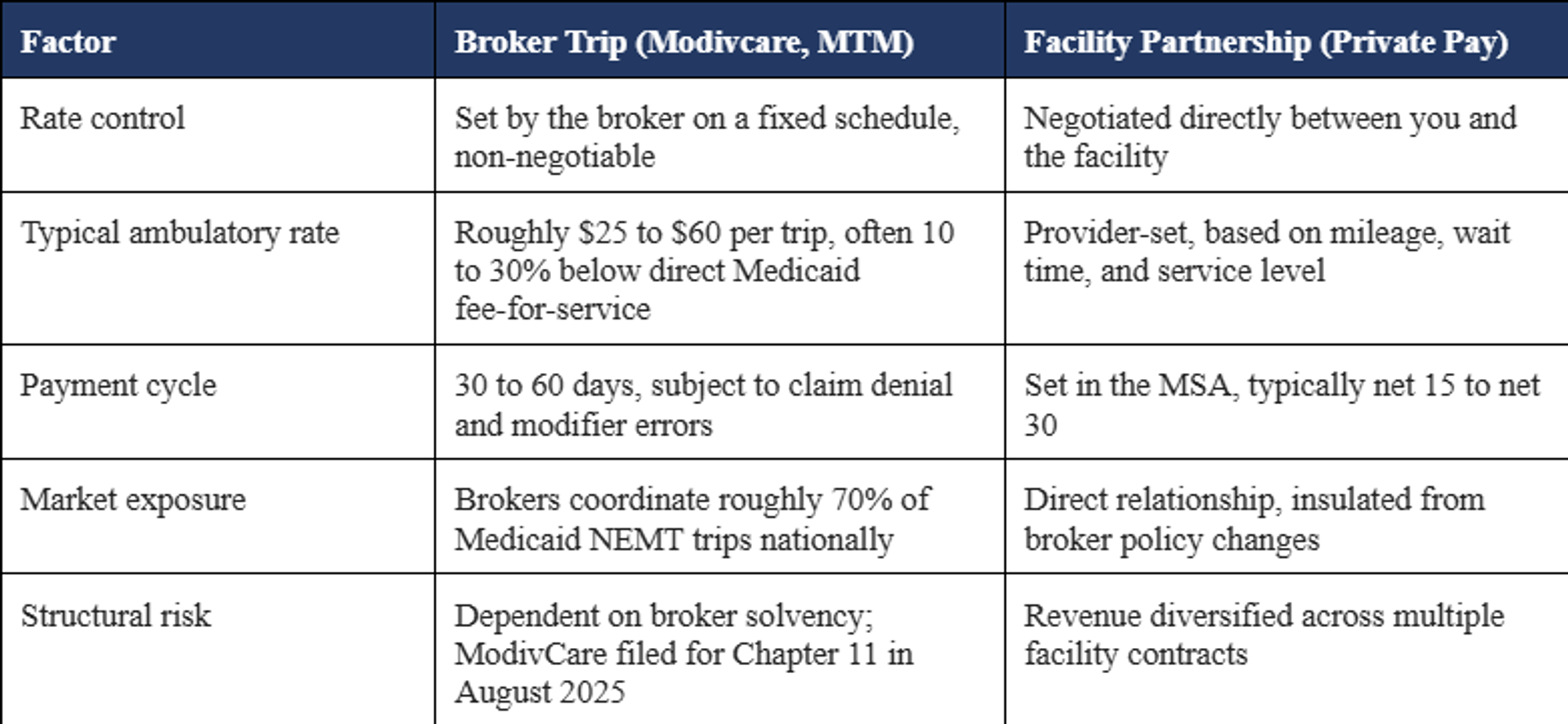
Broker dispatch trades rate control for volume. Facility partnerships trade a longer sales cycle for rate control and recurring volume.
Ready to streamline your transportation workflow?
Discover how an all-in-one NEMT solution can automate scheduling, plan routes and simplify billing so you can focus on delivering exceptional care.
Three Channels for NEMT Client Acquisition in 2026
1. Local SEO and Digital Visibility
Google Business Profile (GBP) is the single highest-leverage free asset for winning local map-pack visibility on searches like “wheelchair transport near me” or “non-emergency medical transportation [city].” Facility coordinators and family members researching transport options both search this way, and the map pack sits above organic results on mobile, where most of this search volume happens.
- Complete every GBP field: service area, vehicle types (ambulatory, wheelchair, stretcher), hours, and a direct phone line.
- Add geo-tagged photos of your vehicles and drivers to build trust signals that convert profile views into calls.
- Collect and respond to reviews consistently. Review volume and recency both factor into local ranking.
- Publish service-area pages for each city or county you cover, with content specific to that area rather than duplicated boilerplate.
This channel has no acquisition cost beyond time, which makes it the correct starting point for a founder with no paid advertising budget.
2. B2B Facility Outreach
Hospital discharge planners, dialysis clinic social workers, and senior living coordinators make transport decisions on behalf of patients every day. They are not searching Google. They need a reliable, professional point of contact and a documented agreement before they will commit patient volume to a new provider.
- Build a one-page capabilities sheet covering vehicle types, coverage area, insurance limits, and response times.
- Request a short in-person or video meeting rather than a cold email; discharge planners respond to relationship-building, not mass outreach.
- Bring a draft Master Service Agreement (MSA) to the second meeting, covering rate, service levels, billing terms, and cancellation policy.
- Prioritise facilities with recurring transport needs, dialysis centres, skilled nursing facilities, and hospital discharge units, over facilities with occasional one-off requests.
An MSA converts a single relationship into a repeatable revenue stream, because the terms are agreed once and trips flow automatically afterwards.
3. Referral Marketing
Existing patients and their families are an underused acquisition channel. A patient who has a reliable, respectful experience with your drivers is a credible source for other patients at the same facility or in the same family network.
- Ask for a referral directly at the point of drop-off, when the service experience is freshest.
- Offer a simple, compliant referral mechanism, such as a business card with a direct booking number, rather than a formal incentive programme that may raise compliance questions under state Medicaid rules.
- Track referral sources so you know which patients and facilities are generating the most repeat business, and prioritise service quality there.
Referral marketing has the lowest CAC of the three channels because it costs nothing beyond consistent service delivery, but it scales slowly and works best as a complement to the other two channels rather than a primary growth engine.
Frequently Asked Questions
How long does it take to secure a facility contract as a new NEMT provider?
Most facility partnerships take four to eight weeks from first outreach to a signed MSA. Hospital systems and larger skilled nursing groups often take longer due to internal procurement and compliance review. Smaller dialysis clinics and independent senior living facilities typically move faster, sometimes closing within two to three weeks if you can demonstrate insurance coverage and vehicle capacity upfront.
What is a Master Service Agreement (MSA) and why does it matter for NEMT growth?
An MSA is a written contract between your NEMT business and a facility that sets the rate, service levels, billing terms, and cancellation policy for all future trips, rather than negotiating each trip individually. It matters because it converts a single sales conversation into recurring, predictable volume, and it gives the facility a documented basis for choosing you over a broker-assigned provider.
How much does it cost to acquire a private pay NEMT client compared to a broker trip?
A broker trip has close to zero acquisition cost because it is assigned automatically once you are credentialed, but the rate is fixed and typically capped well below what direct facility billing allows. A private pay or facility client costs more to acquire, mainly in outreach time and the sales cycle to close an MSA, but the resulting relationship generates recurring volume at a negotiated rate rather than a broker-set one, which raises lifetime value per relationship substantially.
Do private pay NEMT clients require different insurance or licensing?
Generally no. The insurance and state licensing requirements that apply to Medicaid broker trips also apply to private pay and facility-billed trips. What changes is the billing relationship: you invoice the facility or the patient directly under the terms of your MSA, rather than submitting a claim through a broker portal. Confirm your state's specific commercial transport requirements before signing your first facility contract.
How can NEMT Platform assist in finding and retaining private pay NEMT clients?
NEMT Platform supports private pay client acquisition and retention in three specific ways. It provides a passenger booking app that lets private pay patients and facility coordinators book and pay for trips directly, which secures the lead without routing it through a broker. It gives facility case managers real-time trip tracking, which builds the operational trust that keeps a facility renewing its MSA rather than shopping for another provider. It also delivers automated data analytics on driver performance and on-time rates, which gives you documented proof of contract fulfilment when a facility reviews the relationship at renewal.
Related Articles
Medi-Cal NEMT vs Uber/Lyft: California CalHHS Policy Guide
Medi-Cal pays for Uber and Lyft rides under the NMT benefit for ambulatory members, but wheelchair and gurney patients require a certified NEMT provider.
NEMT Billing Explained: From Trip to Paid Claim (2026)
How NEMT billing really works in 2026: the claim lifecycle, why claims get denied, EVV and compliance, and how the right billing software gets you paid faster.
Executive Guide to NEMT: Margin, Risk & Technology
For NEMT leadership: why margins are compressing, the three exposures the C-suite owns, and how technology decisions protect the P&L at enterprise scale.
Starting an NEMT Business in 2026: Where the Real Profit Comes From
NEMT operators in 2026 can reach 20-35% margins via hospital discharge contracts, stretcher and bariatric transport, long-distance trips, and private concierge accounts beyond standard broker rides.