


Table of contents▼
The Complete Guide to Starting an NEMT Business in Louisiana (2026 Edition)
Louisiana's Non-Emergency Medical Transportation market runs on one rule above all others: know your broker before you buy your first van. The state delivers Medicaid NEMT through a managed care model called Healthy Louisiana, and every trip you complete gets authorised, dispatched and paid through one of two transportation brokers, not through the state directly. Get the broker relationship wrong and the best-equipped fleet in Louisiana will still sit idle.
This guide covers the full path to operating a compliant, profitable NEMT business in Louisiana in 2026. It walks through the broker structure, the five managed care organisations that fund the trips, the enrolment and credentialing process through the Louisiana Department of Health, and the billing rules that decide whether your claims get paid or denied.
Understanding the Louisiana NEMT Ecosystem
The Louisiana Department of Health (LDH) administers Medicaid NEMT through its Medical Transportation Program, covering members across all 64 parishes. Like most large Medicaid states, Louisiana does not pay providers directly. It splits the Medicaid population into two groups and routes each through a separate broker.
Healthy Louisiana managed care members make up the large majority of the state's Medicaid population. Each of the five managed care organisations carves NEMT into its benefit package and contracts with a transportation broker to handle authorisation, dispatch and claims on its behalf.
Legacy Medicaid, also called fee-for-service Medicaid, covers the smaller population not enrolled in an MCO. LDH manages this group directly through a single statewide broker.
For a provider, this means your application target depends entirely on which population you intend to serve. You credential with the broker, not the state, and trip volume follows from that relationship.
Ready to streamline your transportation workflow?
Discover how an all-in-one NEMT solution can automate scheduling, plan routes and simplify billing so you can focus on delivering exceptional care.
The Major NEMT Brokers Operating in Louisiana
As of 2026, two brokers control essentially all Medicaid NEMT trip volume in the state.
1. MediTrans
MediTrans holds the broker contract for all five Healthy Louisiana managed care organisations: Aetna Better Health of Louisiana, AmeriHealth Caritas Louisiana, Healthy Blue, Humana Healthy Horizons and Louisiana Healthcare Connections. That single-broker structure is unusual among large Medicaid states. Texas and Florida, by comparison, split their managed care populations across two or three competing brokers. In Louisiana, one credentialing file effectively unlocks access to the entire managed care population, provided MediTrans has capacity in your parish.
MediTrans runs onboarding through a Letter of Intent submitted to its provider relations team, followed by background checks, insurance verification and document upload through its provider portal. Approved applicants typically move from Letter of Intent to active status within two to four weeks. Acceptance is not automatic: MediTrans manages network size against regional demand, so a parish with an already-saturated provider network may see slower or declined applications regardless of fleet quality.
MediTrans requires commercial auto liability of at least one million dollars, general liability cover, and workers' compensation insurance or an approved waiver, with MediTrans listed as certificate holder on every policy.
2. Verida
Verida operates as the statewide broker for Legacy Medicaid, the fee-for-service population not enrolled in a managed care plan. Providers apply through a Request for Qualifications process through Verida's Louisiana provider programme. Verida reviews each submission against regional need before issuing an interview invitation, which means it actively manages network size rather than accepting every applicant.
Because the Legacy Medicaid population is smaller than the combined Healthy Louisiana base, most fleet operators credential with MediTrans first and add Verida later, once they have spare capacity or want to diversify beyond a single broker relationship.
Understanding the MCO Landscape in Louisiana
Because all five Healthy Louisiana plans route through the same broker, the MCO layer matters less for broker selection in Louisiana than it does in states such as Texas, where different plans use different brokers. It still matters for understanding where your referrals and trip authorisations originate. The five Healthy Louisiana managed care organisations are:
- Aetna Better Health of Louisiana
- AmeriHealth Caritas Louisiana
- Healthy Blue
- Humana Healthy Horizons
- Louisiana Healthcare Connections
LDH ended its sixth MCO contract, with UnitedHealthcare Community Plan, on 31 December 2025, and reassigned those members to the five remaining plans from 1 January 2026. LDH extended the remaining five MCO contracts through 31 December 2026, so providers can expect the current five-plan, single-broker structure to hold for the rest of the year.

Step-by-Step Provider Requirements and Enrolment
Louisiana runs credentialing on two parallel tracks: state Medicaid enrollment and broker credentialing. You need both before you can bill a single trip.
Step 1: Baseline Business Infrastructure
Register your business entity with the Louisiana Secretary of State, obtain an EIN, and open a commercial bank account set up for electronic funds transfer. Secure a Type 2 NPI for your company. Vehicles used for ambulatory trips must carry Hire Taxi plates and vans must carry Hire Bus plates, issued through the Office of Motor Vehicles. Stretcher vans, two-door vehicles and pickup trucks are excluded from the programme entirely, regardless of broker.
Step 2: Commercial Insurance Procurement
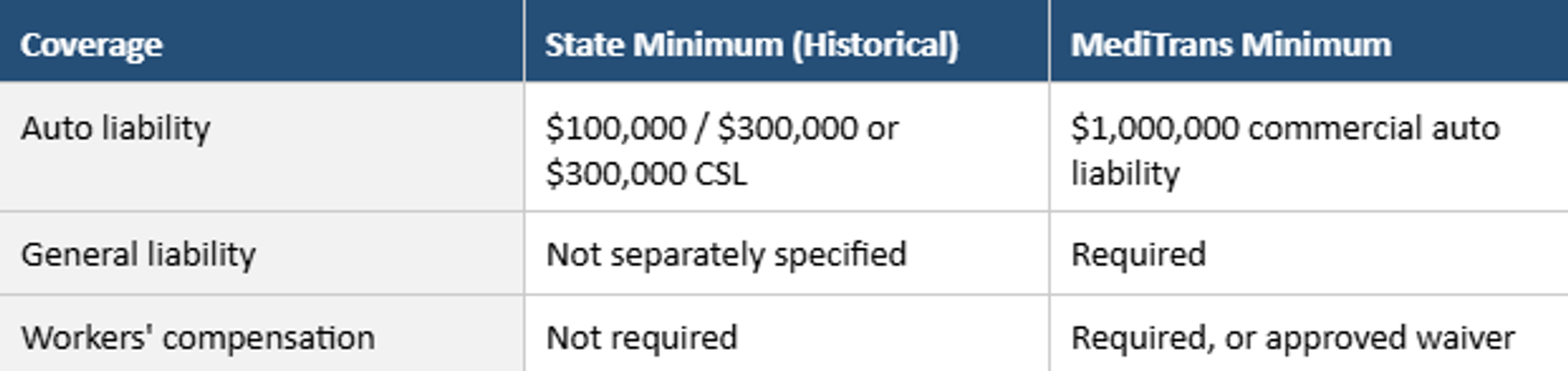
State minimum coverage for NEMT vehicles sits well below what any working broker will accept, so do not size your policy to the state floor. Historical Medicaid provider manuals have cited state minimums as low as one hundred thousand dollars per person and three hundred thousand dollars per accident, or a three hundred thousand dollar combined single limit. Verify the current figure directly with LDH before binding a policy, since these minimums are revised periodically.
Brokers set their own, higher floor. MediTrans requires a minimum of one million dollars in commercial auto liability, plus general liability and workers' compensation or an approved waiver, with MediTrans named as certificate holder. Build your insurance budget around the broker minimum, not the state minimum, or you will need to rebroke your policy the moment you apply for credentialing.
Step 3: Enrollment via the Louisiana Medicaid Provider Enrolment Portal
Louisiana Medicaid enrollment runs through the state's fiscal intermediary, Gainwell Technologies, via the Provider Enrolment Portal at lamedicaid.com. You will need your NPI, business address details and a completed provider enrolment packet. Processing happens centrally rather than through individual MCOs, so a single state enrollment underpins every broker relationship you build afterwards.
Step 4: Broker Credentialing and Network Integration
With your state Medicaid provider number confirmed, submit your Letter of Intent or Request for Qualifications to MediTrans, Verida, or both. Expect to provide:
- Certificates of insurance naming the broker as additional insured
- Driver files, including valid licences, clean motor vehicle records, and an annual criminal history check run through the Louisiana State Police, an authorised agency, or the FBI
- Vehicle registration, current inspection records, and proof of correct plate type
- Completed HIPAA, ADA and defensive driving training for every driver
MediTrans typically completes credentialing within two to four weeks of a Letter of Intent. Combined with state enrolment timelines, providers should plan for roughly 60 to 120 days from a standing start to an active, billable fleet.
Ready to streamline your transportation workflow?
Discover how an all-in-one NEMT solution can automate scheduling, plan routes and simplify billing so you can focus on delivering exceptional care.
NEMT Billing, Rates and Timely Filing in Louisiana
Louisiana pays providers on a base fee plus loaded mileage model: a flat per-trip rate plus a per-mile charge for miles driven with the patient on board. Deadhead miles, the empty miles driven to reach a pickup, are not separately reimbursed, so route density affects your margin more directly than your headline mileage rate.
Brokers may negotiate rates above the state's published Medicaid fee schedule but not below it. That gives operators in high-demand parishes, such as Orleans, Jefferson and East Baton Rouge, some room to negotiate, while rural parishes tend to sit closer to the published floor.
Louisiana Medicaid's general timely filing limit runs to 12 months from the date of service, longer than aggressive states such as Texas, at 95 days, or New York, at 90 days. That headline window is generous, but do not treat it as your operating standard. MediTrans and Verida set their own contractual claims-submission deadlines inside their provider agreements, and those are typically far shorter than the state ceiling. Confirm the exact window in your signed provider agreement rather than assuming the state limit applies to your broker relationship.
Operators serving coastal and rural parishes should also build hurricane-season contingency into their billing calendar. Louisiana Medicaid has a history of extending filing deadlines for declared disaster periods, which is a meaningful operational advantage if a storm disrupts claims submission. It is not automatic, though, and providers still need to document the disruption to qualify.
Q&A: Navigating Louisiana NEMT
Do I bill the State of Louisiana directly for NEMT trips?
No. You bill whichever broker authorised the trip: MediTrans for Healthy Louisiana managed care members, or Verida for Legacy Medicaid fee-for-service members. The broker is your direct payer relationship. LDH sets the rules but does not process individual trip claims.
How long does Louisiana NEMT credentialing take?
Plan for 60 to 120 days from a standing start. State Medicaid enrollment through lamedicaid.com runs in parallel with broker credentialing, and MediTrans typically completes its own review within two to four weeks once your Letter of Intent and documentation are submitted.
Can I serve Louisiana Medicaid members with state-minimum insurance?
No. Historical state minimums sit well under one million dollars, but MediTrans requires at least one million dollars in commercial auto liability before it will credential your fleet. Budget for the broker requirement, not the state floor.
What is the timely filing limit for Louisiana NEMT claims?
Louisiana Medicaid's general limit is 12 months from the date of service. Your broker contract may set a shorter deadline, so check your signed provider agreement with MediTrans or Verida rather than relying on the state limit alone.
How can NEMT Platform help me run a Louisiana NEMT business?
NEMT Platform gives Louisiana operators one system for dispatch, route planning, billing and broker-ready trip documentation, instead of stitching together spreadsheets and separate compliance trackers. AI-assisted routing and automated mileage logging support the loaded-mile billing model Louisiana brokers use, while centralised driver and vehicle records keep your MediTrans and Verida credentialing files audit-ready. That combination lets a growing fleet add vehicles and parishes without adding back-office headcount for every new contract.
Quick Summary
This guide breaks down the Non-Emergency Medical Transportation broker structure in Louisiana for 2026, covering the state's two-broker model of MediTrans and Verida, the five Healthy Louisiana managed care organisations, provider enrolment through the Louisiana Medicaid Provider Enrollment Portal, and the billing and timely filing rules that govern claims.
Who This Blog Post Is For
This guide is for current NEMT fleet owners, aspiring operators and dispatch managers planning to enter or expand within the Louisiana market and credential with MediTrans, Verida, or both.
Disclaimer
The information in this guide is for general informational and educational purposes only and does not constitute legal, financial or professional business advice. NEMT regulations, broker requirements, Medicaid policy and insurance minimums in Louisiana change frequently. Providers should independently verify all credentialing requirements directly with the Louisiana Department of Health, the Louisiana Medicaid Provider Enrolment Portal, and their respective brokers before making operational or financial decisions.
Related Articles
Starting an NEMT Business in 2026: Where the Real Profit Comes From
NEMT operators in 2026 can reach 20-35% margins via hospital discharge contracts, stretcher and bariatric transport, long-distance trips, and private concierge accounts beyond standard broker rides.
NEMT Brokers in California
California is the largest Medi-Cal market in the country, with more than 14 million enrollees and a county-based managed care model that routes all NEMT trips through contracted transportation brokers, not the state directly. To run a compliant NEMT business in California, you need a CPUC Charter-Party Carrier (TCP) permit, Medi-Cal enrolment through the DHCS PAVE portal, and credentialing with the brokers serving your target counties, primarily ModivCare, MTM and SafeRide Health. Our 2026 guide covers California-specific insurance requirements under CPUC General Order 115, the Physician Certification Statement (PCS) compliance framework, the 180-day Medi-Cal FFS timely filing limit, and how to build a multi-county operation across California's fragmented broker landscape.
How to Market Your NEMT Business Effectively
Discover proven NEMT marketing strategies for 2026, from local SEO to facility contracts, that help providers win high-value institutional healthcare business.
How to Find Clients for Your NEMT Business: The 2026 Growth Playbook
Learn how NEMT providers secure private pay contracts in 2026 through local SEO, facility partnerships, and referrals, bypassing low-margin Medicaid brokers.