Medi-Cal NEMT vs Uber/Lyft: California CalHHS Policy Guide
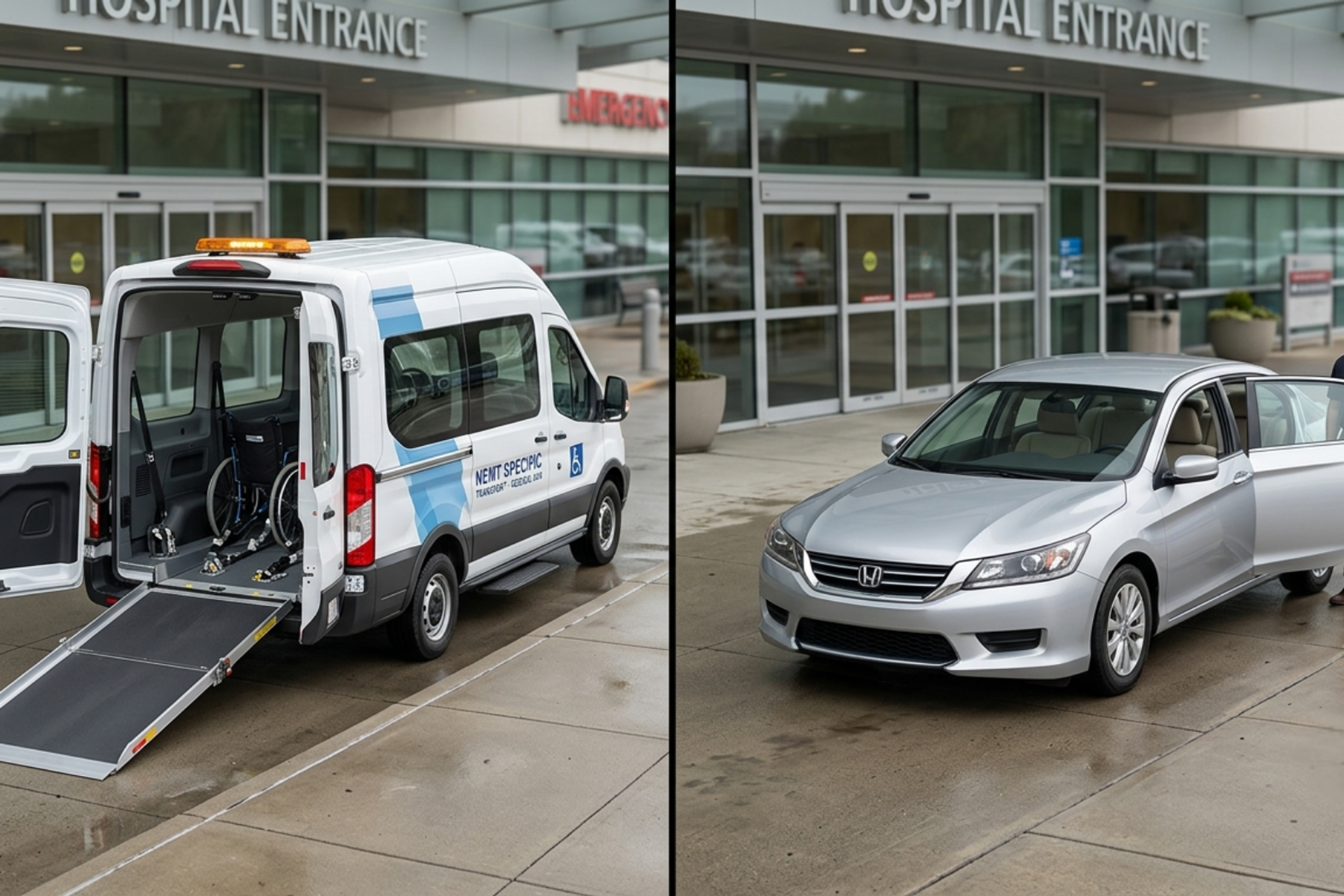
Medi-Cal pays for Uber and Lyft rides under the NMT benefit for ambulatory members, but wheelchair and gurney patients require a certified NEMT provider.
Read more

This guide is written for three specific audiences. First, healthcare facility coordinators and discharge planners responsible for arranging NEMT rides for patients who cannot use standard transport. Second, medical case managers at health plans, MCOs, and managed Medicaid programmes evaluating whether rideshare platforms can substitute for contracted NEMT operators. Third, NEMT fleet operators and dispatch managers analysing where NEMT Uber partnerships, Lyft Healthcare contracts, and traditional broker networks each fit within a competitive local and regional market.
Direct answer: Specialised NEMT, Uber Health, and Lyft Healthcare serve different patient populations, carry different compliance requirements, and bill through different funding channels. They are not interchangeable.
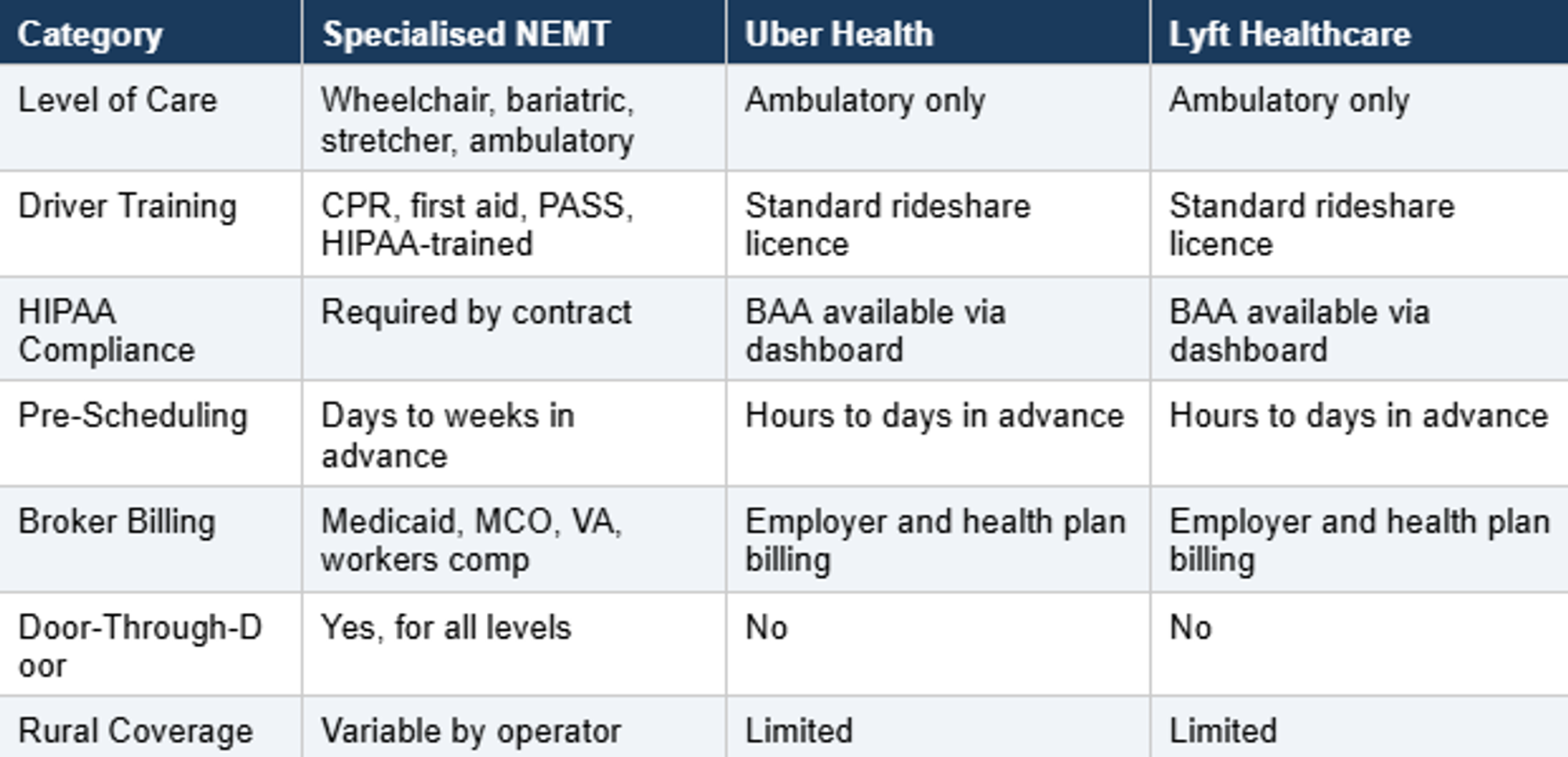
Specialised NEMT covers the full range of transport levels: wheelchair-accessible vehicles, bariatric transport, stretcher transport, and ambulatory. Drivers hold certifications including CPR, first aid, and Passenger Assistance Safety and Sensitivity (PASS). Trips bill through Medicaid, MCOs, Veterans Affairs, or workers compensation programmes. The care model is door-through-door: the driver enters the facility, assists the patient, and remains responsible until the patient is inside the destination.
Uber Health is a business-to-business platform that allows healthcare coordinators to book standard rideshare trips on behalf of patients. It is ambulatory only. Drivers are standard Uber drivers; there is no medical or HIPAA-specific credentialing beyond the Business Associate Agreement (BAA) available through the Uber Health dashboard. Uber Health works for low-acuity patients who can walk, manage their own belongings, and do not require assistance beyond the vehicle ride itself.
Lyft Healthcare operates on the same model as Uber Health with comparable limitations. The platform offers a coordinator dashboard, bulk trip scheduling, and BAA capability for HIPAA coverage. It serves ambulatory patients and is used primarily by health systems, insurers, and non-clinical transport coordinators managing low-acuity ride volumes. Neither Lyft nor Uber can legally or operationally service patients who require wheelchair securement, bariatric vehicles, or hands-on driver assistance during transit.
The clinical population that requires NEMT rides is not a single category. Medicaid non-emergency transport covers at least four distinct service levels, and most state programmes define them separately in their transport broker contracts.
A patient using a power wheelchair weighing 350 lbs requires a vehicle with a certified lift or ramp, an ADA-compliant interior, and a driver trained in four-point tie-down securement. No standard NEMT Uber or Lyft vehicle carries this equipment. Deploying a rideshare vehicle for a wheelchair-dependent patient is not a cost-saving decision; it is a patient safety failure and a contract compliance violation in most Medicaid transport agreements.
Bariatric patients require reinforced vehicle interiors, wider entry points, and drivers trained in safe patient handling. Standard vehicles have weight limits between 250 lbs and 300 lbs for occupant safety. Specialised bariatric NEMT vehicles are built or upfitted specifically for this population. Rideshare platforms offer no bariatric capability.
Ambulatory patients who are mobile, independent, and carrying no medical equipment represent the overlap zone. For this population, Uber Health and Lyft Healthcare are legitimate and often cost-effective tools. The scheduling capability, coordinator dashboard, and BAA compliance make both platforms useful for health systems managing high volumes of low-acuity trips. Many NEMT operators also serve ambulatory patients through broker networks; the difference is billing channel and oversight structure, not vehicle type.
Discover how an all-in-one NEMT solution can automate scheduling, plan routes and simplify billing so you can focus on delivering exceptional care.
Compliance requirements separate specialised NEMT from rideshare-based health transport more than any other factor.
A credentialed NEMT driver typically holds current CPR and first aid certification, PASS training, a clean criminal background check, and in many states a chauffeur or medical transport licence. Some state Medicaid programmes require additional certifications for specific patient populations, including dementia care awareness training for memory care facility transport. These requirements are set by broker contracts, state Medicaid rules, and in some cases accreditation bodies such as the Commission on Accreditation of Medical Transport Systems (CAMTS).
Drivers employed by operators using NEMT Platform are tracked inside the system. Certification expiry dates generate alerts before lapse, which prevents a credentialled driver from being assigned to a trip after their CPR certification has expired. This matters in broker audits, where a single uncertified driver on a completed trip can trigger a billing clawback.
Uber Health and Lyft Healthcare both offer BAAs, which provide legal HIPAA coverage for the protected health information transmitted through their coordinator dashboards. This covers the trip data, patient name, and pickup and drop-off addresses. It does not extend to any interaction between the driver and the patient during the trip, because drivers are not HIPAA-trained contractors. Specialised NEMT operators train drivers on HIPAA obligations as a condition of employment and typically sign BAAs directly with the broker or health plan as part of the credentialing process.
Commercial medical transport insurance is a separate product from standard rideshare insurance. NEMT operators carry commercial auto, general liability, and in many states a medical liability endorsement. Rideshare drivers carry personal auto policies augmented by platform-level coverage during active trips. For health systems evaluating liability exposure when arranging patient transport, the insurance framework of specialised NEMT is meaningfully different from rideshare.
Pre-scheduling is a structural requirement in NEMT, not a convenience feature. A dialysis patient needs transport three times per week at consistent times. A chemotherapy patient books trips weeks in advance around treatment calendars. A discharge transport may be same-day but requires confirmation before the patient leaves the bed.
Specialised NEMT operators work from pre-scheduled manifests. Dispatch is built around known trip volumes, vehicle availability, and driver assignments. When managed through a platform like NEMT Platform, the dispatcher sees all trips across all vehicles on a single screen, with real-time GPS tracking, estimated arrival times, and automated status updates to facilities and patients.
Uber Health and Lyft Healthcare allow advance booking through their coordinator dashboards, typically hours to one or two days ahead. Both platforms depend on driver availability in the area at the time of the trip. In lower-density markets, driver availability cannot be guaranteed at the precision that medical transport requires. A dialysis patient with a 3:00 AM pickup in a rural county is not a viable Uber Health trip; it is a specialised NEMT ride that requires a pre-assigned driver and a confirmed vehicle.
When a patient or coordinator searches for NEMT near me, the results reflect what is available in their specific geography. Urban markets have both options. Rural and semi-rural markets often have only one.
Uber Health and Lyft Healthcare coverage follows the standard rideshare driver pool. In markets with active rideshare supply, both platforms function adequately for ambulatory trips. In rural counties, tribal areas, and low-density suburban zones, driver supply is thin, wait times are unpredictable, and advance booking reliability drops.
Specialised NEMT operators serving rural markets exist specifically to fill this gap. They contract with state Medicaid brokers to provide coverage in areas where no other transport option is available. These are often small, owner-operated fleets of two to eight vehicles serving a defined county or service zone. For patients in these areas, the question of NEMT Uber versus local NEMT is not a real comparison; rideshare is not available at the required time or with the required equipment.
For NEMT operators building local search visibility, NEMT near me is a high-intent search term. Patients and caregivers use it when they need transport fast. Operators who appear in local search results, Google Business profiles, and broker directories capture this demand; operators who do not, lose it to platform referrals or broker reassignment.
The practical decision framework is simpler than the competitive framing suggests.
Use specialised NEMT for any patient requiring wheelchair securement, bariatric transport, stretcher transport, door-through-door assistance, or trips that bill through Medicaid, MCO, VA, or workers compensation. Use it for pre-scheduled recurring trips in any geography. Use it whenever the driver's credential status is contractually auditable.
Use Uber Health or Lyft Healthcare for ambulatory patients with reliable mobility, in markets with strong rideshare driver supply, for trips that bill through employer health plans or direct-pay channels, and for low-acuity discharge transport where the patient requires a ride but not assistance.
Use both where the patient population spans acuity levels. A health system with a large ambulatory case volume can run Lyft Healthcare for low-acuity trips while maintaining contracted NEMT operators for wheelchair-dependent and bariatric patients. The two models are not competitors in a properly organised transport programme; they cover different patient segments.
Discover how an all-in-one NEMT solution can automate scheduling, plan routes and simplify billing so you can focus on delivering exceptional care.
No, for any patient population requiring wheelchair transport, bariatric vehicles, stretcher transport, or door-through-door care. Rideshare platforms are not equipped, credentialled, or insured for these trip types. For ambulatory-only programmes in well-served urban markets, Uber Health and Lyft Healthcare can reduce trip costs and coordinator workload for low-acuity volume.
Yes. Non-emergency medical transportation is a federally mandated Medicaid benefit under 42 CFR 440.170. Coverage specifics, including vehicle types, advance notice requirements, and approved transport networks, vary by state. Most states administer the benefit through a transportation broker who manages the contracted NEMT operator network. Neither Uber Health nor Lyft Healthcare is enrolled as a Medicaid NEMT provider in most states; they operate on separate commercial billing channels.
For NEMT operators, NEMT near me is a high-volume local search query representing patients and caregivers actively looking for transport. Operators who invest in local SEO, Google Business optimisation, and broker directory listings capture this search traffic and convert it to trip volume. Operators who do not invest in local visibility rely entirely on broker dispatch assignment, which limits their ability to grow direct business.
No. The BAA in both programmes covers the platform coordinator dashboard and the data transmitted through it. Individual drivers are not parties to the agreement and are not HIPAA-trained contractors. This distinction matters when a health system is evaluating its HIPAA exposure for the full transport interaction, not just the scheduling record.
NEMT Platform gives local and regional NEMT operators the operational infrastructure to compete on service quality where rideshare cannot follow. The OVERSIGHT module provides real-time GPS tracking across the entire active fleet, so facility coordinators and patients receive the same live arrival visibility they expect from a consumer rideshare app. Dispatch reliability is managed through a single-screen system where the dispatcher sees all vehicles, all trips, and all driver status updates simultaneously, with no information spread across multiple tools or manually tracked on paper.
For broker billing, NEMT Platform handles multiple broker contracts inside one system. Direct API broker integrations and CSV-based billing workflows run alongside each other without manual reconciliation. This matters when an operator serves both Medicaid broker contracts and direct health plan agreements simultaneously.
For high-acuity trips that rideshare cannot accept, including bariatric transport, multi-stop dialysis runs, and wheelchair securement trips, NEMT Platform tracks driver credentials, vehicle certifications, and equipment assignments to ensure the right vehicle and the right driver are dispatched to every trip. This is the capability gap that Uber Health and Lyft Healthcare do not address and cannot address within their current service model.
Medi-Cal pays for Uber and Lyft rides under the NMT benefit for ambulatory members, but wheelchair and gurney patients require a certified NEMT provider.
How NEMT billing really works in 2026: the claim lifecycle, why claims get denied, EVV and compliance, and how the right billing software gets you paid faster.
For NEMT leadership: why margins are compressing, the three exposures the C-suite owns, and how technology decisions protect the P&L at enterprise scale.
NEMT operators in 2026 can reach 20-35% margins via hospital discharge contracts, stretcher and bariatric transport, long-distance trips, and private concierge accounts beyond standard broker rides.
See NEMT Platform in Action
Get a free, personalized walkthrough of dispatch, billing & scheduling built for NEMT providers.