Who This Blog Post Is For
This comprehensive guide is written for Texas NEMT operators, startup founders, and fleet managers who need to navigate the state's complex web of Medicaid enrollment, broker credentialing, driver certification, and vehicle requirements in 2026. If you are launching or expanding an NEMT operation in Texas and want to ensure full compliance with state regulations, MCO contracts, and broker standards, this post will walk you through every critical requirement.
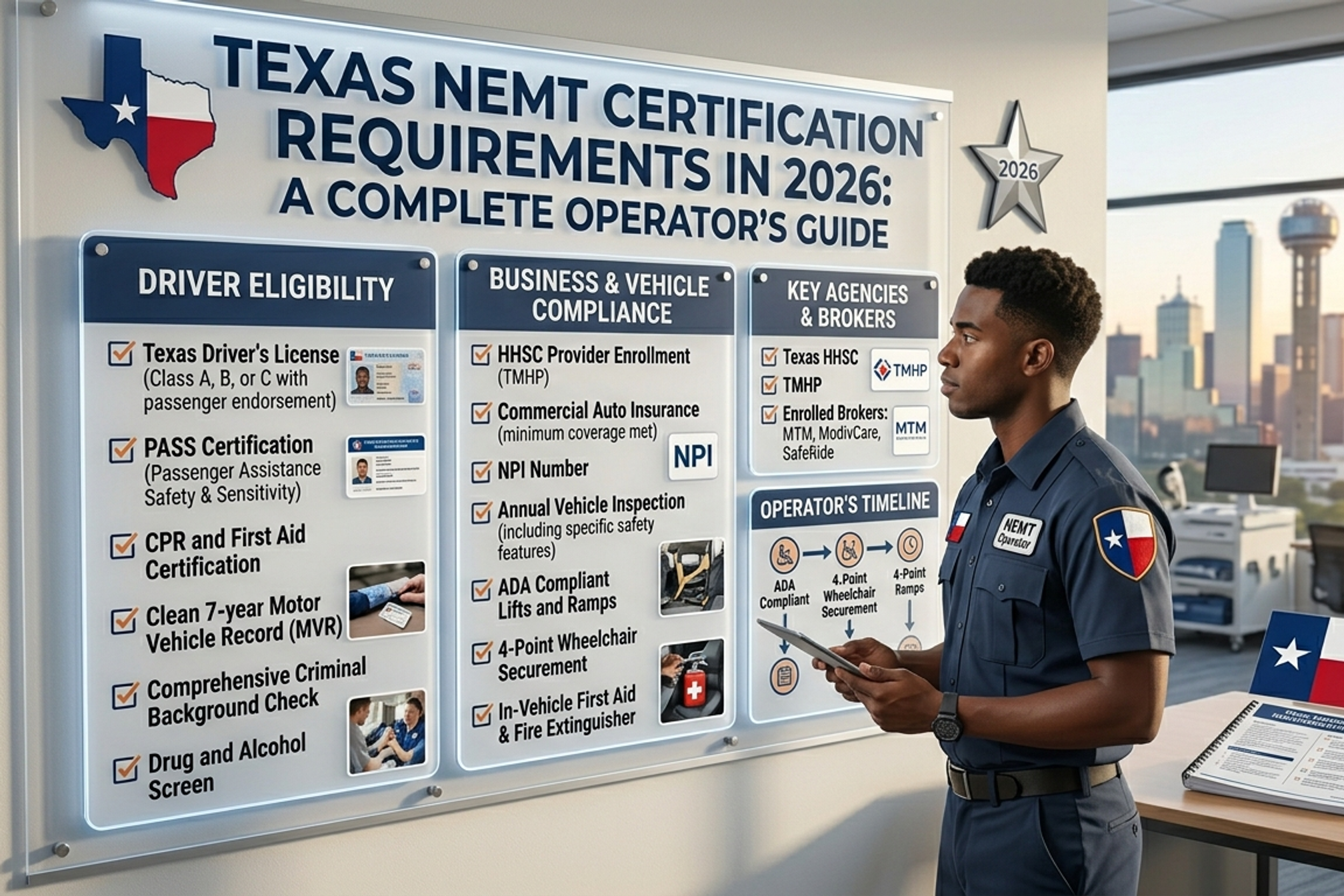
- Texas does not issue a standalone "NEMT license." To operate Medicaid NEMT in Texas in 2026, providers must (1) enroll with Texas Medicaid through TMHP's Provider Enrollment and Management System (PEMS) under 1 TAC Chapter 352 and Chapter 380, (2) contract with the dominant Medicaid managed care brokers — ModivCare, MTM, and SafeRide Health — and/or with the HHSC-contracted Managed Transportation Organizations such as Project Amistad (Region 2), and (3) meet the driver and vehicle standards codified at 1 TAC §§380.501–380.502, plus broker-specific credentialing (PASS or NEMTAC CTS, CPR/First Aid, HIPAA, defensive driving, OIG monthly checks, MVR, criminal background, drug screen).
- PASS (CTAA) and CTS (NEMTAC) are not mandated by Texas HHSC rule, but they are de facto required because ModivCare, MTM, and SafeRide — the three brokers that control essentially all Texas Medicaid managed-care NEMT volume — list them (especially PASS-Wheelchair / NEMTAC MDS for WAV drivers and CTS for general drivers) in their provider manuals. CPR/First Aid is a broker requirement, not a state-rule requirement.
- The biggest 2025–2026 changes: effective January 1, 2026, SafeRide Health became the NEMT vendor for UnitedHealthcare Community Plan of Texas (joining its existing Texas Children's Health Plan and Superior HealthPlan STAR+PLUS contracts); ModivCare emerged from Chapter 11 bankruptcy on December 29, 2025 after eliminating $1.1 billion in funded debt; the CY 2026 CMS Medicaid provider application fee is $750 (up from $730 in CY 2025); Texas drivers' license renewals must be REAL ID-compliant (May 7, 2025); and Texas DPS eliminated annual safety inspections for non-commercial vehicles (effective January 1, 2025), although for-hire NEMT vehicles continue to require commercial inspection.
Key Findings
Two regulatory tracks. Texas Medicaid NEMT is governed by 1 TAC Chapter 380 (HHSC's Medical Transportation Program rules) for the MTP — which serves fee-for-service Medicaid, CSHCN, and TICP clients — and by the Uniform Managed Care Contract and UMCM 16.4 NEMT Services Handbook for STAR, STAR+PLUS, STAR Kids, and STAR Health managed care members.
No HHSC-issued "NEMT license." Texas requires enrollment, not licensure. Providers enroll via TMHP's PEMS as a Medical Transportation Program (MTP) provider type.
Brokers, not the state, are the gatekeepers. Three brokers — ModivCare, MTM, and SafeRide Health — control essentially the entire Texas Medicaid managed-care NEMT market. Each MCO routes NEMT through one of these three.
Driver minimums are contractual, not regulatory. 1 TAC §380.502 does not state a numeric minimum driver age. The widely cited "21 years old, 3-year clean MVR" Texas baseline is imposed through HHSC's contracts with MTOs/FRBs and through broker provider manuals, not the TAC itself.
Vehicle standards are codified. 1 TAC §380.501 mandates ADA compliance (36 CFR 1192), FMVSS (49 CFR 571), seat belts at each position, fire extinguisher, first aid kit, signage ("No Smoking, Eating or Drinking"; "All passengers must wear seat belts"; "Concealed Weapons Prohibited"), exterior identification in 6-inch letters, and working HVAC.
OIG exclusion checks are federally mandatory under Social Security Act §1128 / 42 CFR §455.436 and enforced by HHSC OIG. ModivCare and the other Texas brokers require monthly OIG LEIE checks plus SAM.gov verification.
Texas-specific add-on: Drivers must be cleared against the Texas Employee Misconduct Registry (EMR) for patient-facing healthcare workers — a check generic NEMT compliance guides routinely miss.
HIPAA training is required by every broker as a condition of network participation but is not separately mandated by Texas HHSC rule; it derives from the federal HIPAA Privacy Rule applied to Medicaid trip data and from the broker's Business Associate Agreement.
Ready to streamline your transportation workflow?
Discover how an all-in-one NEMT solution can automate scheduling, plan routes and simplify billing so you can focus on delivering exceptional care.
Details
1. HHSC / TMHP Medicaid enrollment (PEMS)
All NEMT providers wishing to be reimbursed by Texas Medicaid — directly through the MTP fee-for-service program or as a subcontractor to an MTO/FRB/MCO broker — must enroll in Texas Medicaid through the Texas Medicaid & Healthcare Partnership (TMHP) Provider Enrollment and Management System (PEMS). The legal basis is 1 TAC Part 15, Chapter 352 and Chapter 380.
Required documents and steps for MTP enrollment:
- Completed Medical Transportation Program Provider Application (TMHP REV. XII, January 2021 version is still active for MTP) submitted through PEMS.
- National Provider Identifier (NPI) — taxonomy 343900000X (Non-Emergency Medical Transport / Van).
- HHSC Medicaid Provider Agreement (signed by an authorized principal).
- Federal Employer Identification Number (EIN), Texas Secretary of State filing (LLC/Corp), Texas Comptroller franchise tax registration.
- ACA application fee — the CY 2024 fee was $709, CY 2025 was $730, and the CY 2026 fee is $750 per Federal Register notice 2025-21877 (Dec. 3, 2025): "The enrollment application fee for institutional providers for the 2026 calendar year has increased from $730 to $750." The fee is required with any enrollment application submitted on or after January 1, 2026, and on or before December 31, 2026.
- $50,000 surety bond per enrolled location on the State of Texas Medicaid Provider Surety Bond Form, continuous, 12-month term — required of provider types designated "moderate" or "high" risk under 42 CFR §455.450, which includes most NEMT operators.
- Proof of commercial auto liability insurance (minimum levels are set in HHSC contracts, not in the TAC; brokers commonly require $1M Combined Single Limit).
- Pre-enrollment site visit (required of unlicensed entities at moderate/high risk).
- Ownership and control disclosures per 42 CFR §455.104 (Owner/Creditor/Principal entries in PEMS).
- License/certification copies for any vehicles requiring them.
Timelines: TMHP indicates 30–60 days for clean enrollment applications; revalidation is required every 3 to 5 years depending on risk level. Following CMS's late 2024 enforcement push, HHSC has implemented revalidation flexibilities: dates were extended, and providers dis-enrolled for failing to revalidate between November 1, 2023 and December 12, 2024 can have their NPI enrollment back-dated up to 365 days (Phase 1, effective January 17, 2025). Claims reprocessing began February 2025, completing by June 30, 2025.
Important practical caveat: Enrollment in Texas Medicaid alone does not produce trip volume. Because HHSC delivers virtually all NEMT through managed care, the operator must separately credential with each MCO's NEMT broker (ModivCare, MTM, or SafeRide) to receive trip assignments.
2. Driver requirements — codified vs. contractual
1 TAC §380.502 (Standards for Motor Vehicle Operators) — verbatim summary. Adopted August 6, 2013; amended effective September 1, 2014. The MTO or regional contracted broker MUST:
- (1) Verify the driver has a valid driver's license.
- (2) Check the DPS driving record per Chapter 521, Subchapter C, Transportation Code, against the driving-history threshold in the HHSC contract.
- (3) Check DPS public criminal records and disqualify drivers who have:
- (A) Any DWI or driving-under-the-influence finding within 7 years before hire or after hire (7-year ineligibility from any post-hire conviction);
- (B) Felony or misdemeanor conviction within 7 years pre-hire or any time post-hire for: abuse/neglect/exploitation of children, elderly, or persons with disabilities (Tex. Family Code Ch. 261; Tex. Human Resources Code Ch. 48); offenses against the person, family, public order, public health/safety/morals, or property under the Texas Penal Code; offenses under Texas Health and Safety Code Ch. 481 (Controlled Substances Act); or any violation of Texas Human Resources Code Ch. 36 (Medicaid Fraud Prevention).
- (4) Provide annual training to all drivers on: passenger safety, passenger assistance, assistive devices including wheelchair lifts/tie-downs/child safety seats, non-discrimination/sensitivity/diversity, customer service, defensive driving (at least every 2 years), prohibited behavior (offensive language, tobacco/alcohol/drugs, sexual harassment), and any other training HHSC determines necessary.
Rule does NOT specify: a minimum driver age, MVR moving-violation count, drug-test requirement, CPR/First Aid, PASS, NEMTAC CTS, or HIPAA. Those are imposed contractually.
The contractual Texas baseline (HHSC + brokers, consistently applied):
- Minimum age 21; valid Texas driver's license held for at least 3 years; clean MVR within the past 3 years; no more than 1 moving violation in any rolling 12-month period (this 1-violation cap IS in §380.502(3)(B) effectively through contract).
- Pre-employment drug screen (5-panel); annual MVR re-check.
- DPS Texas Criminal History check + national criminal background check (7-year multi-state, with NSOPW sex offender registry verification).
- Employee Misconduct Registry (EMR) check through HHSC for patient-facing healthcare workers.
- DFPS Central Registry check is used as an additional screening tool for drivers transporting children or vulnerable adults (per HHSC guidance and the Texas Human Resources Code §40.005 framework).
3. PASS (CTAA) and CTS (NEMTAC) — are they required?
By HHSC rule: No. Neither PASS (Passenger Assistance Safety and Sensitivity, issued by the Community Transportation Association of America) nor CTS (Certified Transport Specialist, issued by NEMTAC) is named in 1 TAC Chapter 380 or in the HHSC Medical Transportation Program manual.
By the dominant Texas brokers: Effectively yes.
- ModivCare requires "PASS Wheelchair Certificate (hands-on wheelchair transport training), valid First Aid/CPR certification, defensive driving certificate, passing drug screening, clean motor vehicle report, and thorough background check" for drivers in its network. ModivCare also explicitly recognizes NEMTAC programs in its compliance training.
- MTM — which completed its acquisition of Access2Care from Global Medical Response on October 8, 2024, adding "1,900 transportation provider partners, 14,000 vehicles, and 1,400 employees" and expanding MTM to all 50 states — requires equivalent driver training and recognizes NEMTAC MDS / CSO for advanced WAV and stretcher endorsements.
- SafeRide Health requires "first aid (or CPR or AED) training, defensive driver trainings, wheelchair securement trainings" plus national background checks, national sex offender registry checks, MVR, and pre-hire drug screens.
- NEMTAC lists ModivCare, MTM, SafeRide, Alivi, Southeast Trans, Tennessee Carriers, and Transdev as brokers that recognize its programs nationally.
Bottom line for Texas operators: Plan for PASS or NEMTAC CTS plus the NEMTAC MDS (formerly AMDS) for any driver assigned WAV trips and NEMTAC CSO for stretcher drivers. PASS certification is valid for 3 years; NEMTAC CTS is valid for 2 years. These are not state requirements but they are de facto network entry tickets.
Ready to streamline your transportation workflow?
Discover how an all-in-one NEMT solution can automate scheduling, plan routes and simplify billing so you can focus on delivering exceptional care.
4. Vehicle certification and inspection
1 TAC §380.501 governs vehicles operated under Texas MTP. Each MTO/FRB must ensure all NEMT vehicles:
- Meet or exceed state and federal mechanical operating standards.
- Display transportation provider name and vehicle number in letters ≥6 inches.
- Have functioning seat belts at each seat position (stored off the floor when unused), working speedometer/odometer, interior lighting, side and interior mirrors, clean interior/exterior free of broken mirrors, excessive grime, rust, chipped paint, or major dents.
- Carry a secured, accessible fire extinguisher and a first aid kit (must include latex gloves, hazardous waste disposal bags, scrub brush, disinfectant, deodorizer).
- Have working HVAC.
- Display required signage: "No Smoking, Eating or Drinking"; "All passengers must wear seat belts"; "Concealed Weapons Prohibited."
- Comply with ADA Accessibility Guidelines for Transportation Vehicles (36 CFR 1192), FMVSS (49 CFR 571), and Tex. Transp. Code Ch. 547.
Texas DPS vehicle inspection: As of January 1, 2025, Texas eliminated the annual safety inspection for non-commercial passenger vehicles. Commercial vehicles — which includes for-hire NEMT vans operated for compensation — still require an annual safety inspection at a certified DPS inspection station per Tex. Transp. Code Ch. 548. Emissions tests continue in emissions counties.
TxDMV / TxDOT: NEMT operators are not required to obtain a Texas Department of Motor Vehicles "TCP-equivalent" permit (California's CPUC TCP permit has no Texas analog). However:
- For intrastate for-hire passenger operations using a vehicle with a GVWR ≤26,000 lbs and ≤15 passengers, no TxDMV motor carrier registration is required.
- Vehicles with GVWR >26,001 lbs or designed to seat ≥16 passengers (including driver) require a USDOT number and TxDMV motor carrier registration; CDL with passenger endorsement is also required.
- Interstate trips (e.g., Texas-Louisiana, Texas-New Mexico) require USDOT authority and FMCSA compliance regardless of vehicle size if the vehicle carries paying passengers.
- Industry guides reference a "TxDMV livery endorsement" for for-hire vehicles; this is the TxDMV motor carrier registration plus appropriate vehicle registration as a for-hire vehicle. There is no separate Texas county-level NEMT permit, though Houston, Dallas, and Austin maintain their own local vehicle-for-hire permit regimes for taxi and ground-transportation operators that some NEMT operators may technically come under depending on city ordinances.
5. Dominant brokers and what they require in Texas
The Texas Medicaid managed-care broker map for 2026:
- ModivCare — handles NEMT for Blue Cross and Blue Shield of Texas (BCBSTX) STAR and STAR Kids members; large general STAR+PLUS book of business. ModivCare's Texas mileage reimbursement rate for individual transportation participants increased to 72.5 cents per mile effective January 1, 2026, matching the IRS standard mileage rate.
- MTM — large STAR and STAR Kids volume across multiple MCOs; absorbed Access2Care (October 8, 2024) which had previously handled Molina, Community Health Choice, El Paso Health, and FirstCare.
- SafeRide Health — effective January 1, 2026, became the NEMT vendor for UnitedHealthcare Community Plan of Texas (STAR, STAR Kids, STAR+PLUS, CHIP, Dual SNP); previously held Superior HealthPlan STAR+PLUS (since June 1, 2021) and Texas Children's Health Plan.
- Project Amistad — the HHSC-contracted Managed Transportation Organization (MTO) for Region 2 (West Texas, 23 counties including El Paso, Midland, and Odessa) since September 1, 2014.
- Other MTOs serve other HHSC regions.
- Full Risk Brokers (FRBs) historically served Dallas/Fort Worth and Houston/Beaumont SDAs; MTM and ModivCare (formerly LogistiCare) have held these contracts.
Driver and operator credentialing common across all three brokers (Texas-specific):
- Operator: TMHP MTP enrollment (Provider ID), Texas Secretary of State business filing, current Certificate of Insurance naming the broker as additional insured, W-9, EFT/ACH setup, Texas Comptroller good-standing, and (for ModivCare and MTM) Sexual Abuse and Molestation (SAM) endorsement on the general liability policy.
- Driver Qualification File: valid Texas DL, 3-year clean MVR (annual re-pull), DPS Texas Criminal History + national criminal background check, NSOPW sex offender check, OIG LEIE check (monthly), SAM.gov check, Texas Employee Misconduct Registry, pre-employment 5-panel drug screen, PASS or NEMTAC CTS certificate, NEMTAC MDS (formerly AMDS) for WAV drivers, CPR and First Aid card, HIPAA training acknowledgement, defensive driving certificate, signed Code of Conduct and Compliance attestation.
- Vehicle: TX registration in business name, commercial auto insurance certificate, annual DPS commercial safety inspection, photos of interior/exterior, wheelchair lift/tie-down certification (Q'Straint or equivalent 4-point), broker decal placement.
- Technology: WellRyde (ModivCare), MTM Link (MTM), or SafeRide's app/portal access for trip assignment, EVV, and claims. Onboarding timelines: ModivCare 4–8 weeks; MTM 6–10 weeks; SafeRide typically 4–6 weeks for complete applications.
6. Texas-specific licensing beyond HHSC
There is no Texas state-level "NEMT license," "TCP permit," or county-level permit specifically required for NEMT operation. The principal Texas-specific requirements are:
- TMHP MTP enrollment via PEMS (state Medicaid).
- 1 TAC §380.501/§380.502 (HHSC NEMT rules) enforced through broker/MTO/FRB contracts.
- Texas Secretary of State entity registration.
- Texas Comptroller registration and franchise tax filing.
- Texas DPS commercial vehicle safety inspection annually.
- TxDMV motor carrier authority if applicable based on vehicle weight/seating.
- Standard Texas Workforce Commission registration if the operator hires W-2 drivers (workers' compensation in Texas is non-subscription-eligible but every NEMT broker requires WC coverage if employees are used).
- City vehicle-for-hire permits in Houston, Dallas, and Austin may apply to ambulatory NEMT vehicles depending on local ordinance interpretation; many NEMT operators have historically been exempt as "medical transportation" but should verify with their local Vehicles-for-Hire administrator.
7. HIPAA training
HIPAA training is not required by 1 TAC Chapter 380 or by HHSC for NEMT drivers specifically. However:
- NEMT brokers (ModivCare, MTM, SafeRide) each impose HIPAA training and an attestation through their Business Associate Agreement and provider Code of Conduct/Compliance Training, completed at onboarding and annually thereafter.
- Trip data, including diagnosis-related information (e.g., dialysis appointments), is PHI under 45 CFR Part 160/164, and NEMT providers and drivers function as Business Associates of the broker (which is itself a BA of the MCO).
- NEMTAC offers an "Essential HIPAA training for NEMT" module aligned to the 2026 curriculum; this is the most commonly accepted course among Texas brokers.
Ready to streamline your transportation workflow?
Discover how an all-in-one NEMT solution can automate scheduling, plan routes and simplify billing so you can focus on delivering exceptional care.
8. OIG exclusion check requirements
OIG checks are mandatory:
- Federal: 42 CFR §1001.1901 and Social Security Act §1128 prohibit any payment to an excluded individual or entity. CMS guidance (the 2013 Updated Special Advisory Bulletin) recommends monthly LEIE checks of all employees, contractors, and vendors.
- Texas HHSC OIG maintains its own exclusion list and enforces it through the Texas Medicaid Fraud Prevention statute (Texas Human Resources Code Chapter 36). Inclusion on either federal LEIE, SAM.gov debarred list, or Texas HHSC OIG exclusion list disqualifies the entity from any Medicaid payment, including NEMT.
- Brokers require monthly OIG LEIE checks plus SAM.gov verification at hire and at intervals defined in the contract; ModivCare and MTM typically require attestations quarterly.
9. CPR / First Aid
Not required by 1 TAC §380.502, but every major Texas broker (ModivCare, MTM, SafeRide) requires it as a condition of driver credentialing. Acceptable standards are American Heart Association Heartsaver CPR/AED or American Red Cross equivalent, renewed every 2 years.
10. 2025–2026 regulatory changes affecting Texas NEMT
- SafeRide Health–UnitedHealthcare Community Plan of Texas: Effective January 1, 2026, all NEMT for UnitedHealthcare Community Plan members in Texas (STAR, STAR Kids, STAR+PLUS, CHIP, D-SNP) moved from prior vendors to SafeRide Health. Reservations opened December 15, 2025; the member services line is 1-888-462-6050.
- ModivCare Chapter 11 bankruptcy: ModivCare Inc. filed Chapter 11 in the U.S. Bankruptcy Court, Southern District of Texas, in August 2025 (Case No. 25-90309) with approximately $1.187 billion in principal debt (per ModivCare's SEC Form 8-K of Aug. 21, 2025: "the conversion of (i) approximately $871 million in principal claims under the Existing First Lien Credit Agreement … and (ii) approximately $316 million in principal claims under the Second Lien Notes Indenture"). The reorganization plan was confirmed December 15, 2025 and the company emerged on December 29, 2025, "reducing funded debt by $1.1 billion—more than 85% of prior funded debt" (ModivCare 8-K Exhibit 99.1, Dec. 29, 2025) and transitioning to private ownership. Texas contracts continued without operational interruption.
- Texas HHSC OIG Audit Report No. AUD-26-002 (SafeRide / Superior HealthPlan): Issued September 4, 2025 at oig.hhs.texas.gov. The audit found that SafeRide was overpaid $515,890.65 under Superior's STAR+PLUS contract due to deficiencies in complaint resolution, billing accuracy, segregation of duties, and prior-authorization controls. SafeRide agreed corrective actions would be implemented by December 2025. This audit signals increased Texas OIG scrutiny of broker-level NEMT operations and is likely to push tighter sub-contractor controls in 2026.
- CMS NEMT Final Rule (April 2024): Codified federal NEMT requirements in the Medicaid Access Final Rule, but no significant 2025–2026 Texas-specific implementation change beyond reinforcing driver-qualification and trip-record obligations Texas already enforces through Chapter 380.
- CMS revalidation extension flexibilities: HHSC began Phase 1 of revalidation back-dating on January 17, 2025, restoring enrollment for providers dis-enrolled between November 1, 2023 and December 12, 2024.
- Senate Bill 1266 (89th Legislature, 2025): Requires HHSC to provide a dedicated TMHP PEMS support team, 30-day pre-revalidation notice (email and physical mail), and annual published evaluations of TMHP enrollment/credentialing performance. Effective September 1, 2025.
- Senate Bill 1038 (2025): Broadens HHSC OIG's authority to find Medicaid fraud and abuse; passed over Texas Hospital Association objections. NEMT operators should expect more aggressive HHSC OIG audits beginning FY 2026.
- HB 26 (2025): Allows Medicaid MCOs to offer nutrition support services in lieu of certain other plan services — peripheral to NEMT but indicative of MCO benefit-design flexibility being extended.
- Texas DPS REAL ID enforcement: Effective May 7, 2025, all renewed Texas DLs must be REAL ID-compliant. This affects driver verification for NEMT drivers whose licenses expired in 2025–2026.
- Texas DPS vehicle safety inspection: Effective January 1, 2025, non-commercial vehicles no longer require annual safety inspection prior to registration. Commercial (for-hire) NEMT vehicles continue to require annual inspection.
- CMS provider application fee schedule: $709 (CY 2024) → $730 (CY 2025) → $750 (CY 2026), per Federal Register notice 2025-21877 (Dec. 3, 2025).
11. Texas Medicaid managed care organizations operating in NEMT
The Texas MCO universe relevant to NEMT in 2026:
- STAR (traditional Medicaid): Aetna Better Health, Wellpoint (formerly Amerigroup), Community First, Community Health Choice, Cook Children's, Driscoll, El Paso Health, FirstCare, Molina Healthcare of Texas, Parkland Community Health Plan, BCBSTX, Superior HealthPlan, Texas Children's Health Plan, UnitedHealthcare Community Plan.
- STAR+PLUS (adults with disabilities or age 65+): Superior, Wellpoint, Molina, UnitedHealthcare, BCBSTX, El Paso Health (varies by SDA; effective September 1, 2024, seven MCOs serve the SDAs under the new contract cycle).
- STAR Kids: Aetna, BCBSTX, Community First, Cook Children's, Driscoll, Superior, Texas Children's, UnitedHealthcare, Wellpoint (varies by SDA).
- STAR Health (statewide, foster care): Superior is the sole contractor.
- CHIP: similar mix to STAR.
Each MCO's NEMT vendor as of January 2026:
- UnitedHealthcare → SafeRide Health
- BCBSTX → ModivCare
- Superior HealthPlan → SafeRide Health
- Texas Children's Health Plan → SafeRide Health
- Molina, Community Health Choice, El Paso Health, FirstCare → MTM (post-Access2Care acquisition completed October 8, 2024)
- Aetna Better Health → ModivCare in most SDAs
Members not enrolled in managed care receive NEMT through HHSC's Medical Transportation Program (MTP), administered through MTOs/FRBs and direct HHSC subcontracts. Schedule at least 48 hours in advance; 5 days for trips outside the region.
Ready to streamline your transportation workflow?
Discover how an all-in-one NEMT solution can automate scheduling, plan routes and simplify billing so you can focus on delivering exceptional care.
12. Driver Qualification File (DQF) for Texas NEMT
While 49 CFR §391.51 only requires a DQF for drivers of CMVs ≥10,001 lbs in interstate commerce, every Texas Medicaid broker requires the functional equivalent for every NEMT driver. A compliant 2026 Texas DQF should contain:
- Employment application with 3-year address and employment history.
- Copy of valid Texas DL (REAL ID-compliant where applicable).
- Annual MVR from DPS.
- DPS Texas Criminal History + national 7-year criminal background.
- NSOPW sex offender registry screen.
- Texas Employee Misconduct Registry (EMR) check.
- OIG LEIE and SAM.gov screens (initial + monthly).
- Pre-employment DOT 5-panel drug test (chain of custody) and any required FMCSA Clearinghouse query for CDL drivers.
- Texas annual TB screening (commonly required by Texas brokers for patient-contact drivers).
- PASS (CTAA) or NEMTAC CTS certificate; NEMTAC MDS (formerly AMDS) for WAV drivers; NEMTAC CSO for stretcher drivers.
- Current CPR/AED and First Aid card.
- HIPAA training acknowledgment.
- Defensive driving certificate (per 1 TAC §380.502(4)(F), refreshed at least every 2 years).
- Annual training documentation for: passenger safety, passenger assistance, assistive devices, non-discrimination/sensitivity, customer service, prohibited behavior (per §380.502(4)).
- DOT physical (MCSA-5876) where vehicle GVWR ≥10,001 lbs or broker policy requires.
- Signed broker Code of Conduct, Compliance Attestation, Fraud-Waste-Abuse training certificate.
- Vehicle assignment record and operator's safety performance history from prior NEMT employers.
Retention: Texas Medicaid record retention is generally 5 years from date of service; broker contracts often require 7 years. Drug/alcohol records require 5 years under §382.401(a). Apply the longest applicable period.
How NEMT Platform Supports Texas Providers
Accelerate your Texas launch with NEMT Platform. Our NEMT dispatch software is purpose-built for Texas Medicaid compliance:
- Broker integrations: Direct API connections to ModivCare, MTM, and SafeRide for real-time trip sync and claims processing — no more manual data entry from broker portals.
- HHSC audit support: Automatically collect and store the trip records, driver documentation, and electronic signatures Texas Medicaid auditors require. Configurable reports put audit-ready data at your fingertips.
- Driver compliance management: Track PASS, CTS, MDS, and CSO certifications, CPR/First Aid expiration, HIPAA attestations, OIG checks, and Texas-specific requirements like REAL ID and EMR clearance. Proactive renewal alerts keep your team ahead of deadlines.
- Built-in EVV: Integrated electronic visit verification with state-compliant data capture for every trip — NEMT Platform is a TMHP-verified EVV vendor.
- Intuitive driver app: NEMT-optimized Android/iOS app with clean, accessible interface, in-app navigation, real-time manifest sync, and built-in EVV.
- Powerful billing engine: Configurable payer templates support Texas FFS and managed care billing from day one. Claims automatically attach required documentation for faster payment.
- Expert Texas support: Dedicated success managers with deep Texas NEMT experience. We help you navigate compliance changes and maximize reimbursement.
See how NEMT Platform fits your Texas operation. Schedule a free consultation at nemtplatform.com/schedule.
Ready to streamline your transportation workflow?
Discover how an all-in-one NEMT solution can automate scheduling, plan routes and simplify billing so you can focus on delivering exceptional care.
Recommendations
Stage 1 — Pre-launch (Weeks 1–4):
- Form Texas LLC with Secretary of State ($300 filing fee), obtain EIN, register with Texas Comptroller.
- Apply for NPI (taxonomy 343900000X) at nppes.cms.hhs.gov.
- Open a TMHP PEMS account and begin the MTP enrollment application. Budget the CY 2026 CMS application fee of $750 (Federal Register 2025-21877). Plan 30–60 days for enrollment.
- Purchase commercial auto liability ($1M CSL minimum), general liability ($1M/$2M), workers' compensation, and a $50,000 HHSC surety bond.
Stage 2 — Credentialing (Weeks 4–10): 5. Submit applications to all three dominant brokers (ModivCare, MTM, SafeRide) — operating with only one broker leaves you exposed to a single MCO loss. Plan 4–10 weeks per broker. 6. Build complete Driver Qualification Files for every driver before broker application — incomplete DQFs are the #1 reason for credentialing delay. 7. Enroll drivers in PASS (CTAA) or NEMTAC CTS, NEMTAC MDS for WAV drivers, and AHA Heartsaver CPR/AED. 8. Complete monthly OIG LEIE / SAM.gov / Texas EMR check workflow before the first trip.
Stage 3 — Texas operational compliance (ongoing): 9. Annual DPS commercial vehicle inspection on every NEMT vehicle. 10. Annual MVR re-pulls; annual training refresh per 1 TAC §380.502(4); defensive driving refresh every 2 years. 11. Track Texas-specific compliance items (EMR check, TB screen, REAL ID DL renewal) separately from the federal/broker checklist — generic compliance software typically misses these. 12. Subscribe to TMHP banner alerts and the Texas Medicaid Provider Procedures Manual release notes (manual is updated monthly) to catch policy changes.
Stage 4 — Strategic positioning for 2026: 13. Prioritize SafeRide credentialing — it now controls the UnitedHealthcare and Superior books of business and is the fastest-growing Texas broker. 14. Monitor the HHSC OIG audit cadence post-SafeRide/Superior AUD-26-002 (issued September 4, 2025); expect heightened broker enforcement that will cascade to sub-contractors. 15. For WAV-heavy operations, plan for higher reimbursement WAV trips by certifying all drivers under NEMTAC MDS; for stretcher transport, certify under NEMTAC CSO. 16. Reassess broker mix annually; the MCO–broker assignment can change at MCO contract renewal (UnitedHealthcare moved to SafeRide for January 1, 2026 — these shifts are frequent).
Thresholds that should change the plan:
- If your fleet grows beyond 10 vehicles, pursue NEMTAC Accreditation ($3,000 program fee) — increasingly recognized by brokers and a differentiator on RFPs to MCOs and hospital systems.
- If your operation expands to interstate trips (Louisiana, Arkansas, Oklahoma, New Mexico for MTP cross-border medically necessary trips), apply for FMCSA operating authority and USDOT registration.
- If you contemplate direct MCO contracts (rare but possible for large operators), expect a separate credentialing layer with each MCO on top of broker credentialing.
Frequently Asked Questions
What license do I need for NEMT in Texas? Texas does not issue a specific "NEMT license." NEMT operators enroll as Medicaid providers through TMHP's Provider Enrollment and Management System (PEMS) — this is an enrollment, not a license. Most Texas NEMT trips are delivered through the state's Medicaid managed care system, so providers must also contract with the MCOs' brokers (ModivCare, MTM, SafeRide Health) to receive trip volume.
How much does Medicaid pay NEMT providers in Texas? Texas NEMT rates vary by level of service. Typical ranges for 2026:
- Ambulatory sedan: $25–$35 base + $1.50–$2.50/mile
- Wheelchair van: $40–$55 base + $2.00–$3.50/mile
- Stretcher/ambulette: $65–$85 base + $3.00–$4.50/mile Actual rates depend on the broker contract and the MCO's payment terms. Historically, direct fee-for-service MTP rates (for non-managed-care transports) have been 10–20% higher than average broker rates.
How much do NEMT drivers make in Texas? Average NEMT driver pay in Texas ranges from $15–$22/hour for ambulatory drivers to $17–$26/hour for wheelchair van drivers based on 2026 market data. Stretcher/ambulette drivers earn a 15–20% premium above wheelchair rates. Actual wages depend on the operator's revenue and operating model.
How much do NEMT company owners make in Texas? NEMT owner-operator income varies widely based on fleet size, payer mix, and operating efficiency. Typical net income benchmarks:
- Single-vehicle operation: $50,000–$60,000/year
- 3–5 vehicle fleet: $120,000–$250,000/year, 15–25% net margin
- 10+ vehicle fleet: $500,000+/year with robust systems
How do I get NEMT clients in Texas? Most Texas NEMT volume flows through the state's Medicaid managed care system. To access these trips, NEMT operators must contract with the MCOs' brokers — ModivCare, MTM, and SafeRide Health. These brokers assign trips to their sub-contracted fleets based on credentialing, fleet capacity, and service-level performance.
Which Texas counties are best for new NEMT startups? The most accessible major markets for new NEMT entrants are:
- Houston — Dense population, high Medicaid volume, and a large dialysis market. No COPCN requirement (unlike Dallas), but high insurance costs.
- San Antonio — Fast-growing with a significant Medicare Advantage opportunity. Less competition than Houston.
- Austin — Startup-friendly with lower commercial insurance rates. Growing senior population.
- El Paso — West Texas hub with strong hospital and clinic demand. Lighter competition than the other major metros. Avoid Dallas and Fort Worth initially — their COPCN requirements create barriers to entry that favor incumbents.
How long does it take to enroll as an NEMT provider in Texas? Texas Medicaid enrollment through TMHP/PEMS typically takes 30–60 days from submission of a clean application. Incomplete applications or missing documentation can extend this timeline. Providers must be enrolled in Texas Medicaid before they can bill for services.
Do I need PASS or NEMTAC certifications in Texas? Texas HHSC rules do not specifically require PASS (from CTAA) or CTS/MDS/CSO (from NEMTAC). However, the dominant brokers and MCOs — ModivCare, MTM, SafeRide — contractually require them as a condition of credentialing. The de facto baseline: all drivers should have PASS or CTS; wheelchair drivers need NEMTAC MDS; stretcher drivers need NEMTAC CSO.
Ready to streamline your transportation workflow?
Discover how an all-in-one NEMT solution can automate scheduling, plan routes and simplify billing so you can focus on delivering exceptional care.
Disclaimer
This blog post is written based on publicly available information, industry reports, and Texas NEMT operator interviews current as of May 2026. Regulations, broker requirements, and Medicaid reimbursement rates change frequently. The information provided is for general educational purposes only and is not a substitute for legal or financial advice specific to your operation. Always consult directly with Texas HHSC, TMHP, MCOs, and brokers for the most current and applicable requirements before making business decisions. NEMT Platform is not liable for any inaccuracies and each operator is solely responsible for their own compliance under state and federal law. Validate all credentialing requirements with your contracted brokers prior to investing in certifications or hiring drivers.
Caveats
- The "21-year-old" minimum driver age and the "$1M CSL" commercial auto minimum are consistently reported by industry sources for Texas NEMT but are imposed through HHSC contracts and broker manuals, not the Texas Administrative Code itself. Operators should obtain the current HHSC contract terms or current broker provider manual to confirm exact contract language for their region and broker.
- PASS vs. CTS: While both are widely accepted, individual broker provider manuals sometimes prefer one over the other. Verify directly with each broker's credentialing team before paying for a specific certification.
- Texas Employee Misconduct Registry (EMR) applicability: The EMR is most clearly required for licensed long-term-care facility employees and personal care attendants under 26 TAC Chapter 561. Its application to NEMT drivers is well-established in practice (and required by brokers serving STAR+PLUS LTSS populations), but its statutory basis for general NEMT drivers is contractual rather than rule-based.
- Vehicle inspection: Texas eliminated non-commercial vehicle inspection effective January 1, 2025, but for-hire NEMT vehicles continue to require annual commercial inspection — confirm classification with DPS for each vehicle.
- MCO–broker assignments shift annually. The 2026 mapping above is current as of January 1, 2026, but expect changes at each MCO contract renewal.
- HHSC primary sources (UMCM 16.4 NEMT Handbook PDF) returned access errors during research; the rule citations to 1 TAC §380.501–502 are authoritative, but specific contract dollar figures (insurance minimums, exact surety bond language) should be verified on TMHP at the time of application.
- ModivCare's post-bankruptcy status: Although ModivCare emerged from Chapter 11 on December 29, 2025 with reduced funded debt ($1.1 billion eliminated, ~85% of prior funded debt) and continued operations, operators should monitor 2026 financial stability and ensure broker contracts include adequate payment-terms protections.
Federal regulatory tailwinds: The 2025 federal "One Big Beautiful Bill Act" (HR 1) imposes new constraints on Medicaid eligibility and enrollment processes through 2034; while NEMT itself remains a federally mandated state Medicaid benefit, downstream effects on MCO membership volumes in Texas may indirectly affect trip volume.
Related Articles
Long-distance NEMT trips are the fastest way to increase per-trip revenue. This guide shows you how to build a long-trip business model, where to find the contracts, and how to structure your operations so distance runs stay profitable.
Profitability in NEMT comes from three things: controlled startup costs, consistent broker contracts, and operational efficiency. Miss any one and you'll spend the first 18 months losing money. This guide walks you through the steps and shows you where the real money leaks happen.
NEMT, Uber Health, and Lyft cover different patient needs. Use specialised NEMT for wheelchair, bariatric, or Medicaid trips. Use rideshare only for ambulatory, low-acuity rides.
Buying an NEMT business? Check finances, fleet, Medicaid IDs, and broker contracts. California buyers must verify Medi-Cal enrollment and CHP inspections before close.