


Table of contents▼
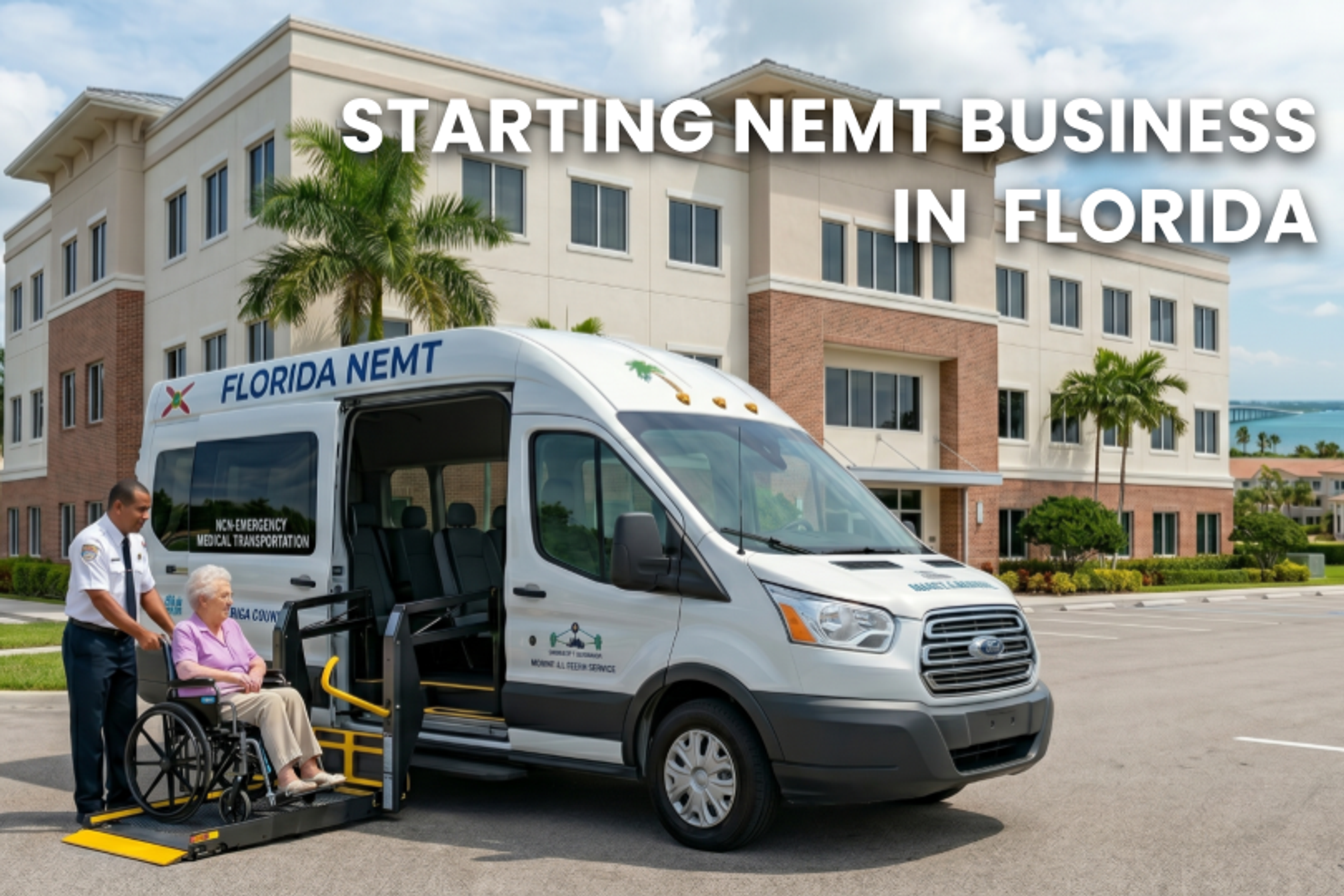
Starting an NEMT Business in Florida:
Licenses, Rates & Broker Guide (2026)
Published May 2026 | nemtplatform.com | 12 min read
NEMTAC Transform 2026 is coming to Orlando, Florida on August 16-19 at the JW Marriott Grande Lakes, and nearly 2,000 NEMT operators, brokers, and technology partners are expected to attend. With the industry converging on the Sunshine State, there is no better time to understand what makes Florida one of the most opportunity-rich, and operationally demanding, NEMT markets in the country.
Florida has more dialysis patients, more retirees, and more Medicaid-enrolled residents than almost any other state. It also has county-level licensing rules that catch new operators off guard, insurance costs that rank among the highest nationally, and a reimbursement structure that rewards operators who know how to bill correctly.
This guide covers what you need to start and grow an NEMT business in Florida in 2026. Licensing, driver requirements, insurance, brokers, reimbursement rates, and the step-by-step launch sequence. Whether you are preparing to launch before NEMTAC or expanding an existing operation into the state, this is your starting point.
Who Is This Blog Post For?
This post is written for:
Entrepreneurs considering starting an NEMT business in Florida for the first time
NEMT operators in other states looking to expand into Florida
Existing Florida providers who want to verify their compliance and understand the broker landscape
Anyone attending NEMTAC Transform 2026 in Orlando who wants state-specific context before they arrive
Why Florida Is a Strong NEMT Market
The fundamentals are difficult to argue with. Florida has the oldest median age of any large US state, and aging populations drive NEMT demand in a direct, measurable way. Dialysis patients need three trips per week. Chemotherapy patients cannot drive themselves. Behavioral health appointments do not get cancelled because the economy softens.
Florida currently has more than 4.7 million Medicaid enrollees, one of the largest Medicaid populations in the country. That is a deep, reliable rider base for providers who are credentialed and operational.
- Aging population: Over 21% of Florida residents are 65 or older, the highest share of any large US state. This demographic drives consistent, long-term demand for medical transportation.
- Dense dialysis market: Florida has hundreds of dialysis centers statewide. DaVita, Fresenius, and American Renal Associates all operate large Florida networks. Dialysis transport means three trips per week, 52 weeks per year, per patient. It is the most predictable recurring revenue in NEMT.
- Wait-time billing: Florida is one of the few states that allows providers to bill for extended facility waits, typically $25-$100 per hour. Most new operators never claim this revenue. We cover how it works later in this guide.
- MTM now dominant statewide: As of March 2026, MTM Health manages NEMT for UnitedHealthcare Community Plan of Florida members, making it one of the two dominant brokers operating statewide alongside ModivCare.
Florida's Two-Layer Licensing Structure
Florida's licensing structure has two distinct layers. Operators who complete the first and skip the second find out the hard way that they cannot legally operate in their target county.
Layer 1: Statewide AHCA Medicaid Enrollment
The Agency for Health Care Administration (AHCA) is Florida's Medicaid authority. To bill Florida Medicaid for NEMT trips, you must be enrolled as a provider with AHCA. The process is free and typically takes 30-60 days from a complete application.
What AHCA enrollment requires:
- Active Florida LLC or corporation with Articles of Organization
- Federal EIN from the IRS
- National Provider Identifier (NPI), Type 2 for your organisation
- Certificate of Insurance for commercial auto liability, with continuous coverage documented
- Vehicle inspection documentation
- Driver background screening clearance through AHCA's Background Screening Clearinghouse
- Trip scheduling procedures and incident response protocols
AHCA requires Level 2 background screening for all NEMT drivers serving Medicaid clients. This is fingerprint-based through the Florida Department of Law Enforcement (FDLE), not a standard name-based criminal check. It takes additional processing time. Build this into your hiring timeline from day one.
Layer 2: The County COPCN
Many Florida counties require a Certificate of Public Convenience and Necessity (COPCN) before you can operate, regardless of your AHCA enrollment status. This is where operators get surprised.
Miami-Dade County is the most demanding example. Their COPCN process involves a formal application, a public notice period, and a public hearing before the Board of County Commissioners. Expect a minimum of three to six months in South Florida.
Not every county requires this. Before you register your LLC or spend a dollar on a vehicle, contact your target county's transportation or emergency management office and confirm whether a COPCN applies to your service area.
Here is what to expect by county:
- Miami-Dade County: Full COPCN required. Public hearing process, minimum 3-6 months. Start this application before anything else if Miami-Dade is your target market.
- Broward County: Requirements vary by service type. Verify directly with the county before submitting any application.
- Palm Beach County: Confirm with the county before beginning your launch process.
- Orange County (Orlando): Host county for NEMTAC Transform 2026. Verify requirements with the county directly.
- Hillsborough County (Tampa): Contact the county transportation office to confirm current requirements before applying.
- Duval County (Jacksonville): Generally a lower regulatory barrier than South Florida counties. A more accessible entry point for new operators.
If your launch county requires a COPCN, start that application before anything else. It is your longest-lead item in the entire process.
Ready to streamline your transportation workflow?
Discover how an all-in-one NEMT solution can automate scheduling, plan routes and simplify billing so you can focus on delivering exceptional care.
Florida Driver Requirements
Florida sets specific driver standards for anyone transporting Medicaid patients under AHCA oversight. These go beyond what most states mandate.
- Minimum age 21. Florida is one of the stricter states on this requirement.
- Valid Florida driver's license. Out-of-state licences must be converted before the driver starts work.
- Level 2 AHCA background screening. Fingerprint-based check through FDLE and AHCA's Background Screening Clearinghouse. Non-negotiable for all drivers with patient contact.
- Clean Motor Vehicle Record (MVR). Most brokers require a 3-5 year history with fewer than 2-3 moving violations. Pull the MVR before you make a hire offer.
- CPR and First Aid certification. AHA Heartsaver is the standard accepted by Florida's primary brokers.
- PASS or CTS certification. ModivCare and MTM both require either CTAA PASS training or NEMTAC CTS certification for all drivers in their Florida networks.
- Monthly OIG exclusion checks. CMS requires every provider to screen all staff against the Office of Inspector General exclusion list every month, not just at hire. This must be documented in each driver's file.
All Florida driver AHCA Level 2 fingerprint clearances must be documented in each driver's Driver Qualification File (DQF). During a Medicaid audit, this is one of the first items reviewed. A missing or expired clearance is an automatic finding.
Florida NEMT Insurance: What You Will Actually Pay
Florida is a no-fault state. Mandatory personal injury protection (PIP) coverage adds directly to your base premium, and Florida already ranks among the most expensive states nationally for commercial NEMT insurance.
Here is what to budget by coverage type:
- Commercial Auto Liability at $1 million CSL: Typically $5,000-$8,500 per vehicle per year. This is the minimum required for AHCA Medicaid enrollment.
- General Liability at $1 million/$2 million: Either bundled into your policy or an additional $800-$1,500 per year. Required by all major brokers including MTM and ModivCare.
- Workers' Compensation: Required if you have employees. Cost varies by payroll size and classification.
- SAM Endorsement (Sexual Abuse and Molestation): An additional $200-$600 per year. Required by MTM and most major brokers operating in Florida.
- Full bundle estimate: Most Florida NEMT operators pay $7,000-$13,000 per vehicle per year for a complete compliant insurance stack. This ranks among the highest in the country.
First-year operators without prior claims history typically pay 30-50% more per vehicle than established operators. Carriers price new operations as higher risk because there is no loss history to underwrite against. That surcharge usually drops after 12 months of clean coverage and approaches standard rates after three years.
Ways to reduce your Florida premium:
- Install telematics and dashcams. Most carriers discount 5-15% for operators with documented telematics programmes.
- Maintain a written preventive maintenance log that satisfies AHCA vehicle standards.
- Get your drivers NEMTAC CTS certified. Some carriers factor this into their risk assessment.
- Buy vehicles in the 3-6 year, under 150,000-mile range. This is the insurance sweet spot for NEMT fleets.
- Work with an NEMT-specialist insurance broker, not a generalist commercial auto agency. Fewer than 30 carriers nationwide write this risk class. A specialist accesses more of them and knows how to present your operation correctly.
Florida's Broker Landscape
Florida operates under a Statewide Medicaid Managed Care (SMMC) model. NEMT trips flow through brokers rather than being billed directly to the state. You need to be credentialed with the right brokers before you can run a single Medicaid trip.
- MTM Health: As of March 2026, MTM manages NEMT for UnitedHealthcare Community Plan of Florida members, one of the largest Medicaid contracts in the state. MTM's credentialing process typically runs 6-10 weeks from complete application submission.
- ModivCare: The largest NEMT broker nationally, operating throughout Florida. You need both MTM and ModivCare to build meaningful statewide trip volume.
- Alivi Transportation: Florida and Southeast-focused, with strong Medicare Advantage presence. A useful third enrollment once you are operational with the two primary brokers.
What both primary brokers require to credential you:
- Active AHCA Medicaid provider enrollment
- NPI (Type 2)
- Certificate of Insurance naming the broker as additional insured, with specific COI endorsement language for each broker
- SAM (Sexual Abuse and Molestation) endorsement on your insurance policy
- W-9 and voided check for electronic funds transfer setup
- Complete Driver Qualification Files for all active drivers
- Current vehicle inspection reports
Broker payment terms in Florida typically run 7-30 days from claim submission, but first-time providers sometimes experience longer initial delays while systems are established. Build a 60-90 day cash reserve before your first broker trip. Running out of working capital during the billing lag is the most common reason new Florida NEMT operators fail in year one.
Ready to streamline your transportation workflow?
Discover how an all-in-one NEMT solution can automate scheduling, plan routes and simplify billing so you can focus on delivering exceptional care.
Florida Medicaid Reimbursement Rates
Florida's rates are competitive relative to the national average. The wait-time billing provision is the real differentiator that separates operators who understand the market from those who do not.
Current 2026 rate benchmarks by trip type:
- Ambulatory sedan trips: Base rate of $25-$35 plus $1.50-$2.50 per mile. Highest volume category but lowest per-trip reimbursement.
- Wheelchair-accessible van (WAV) trips: Base rate of $40-$55 plus $2.00-$3.50 per mile. Strong demand across Florida's large elderly and disabled population.
- Stretcher and ambulette trips: Base rate of $65-$85 plus $3.00-$4.50 per mile. Highest reimbursement category and requires specialised equipment and driver training.
- Wait-time billing: $25-$100 per hour during documented facility waits. Applicable on eligible trip types including dialysis and hospital discharges. This is a Florida-specific provision that most new operators do not use.
Wait-Time Billing: The Florida Revenue Most Operators Miss
Florida's Medicaid programme allows NEMT providers to bill for extended facility wait times on eligible trip types, particularly dialysis runs and hospital discharges. When your driver is at a facility waiting for a patient whose appointment has run long, that wait time is billable.
At $25-$100 per hour, a two-hour hospital discharge wait adds $50-$200 to a single trip. For a fleet running dialysis routes three days per week, wait-time billing can add several thousand dollars monthly without a single additional trip. To claim this correctly, your dispatch software must automatically record the start and end of every facility wait at the trip level. If you are capturing this manually on paper or in a spreadsheet, you are losing claims and creating audit risk.
Best Florida Markets for NEMT
Florida is a large and geographically varied state. Where you launch matters for both volume and complexity.
- South Florida (Miami-Dade, Broward, Palm Beach): The highest-volume NEMT market in the state. Dense Medicaid population, large elderly community, and heavy dialysis centre concentration. The COPCN requirement in Miami-Dade is the tradeoff. Operators who clear it find consistently high trip volume.
- Tampa Bay / Hillsborough County: Strong growth market with a large dialysis and behavioural health patient base. Slightly less regulatory friction than South Florida and a growing Medicare Advantage population.
- Orlando / Orange County: Home to NEMTAC Transform 2026. Solid healthcare infrastructure across the UCF Health system and AdventHealth network. Mid-size NEMT market with room for new entrants.
- Jacksonville / Duval County: The most accessible major Florida market for new operators. Medicaid volume is solid, county-level requirements are simpler than South Florida, and established competition is more manageable.
Your Florida Launch Sequence, In the Right Order
Order is everything here. Doing these steps out of sequence is the most common reason Florida launches run over time and over budget.
- Check your target county's COPCN requirement first. If required, start that application before you do anything else. It is your longest-lead item.
- Form your Florida LLC and get your EIN. Florida LLC filing fee is $125. Your IRS EIN is free and instant at irs.gov.
- Obtain your NPI (Type 2). Free at nppes.cms.hhs.gov. Required before AHCA enrollment will process your application.
- Secure your vehicle and insurance. Get your Certificate of Insurance before starting AHCA enrollment. You will need it as part of the application.
- Start AHCA Medicaid enrollment. Free, 30-60 days. This is the rate-limiting step in your entire Florida timeline. Start it as early as possible.
- Hire and credential your drivers. Level 2 FDLE screening, MVR pull, background check, CPR/First Aid certification, and PASS or CTS certification. Each driver needs a complete Driver Qualification File before their first trip.
- Set up your dispatch software. You need a platform that captures facility wait times for Florida's wait-time billing, connects directly to MTM and ModivCare broker APIs, and records electronic proof of pickup and drop-off for AHCA compliance. NEMT Platform's Provider Panel handles all of this in one connected system.
- Apply to MTM and ModivCare broker networks simultaneously. Start both applications at the same time. MTM credentialing typically runs 6-10 weeks.
- Build direct facility relationships while broker applications process. Contact dialysis centre administrators, hospital discharge planners, and behavioural health facilities in your service area. Direct contracts pay 10-30% more than broker sub-contract rates.
Ready to streamline your transportation workflow?
Discover how an all-in-one NEMT solution can automate scheduling, plan routes and simplify billing so you can focus on delivering exceptional care.
How NEMT Platform Supports Florida Operators
Florida's combination of wait-time billing, strict AHCA documentation requirements, and high broker trip volumes makes dispatch software a genuine operational requirement, not an optional tool.
NEMT Platform was built for exactly this environment. The Provider Panel centralises scheduling, dispatch, billing, and compliance documentation in one connected system. Direct integrations with ModivCare and MTM mean your broker trips sync automatically, removing manual data entry and the errors that come with it. Wait-time timestamps are captured automatically at the trip level, giving you clean documentation for every Florida wait-time billing claim.
The NEMT Max Driver App keeps your drivers connected to dispatch in real time, captures electronic signatures for proof of pickup and drop-off, and supports the documentation trail AHCA auditors look for. Olivia, the AI Receptionist, handles inbound member calls, trip booking, and ride status updates automatically, reducing the phone load on your dispatch team.
See how NEMT Platform works for Florida providers at nemtplatform.com/solutions/nemt-provider-panel.
The Honest Challenges
Florida is a strong market. It is also a demanding one. Go in clear-eyed about these realities:
- Insurance costs are a real burden at launch. At $7,000-$13,000 per vehicle annually, Florida insurance is one of the heaviest overhead items for a 1-2 vehicle startup. Budget for it fully and account for the first-year startup premium surcharge.
- The COPCN process in South Florida is not quick. Miami-Dade's public hearing requirement is a genuine multi-month process. If your timeline is tight, consider launching in a county without this requirement and expanding south once you are operational.
- Broker payment lags hit first-time providers hardest. Build your 60-90 day cash reserve before your first trip. Do not plan on revenue covering expenses from week one.
- Competition in the large metros is established. Miami, Tampa, and Orlando have experienced operators with years of broker relationships. Your competitive edge is reliability, documentation quality, and the technology infrastructure behind your operation.
Ready to Launch Your Florida NEMT Operation?
NEMT Platform gives Florida providers the tools to manage dispatch, billing, driver coordination, and broker integration from one connected system. Whether you are starting your first vehicle or expanding a fleet into Florida, our team can walk you through exactly how the platform fits your operation.
Schedule a demo at nemtplatform.com/schedule and see NEMT Platform in action.
Frequently Asked Questions
What do I need to start a NEMT business in Florida?
To start an NEMT business in Florida you need a registered Florida LLC or corporation, a federal EIN, a Type 2 NPI, commercial auto liability insurance, and AHCA Medicaid provider enrollment. Depending on your target county, you may also need a Certificate of Public Convenience and Necessity (COPCN) before you can operate. All drivers must hold AHCA Level 2 background screening clearance through FDLE. To access Medicaid trips through a broker, you need to complete credentialing with MTM Health and ModivCare.
How profitable is NEMT?
A single well-run NEMT vehicle can generate $50,000-$60,000 in annual revenue. A 3-5 vehicle fleet typically produces $120,000-$250,000 in revenue with net margins of 15-25% for operators managing costs effectively. A 10 or more vehicle fleet with proper systems in place can exceed $500,000 annually. Profitability depends on your state's Medicaid reimbursement rates, payer mix, driver retention, and operational efficiency. Florida's wait-time billing provision gives operators an above-average revenue opportunity compared to most other states.
How much does NEMT cost in Florida?
For patients covered by Florida Medicaid, NEMT is free at the point of service. For private-pay patients, ambulatory sedan trips typically cost $30-$75 one way, wheelchair van trips run $75-$150 one way, and stretcher transport costs $200-$350 on most local routes. Rates vary by provider, distance, and service type.
How much does it cost to start a NEMT business?
A single-vehicle ambulatory startup costs $15,000-$30,000, covering a used vehicle, first-year insurance, licensing fees, and working capital. A single wheelchair-accessible van startup costs $30,000-$55,000. A 3-5 vehicle WAV fleet launch typically requires $170,000 or more depending on vehicle condition, insurance costs, and working capital reserves. The three largest expenses are the vehicle, commercial insurance, and the cash reserve needed to cover the 45-90 day Medicaid payment delay.
Do I need a COPCN to operate NEMT in Florida?
It depends on your county. Miami-Dade County requires a COPCN, which involves a public hearing process and can take 3-6 months. Other counties may have their own requirements or none at all. Always confirm with your specific county before beginning your launch process. Operating without a required COPCN is a compliance violation.
How long does AHCA Medicaid enrollment take in Florida?
AHCA Medicaid enrollment typically takes 30-60 days from a complete application submission. Incomplete applications or missing documentation will extend this timeline. Because AHCA enrollment is required before you can bill your first Medicaid trip, start it as early as possible in your launch sequence.
What background check does Florida require for NEMT drivers?
Florida requires Level 2 background screening for all NEMT drivers serving Medicaid patients. This is a fingerprint-based check processed through the Florida Department of Law Enforcement (FDLE) and AHCA's Background Screening Clearinghouse. It is more comprehensive than a standard name-based criminal history check. Results must be documented in each driver's Driver Qualification File and clearance must remain current.
Which brokers operate in Florida?
The two dominant NEMT brokers in Florida are MTM Health and ModivCare. As of March 2026, MTM manages NEMT for UnitedHealthcare Community Plan of Florida members. ModivCare operates statewide alongside MTM. Alivi Transportation is a third option with a focus on Medicare Advantage plans in the Florida and Southeast market. Most Florida Medicaid NEMT providers credential with at least MTM and ModivCare to access sufficient trip volume.
How does wait-time billing work in Florida?
Florida Medicaid allows NEMT providers to bill for extended facility wait times on eligible trip types such as dialysis and hospital discharges. The rate is typically $25-$100 per hour during documented facility waits. To claim this correctly, your dispatch system must automatically record the start and end of every facility wait at the trip level. Manual documentation creates errors and missed claims. Refer to Florida AHCA's provider billing guidelines for the specific procedure codes and documentation requirements that apply to your trip types.
Can NEMT Platform manage Florida broker trips?
Yes. NEMT Platform integrates directly with ModivCare and MTM, Florida's two primary brokers. Trips sync automatically into the dispatch system, removing manual data entry. The platform captures the documentation required for Florida's wait-time billing and generates the proof of pickup and drop-off records needed for AHCA compliance. Learn more at nemtplatform.com/solutions/nemt-provider-panel.
Disclaimer
The information in this blog post is for general informational purposes only. It does not constitute legal, financial, or regulatory advice. NEMT regulations, Medicaid policies, and reimbursement rates vary by state and change frequently. Statistics and figures cited reflect publicly available data and industry reports at the time of publication. Always consult a licensed attorney, compliance officer, or regulatory specialist before making decisions based on this content. NEMT Platform makes no representations or warranties regarding the accuracy, completeness, or applicability of this information to your specific operation or jurisdiction.
Related Articles
Enterprise NEMT Software: Run 100+ Vehicles on One System
For NEMT providers running 100+ vehicles across multiple locations, fragmented systems drain margin. How enterprise NEMT software unifies the operation.
Best NEMT Software for California Transportation Providers: Medi-Cal, Multi-Broker, and Fleet Automation
Discover why NEMT Platform is the best NEMT software in California, offering live OVERSIGHT dispatch, multi-broker auto-billing, and a 24/7 multilingual AI receptionist.
Starting an NEMT Business in 2026: Where the Real Profit Comes From
NEMT operators in 2026 can reach 20-35% margins via hospital discharge contracts, stretcher and bariatric transport, long-distance trips, and private concierge accounts beyond standard broker rides.
NEMT Brokers in California
California is the largest Medi-Cal market in the country, with more than 14 million enrollees and a county-based managed care model that routes all NEMT trips through contracted transportation brokers, not the state directly. To run a compliant NEMT business in California, you need a CPUC Charter-Party Carrier (TCP) permit, Medi-Cal enrolment through the DHCS PAVE portal, and credentialing with the brokers serving your target counties, primarily ModivCare, MTM and SafeRide Health. Our 2026 guide covers California-specific insurance requirements under CPUC General Order 115, the Physician Certification Statement (PCS) compliance framework, the 180-day Medi-Cal FFS timely filing limit, and how to build a multi-county operation across California's fragmented broker landscape.