Who Is This Blog Post For?
This guide is written for mid-sized NEMT providers (5-50 vehicles) managing Medicaid managed care contracts, broker relationships, and dispatch operations that have outgrown spreadsheets and manual workflows. If you are evaluating NEMT dispatch software, need EVV compliance solutions, or are losing broker contracts because your operational data cannot meet 2026 audit standards, this post explains exactly what software modernization means in practice and why it is no longer optional.
The dispatch hour is dead. Providers running operations on spreadsheets, phone calls, and printed manifests are not behind because they lack budget or talent. They are behind because the rest of the industry crossed a technology threshold that fundamentally changed the economics of running a non-emergency medical transportation fleet.
In 2026, three software pillars separate high-margin NEMT operations from providers losing broker contracts and watching margins compress every quarter. AI predictive scheduling. EVV compliance enforcement. Ride-hailing platform integrations. None of these are emerging trends. They are operational requirements, and providers without them are running out of time.
This guide breaks down what each pillar requires, what the regulatory and economic stakes are, and how NEMT Platform built OVERSIGHT, Auto Planner, Olivia AI, and the Provider Panel to close the gap.
Why the NEMT Software Gap Is Widening in 2026
The U.S. NEMT market is growing at 5.5% compound annual growth rate, driven by an aging population, expanding Medicaid managed care coverage, and the shift toward value-based care models that treat transportation as a medical benefit rather than an administrative cost. Demand is up. Broker contracts are tightening. Compliance enforcement is hardening. Providers who kept dispatch in a spreadsheet have nowhere left to hide.
Missed medical appointments cost the U.S. healthcare system roughly $150 billion annually, and transportation failure is one of the largest contributors. Patients who cannot get to dialysis, chemotherapy, or post-surgical follow-ups do not just miss appointments. They deteriorate, re-hospitalize, and generate downstream costs that brokers and payers now penalize providers for. A missed pickup in 2026 is no longer an inconvenience. It is a clinical event with contractual consequences.
NEMT providers sit directly in the line of that problem, and brokers have moved to make every trip measurable, auditable, and accountable at the individual record level. Aggregate performance reporting is over. Trip-level evidence is the new standard. That standard is impossible to meet without modern NEMT dispatch software.
AI Predictive Scheduling for NEMT Dispatch
AI-driven scheduling and predictive dispatch are no longer experimental tools. Mid-2026 industry data shows AI predictive scheduling reducing no-shows by up to 30% in NEMT operations, with the best implementations cutting manual scheduling time by 40% within the first 90 days of deployment.
What AI Predictive Scheduling Does for NEMT
The traditional NEMT scheduling model treats every trip request as an isolated event. A trip comes in. A dispatcher matches it to a vehicle. A driver gets the address. The system has no memory and no context. That model breaks down at scale because human dispatchers cannot hold the combinatorial complexity of 200 or 500 daily trips while responding to live changes.
AI predictive scheduling rebuilds the model. Instead of treating trips as isolated, the system analyses patterns across thousands of historical rides and forecasts recurring demand weeks in advance. Dialysis appointments, chemotherapy sessions, and physical therapy visits follow consistent patterns. AI recognises those patterns and pre-positions capacity before trips hit the dispatch queue.
The same engine that forecasts demand also predicts patient no-shows. Machine learning models trained on historical no-show data flag high-risk appointments before they happen, allowing providers to confirm rides, reschedule proactively, or reallocate capacity. Research published in 2025 on predictive no-show models showed XGBoost-based machine learning approaches significantly outperforming traditional scheduling heuristics for predicting which patients are likely to miss NEMT appointments.
Ready to streamline your transportation workflow?
Discover how an all-in-one NEMT solution can automate scheduling, plan routes and simplify billing so you can focus on delivering exceptional care.
How NEMT Platform Auto Planner Works
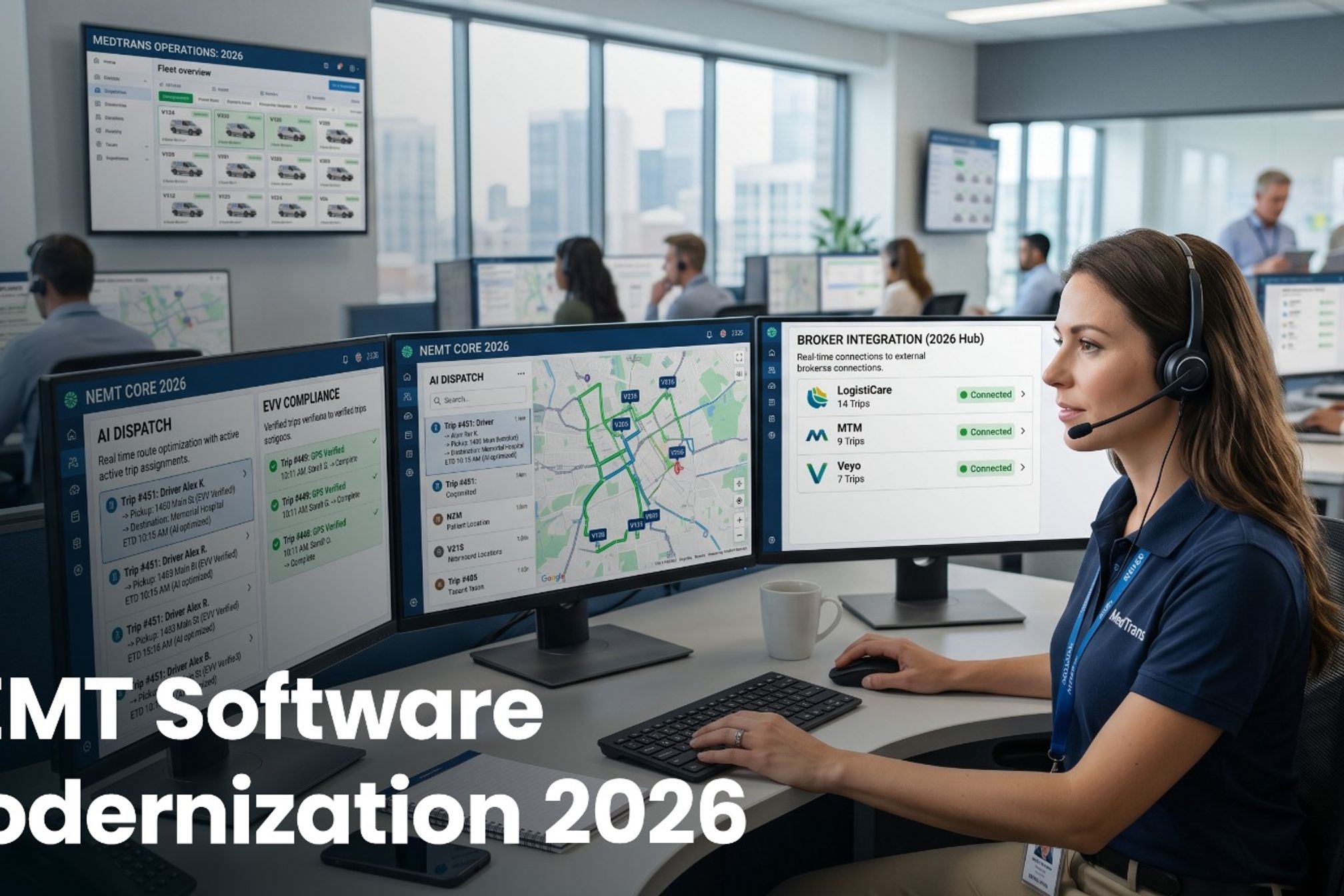
Auto Planner is NEMT Platform's AI-driven dispatch engine. It evaluates dozens of constraints in parallel for every trip including vehicle type, wheelchair or stretcher capacity, driver certifications, shift limits, traffic, appointment windows, broker rules, and B-leg dependencies. Within seconds, it proposes a complete day plan that a human dispatcher would need hours to assemble.
Providers running on NEMT Platform are seeing 88% of their trips auto-assigned by AI. Green Med Trans, an 11-50 vehicle fleet, scaled to 5,000 monthly trips while automating 88% of their dispatching workflow. Their on-time performance climbed near 99%, claim approval reached 99.2%, and their dispatchers stopped doing data entry and started managing exceptions and growth.
The dispatcher does not disappear in this model. The AI is the planner. The human is the editor. That distinction separates working AI dispatch from the failed full-automation pitches the category tried five years ago.
EVV Compliance for NEMT in 2026
EVV stopped being optional years ago. What changed in 2026 is that enforcement got teeth, and the cost of running without a compliant system is no longer measured in soft warnings. It is measured in hard claim denials.
The Federal EVV Mandate
Section 12006(a) of the 21st Century Cures Act required every state to implement Electronic Visit Verification for all Medicaid-funded personal care services by January 1, 2020 and for home health care services by January 1, 2023. States that did not comply faced incremental FMAP reductions of up to 1%. That federal floor is now in place across all 50 states.
What changed in 2026 is the shift from soft edits to hard edits at the state level. Through 2024 and most of 2025, states were largely accepting claims with EVV data even when the data had quality issues. That window closed. In early 2026, states including Minnesota began requiring providers to hit at least a 50% EVV compliance rate, with thresholds rising to 80% later in the year. Other states followed similar enforcement curves. Missouri requires providers to log into the state EVV system at least weekly to confirm data accuracy or face administrative actions up to and including termination from the Medicaid programme.
The result is that claims with missing visit start or end times, caregiver check-ins that do not match claimed service durations, location data showing services outside approved areas, or data submitted after deadlines now trigger automatic denials. EVV is not a documentation requirement anymore. It is a revenue gate.
The Six Required EVV Data Points
Federal EVV requirements mandate that every visit capture six specific data points. The type of service performed. The individual receiving service. The date of service. The location of service delivery. The identity of the caregiver providing service. And the exact times when service began and ended. Any system that fails to capture all six in real time, with location verification and timestamped accuracy, will fail compliance audits and generate denied claims.
The implication for NEMT software is direct. EVV cannot be a manual data entry process. It cannot be reconstructed from driver logs at the end of a shift. The data must be captured at the moment of the visit through geofencing, GPS coordinates, digital signature, and timestamped events. Anything less creates compliance risk and revenue leakage.
How NEMT Platform OVERSIGHT Closes the EVV Gap
OVERSIGHT is NEMT Platform's dispatch intelligence framework, and EVV compliance is built into its foundation rather than bolted on as an afterthought. The NEMT Max driver app captures the six required data points automatically on every trip. Geofencing around pickup and drop-off locations triggers automatic status updates as drivers enter and exit each zone. Status flows from Enroute to On Scene to Transporting to Completed without manual entry.
Every completed trip generates an EVV record including digital signature capture, GPS coordinates, timestamped events, photo verification where required, and trip codes. That record flows directly into billing. Claims are built from verified trip data rather than reconstructed from memory or paper logs.
For providers operating across multiple states with different aggregator models, OVERSIGHT consolidates the compliance overhead into a single workflow. The compliance evidence brokers and state Medicaid auditors now require is already there, timestamped and auditable, the moment a claim is submitted.
NEMT Ride-Hailing Integration: Uber Health and Lyft Healthcare
The third pillar is the one most NEMT providers have been slowest to adopt, and it may have the biggest near-term impact on fleet economics.
Uber Health and Lyft Healthcare have built dedicated NEMT-adjacent products that allow healthcare organisations to schedule rides for patients without requiring an app download on the patient side. These platforms are integrated with major brokers and Medicaid managed care organisations, and they are increasingly positioned as the overflow capacity layer for traditional NEMT providers.
Why NEMT Integration Matters
The economics are straightforward. Most NEMT providers have a fleet sized for average daily demand, not peak demand. When volume spikes during flu season, after a hospital discharge surge, or around dialysis schedule changes, providers either turn down trips and damage broker relationships, or they scramble to find capacity from secondary vehicles and contractor drivers.
Uber Health and Lyft Healthcare give providers a third option. Ambulatory trips that do not require a wheelchair or stretcher can be routed to a ride-hailing platform automatically when fleet capacity is constrained. The patient gets the ride. The broker gets the on-time performance. The provider does not lose the trip allocation or have to build out fleet capacity for peak demand they only see occasionally.
The bridge is the integration layer. A provider without API integration to Uber Health or Lyft Healthcare has to manually book overflow rides through a separate portal, which does not scale and does not preserve the audit trail brokers require. A provider with integrated ride-hailing handoff treats the platforms as an extension of their own dispatch capacity, with all the data flowing back into one operational record.
How NEMT Platform Handles Broker and Ride-Hailing Integration
NEMT Platform's broker integration layer already pulls trips from ModivCare, MTM, Call the Car, VectorCare, Kaiser Permanente, and SafeRide into a single dispatch queue. The same architecture supports ride-hailing platform handoff for ambulatory trips that do not require specialised vehicles. The Provider Panel decides where each trip should go based on vehicle requirements, fleet capacity, and patient needs. The driver receives the assignment through NEMT Max if the trip stays in the provider's fleet. The trip routes to Uber Health or Lyft Healthcare if it is better served there.
The compliance record stays with the provider regardless of where the trip is fulfilled. That is the entire point of the integration layer. Providers without it are choosing between turning down trips and managing chaos. Providers with it run a flexible capacity model that scales with demand.
The 2026 NEMT Modernisation Decision
Every NEMT provider in 2026 is facing the same operational question. The decision tree is short.
If your dispatch still runs on spreadsheets, manual phone calls, and printed manifests, your competitors with AI dispatch are running four times your trip volume with the same headcount. They are not working harder. They are operating on a different cost structure.
If your EVV compliance is being managed through manual data entry or end-of-shift reconciliation, you are one state enforcement update away from a claim denial cliff. The shift from soft edits to hard edits in 2026 is not theoretical. It is already producing denied claims for providers running non-compliant systems.
If you have no ride-hailing integration, you are turning down ambulatory trips during peak demand or building expensive fleet capacity to handle volume you only see occasionally. Neither option is sustainable in a 5.5% growth market where brokers are tightening allocation criteria every quarter.
The providers who modernise their software stack in 2026 will dominate the next decade of NEMT. The ones who do not will keep losing contracts to operators who can demonstrate better trip-level data, cleaner claims records, and more flexible capacity.
How NEMT Platform Supports Provider Modernisation
NEMT Platform gives mid-sized NEMT providers the tools to compete with enterprise fleets without enterprise overhead. Our Provider Panel, Auto Planner, NEMT Max driver app, and OVERSIGHT compliance framework close the modernisation gap in weeks, not years.
- Auto Planner AI dispatch: 88% of trips auto-assigned. Evaluates vehicle type, driver certifications, shift limits, traffic, appointment windows, broker rules, and B-leg dependencies in parallel. Delivers a complete day plan in seconds.
- OVERSIGHT EVV compliance: Built-in geofencing, GPS-validated timestamps, digital signatures, and automatic status flows. Captures the six federally required EVV data points on every trip. Claims are built from verified trip data, not reconstructed logs.
- Broker integration: Direct API connections to ModivCare, MTM, Call the Car, VectorCare, Kaiser Permanente, and SafeRide. All broker trips flow into a single dispatch queue with standardised workflows.
- NEMT Max driver app: Intuitive Android/iOS app with in-app navigation, real-time manifest sync, EVV compliance capture, and offline mode for low-signal areas.
- Olivia AI Receptionist: Handles inbound member calls, trip booking, ride confirmation, and status updates automatically. Reduces dispatcher phone load by 60-70%.
- Flexible capacity management: Route overflow ambulatory trips to Uber Health or Lyft Healthcare when fleet capacity is constrained. The compliance record stays with you.
See how NEMT Platform fits your operation. Schedule a consultation at nemtplatform.com/schedule.
Ready to Modernise Your NEMT Operation?
The operational gap between NEMT providers who keep growing contracts and those who are losing them is increasingly a software gap. The brokers, the auditors, and the payers have moved. The providers who modernise their stack in 2026 will define the next decade.
Get started with NEMT Platform at nemtplatform.com/schedule and close the modernisation gap in weeks, not years.
Frequently Asked Questions
What is NEMT software modernisation?
NEMT software modernisation is the shift from manual or legacy dispatch systems to integrated platforms that combine AI-driven scheduling, EVV compliance, real-time GPS tracking, broker integrations, and ride-hailing connectivity. It is no longer a competitive advantage. It is the operational floor for staying contracted with major brokers and Medicaid managed care organisations.
What are the EVV requirements for NEMT providers in 2026?
Federal EVV requirements under the 21st Century Cures Act mandate that providers capture six data points on every visit including service type, individual served, date, location, caregiver identity, and exact start and end times. In 2026, most states have moved from accepting flagged claims to actively denying claims with EVV data quality issues. Compliance thresholds vary by state but typically range from 50% to 80% required compliance, with sanctions including claim denials and programme termination.
How does AI predictive scheduling reduce NEMT no-shows?
AI predictive scheduling uses machine learning models trained on historical trip data to identify recurring patterns and forecast which appointments are at high risk of becoming no-shows. Providers can use those predictions to confirm rides proactively, reschedule, or reallocate capacity. Industry data shows AI-driven predictive scheduling reducing no-shows by up to 30% in NEMT operations.
Can NEMT Platform integrate with Uber Health and Lyft Healthcare?
NEMT Platform's broker integration layer supports ride-hailing platform handoff for ambulatory trips that do not require specialised vehicles. Providers can route overflow capacity to Uber Health or Lyft Healthcare automatically while keeping the full compliance and audit record in their own Provider Panel.
How long does it take to implement modern NEMT software?
NEMT Platform's average implementation timeline is approximately two weeks from contract execution to fully operational deployment. That includes broker API integrations, NEMT Max driver app onboarding, configuration of exception thresholds, and EVV compliance setup. Most providers are processing live claims through the platform within the first month.
What NEMT brokers does NEMT Platform integrate with?
NEMT Platform integrates directly with ModivCare, MTM, Call the Car, VectorCare, Kaiser Permanente, and SafeRide Health. All broker trips flow into a single dispatch queue with standardised workflows, automated trip imports, and real-time status updates back to the broker portal.
How much does NEMT dispatch software cost in 2026?
NEMT dispatch software pricing varies based on fleet size, feature set, and broker integration requirements. Entry-level platforms for small fleets (1-5 vehicles) start around $125-$200 per month. Mid-tier solutions for growing operations (5-20 vehicles) typically run $500-$1,500 per month. Enterprise platforms for large fleets (50+ vehicles) are often custom-quoted starting at $5,000+ per month. NEMT Platform offers transparent pricing with no hidden implementation fees.
Is EVV mandatory for all NEMT providers?
EVV is federally mandated under the 21st Century Cures Act for Medicaid-funded personal care services and home health care services. Over 45 states now require EVV for NEMT trips as of 2026. Even when not strictly mandated by state law, major brokers and Medicaid managed care organisations increasingly require EVV-compliant trip documentation as a condition of network participation. Claims submitted without compliant EVV data face automatic denial in most state systems.
What is the difference between NEMT dispatch software and NEMT billing software?
NEMT dispatch software handles trip scheduling, driver assignment, route optimisation, real-time tracking, and operational workflows. NEMT billing software handles claim generation, submission to brokers and payers, eligibility verification, denial management, and payment reconciliation. Modern NEMT platforms like NEMT Platform combine both dispatch and billing in one integrated system, so trip data captured during dispatch flows directly into claims without manual data entry or reconciliation gaps.
Disclaimer
The information in this blog post is for general informational purposes only. It does not constitute legal, financial, or regulatory advice. NEMT regulations, Medicaid policies, EVV requirements, and broker integration standards vary by state and change frequently. Statistics and figures cited reflect publicly available data and industry reports at the time of publication. Always consult a licensed attorney, compliance officer, or regulatory specialist before making decisions based on this content. NEMT Platform makes no representations or warranties regarding the accuracy, completeness, or applicability of this information to your specific operation or jurisdiction.
Related Articles
Discover why NEMT Platform is the best NEMT software in California, offering live OVERSIGHT dispatch, multi-broker auto-billing, and a 24/7 multilingual AI receptionist.
How NEMT billing really works in 2026: the claim lifecycle, why claims get denied, EVV and compliance, and how the right billing software gets you paid faster.
For NEMT leadership: why margins are compressing, the three exposures the C-suite owns, and how technology decisions protect the P&L at enterprise scale.
Discover proven NEMT marketing strategies for 2026, from local SEO to facility contracts, that help providers win high-value institutional healthcare business.