If you're starting a Non-Emergency Medical Transportation (NEMT) business, one of the first questions you'll google is: how much does NEMT software cost? The answer you'll find on most vendor websites is some variation of "Contact us for pricing" — which is deeply unhelpful when you're trying to build a startup budget.
This post cuts through that. We'll break down every pricing model in the NEMT software market, give you real numbers where they exist, explain the hidden costs most vendors don't advertise, and help you figure out what you actually need as a new operator — so you can make a decision without a sales call.
Why NEMT Software Pricing Is So Confusing
NEMT software isn't like most SaaS products where you can just check a pricing page. The industry has three distinct buyer segments — solo transporters, small fleet operators, and enterprise brokers — and vendors price differently for each. This creates a messy market where:
- Some vendors charge per vehicle, some charge per trip, some charge flat monthly rates, and some charge all three combined.
- "Starting at" prices often exclude the features you actually need (billing integration, broker connections, AI dispatch).
- Setup fees, training costs, and per-trip overage charges are frequently buried in contracts.
- Enterprise-level platforms (built for brokers managing thousands of trips) are priced for enterprise budgets — making them irrelevant for most new operators.
Understanding the pricing structure before you talk to a vendor puts you in a much stronger negotiating position — and helps you avoid overpaying for features you won't use for months.
The 4 NEMT Software Pricing Models
Before you can compare prices, you need to understand how vendors structure their costs. There are four primary models in use today:
1. Per-Vehicle Pricing
You pay a flat monthly fee for each vehicle in your fleet. This is the most transparent model for operators who want predictable costs.
Example
RouteGenie charges $50 per vehicle per month with no trip limits and no long-term contract. A 3-vehicle starter fleet would run $150/month. Simple.
2. Trip-Based Pricing
You pay per trip completed or per trip above a monthly allowance. This can be cost-effective when you're starting out and running low volume, but costs can spike unexpectedly as your business grows.
Example
Some platforms charge $0.10–$0.50 per trip on top of a base rate. At 500 trips/month and $0.25/trip, that's an additional $125 on top of your subscription.
3. Tiered/Plan-Based Pricing
Vendors offer 3–5 plans at fixed price points, with each tier unlocking more features or supporting more vehicles and drivers. This is the most common model for small-to-mid-size operators.
Example
NEMT Cloud Dispatch offers tiered plans starting around $149.99/month for smaller fleets, scaling up based on fleet size and feature requirements. Bambi charges $69/vehicle/month on a flat, all-inclusive basis with no contracts.
Ready to streamline your transportation workflow?
Discover how an all-in-one NEMT solution can automate scheduling, plan routes and simplify billing so you can focus on delivering exceptional care.
4. Custom / Quote-Based Pricing
Large platforms like Momentm (formerly TripSpark) and Mobisoft Infotech don't publish prices at all. You submit a request and get a quote tailored to your operation size. These are typically built for enterprise operators running hundreds of vehicles and are overkill — and overpriced — for new operators.
💡 Key Takeaway for New Operators
Avoid enterprise quote-based platforms entirely when you're starting out. They're designed for large-scale brokers and MCOs. A tiered plan from a NEMT-specific platform will give you 90% of the functionality at a fraction of the cost.
NEMT Software Pricing Comparison (2025–2026)
Here's a reference table based on publicly available pricing for major NEMT platforms. Note that pricing can change — always verify directly with the vendor before purchasing.
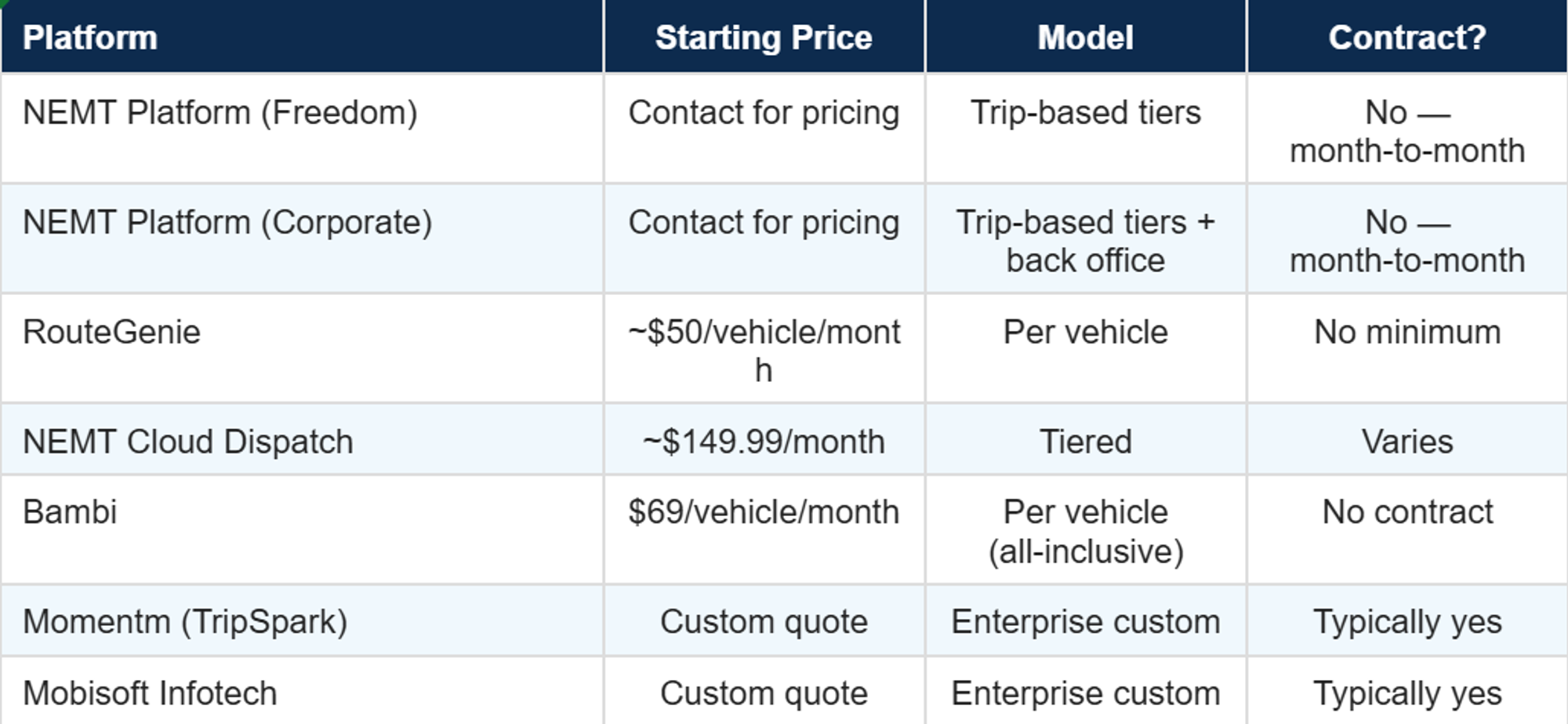
Important caveat: many platforms do not publish exact pricing publicly and require a demo or sales call to get figures. The numbers above reflect what is available from public sources as of early 2026.
The Hidden Costs Nobody Talks About
Subscription fees are only part of what you'll pay. Here are the additional costs that catch new operators off-guard:
Setup and Onboarding Fees
Some platforms charge a one-time onboarding fee to configure the system, migrate your data, and train your team. This can range from nothing (platforms that offer free onboarding as a sales incentive) to $500+ for custom configurations.
- NEMT Cloud Dispatch, for example, charges $65 per hour for custom training sessions beyond what's included in the subscription.
- Platforms like NEMT Platform include unlimited training sessions at no additional cost in their Corporate plan — a meaningful differentiator when you're getting started.
Per-Trip Overage Charges
If your plan has a monthly trip allowance and you exceed it, you'll be charged per additional trip. This is standard across most platforms and not inherently a problem — but you need to know the rate before you sign up.
NEMT Platform Example
The Freedom Plan includes 250 trips/month. Additional trips are charged at $0.30 each. The Corporate Plan includes 475 trips/month at $0.28 per overage trip. No service interruptions — you simply pay for what you use.
Broker Integration Fees
As a new NEMT operator, a significant portion of your trips will come through transportation brokers like ModivCare or MTM. To receive electronic trip assignments and submit billing automatically, your software needs to integrate with these brokers.
- Some platforms charge extra for broker API integrations or EDI billing (CMS-1500 and EDI 837 files).
- Others — including NEMT Platform's Corporate plan — include broker billing support and CMS-1500/EDI 837 integration at no additional charge.
If you're planning to work with Medicaid brokers from day one (and you should be), verify that broker integration is included in your plan before purchasing.
Add-On Features
Features that sound standard are sometimes priced as add-ons. Common examples include:
- Route optimization / Auto-scheduling: Often included only in higher-tier plans. NEMT Platform's Corporate plan includes Auto-Scheduler and Route Optimization as standard. Freedom plan users can add it for $50/month.
- Driver tracking links for members: Available as an add-on on both NEMT Platform plans — useful for keeping passengers informed of ETA.
- AI camera integration: Driver behavior analytics via AI camera is an advanced feature available on the Corporate plan, with hardware costs billed separately.
- IVR / SMS notifications: Automated patient ETA alerts and confirmation texts are often add-ons, not defaults.
Hardware Costs
Some platforms require or strongly recommend hardware — tablets for drivers, GPS units, or dashcams. These aren't subscription costs, but they're real startup expenses. Budget $50–$300 per vehicle for basic hardware if your platform requires it.
Ready to streamline your transportation workflow?
Discover how an all-in-one NEMT solution can automate scheduling, plan routes and simplify billing so you can focus on delivering exceptional care.
What Features Do New NEMT Operators Actually Need?
A common mistake is paying for enterprise features you won't use for months. Here's a practical breakdown of must-haves vs. nice-to-haves when you're just starting out:
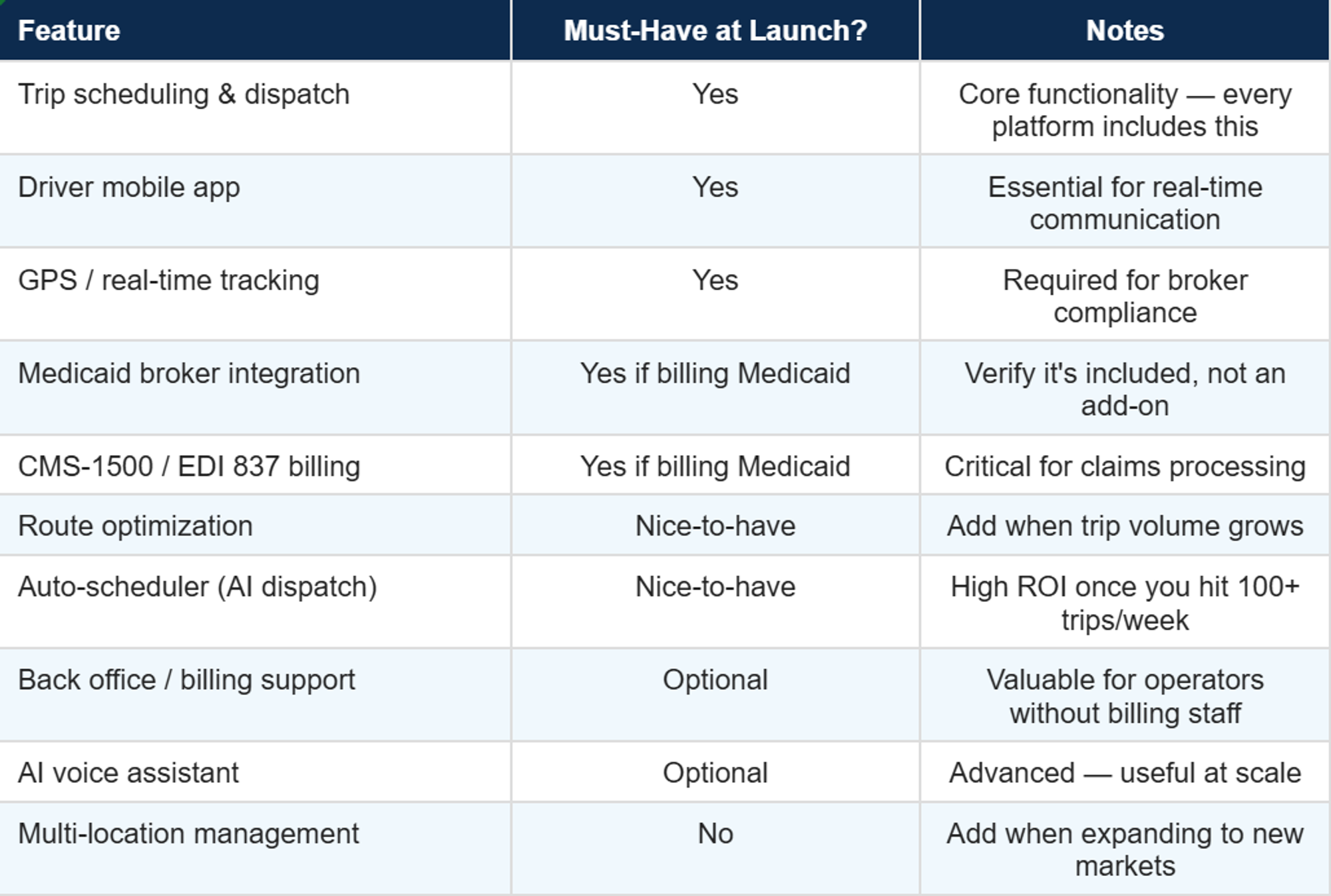
The practical implication: a Freedom-tier or entry-level plan from a reputable NEMT platform will cover everything you need to launch. Upgrade to a Corporate or mid-tier plan when your trip volume justifies the additional cost — or if you want broker billing and back office support handled for you from day one.
The Real Cost of Delaying Software Adoption
Some new operators try to delay software costs by running operations manually — spreadsheets, phone calls, paper logs. This is a false economy. The costs of manual operations compound fast:
Real-World Example
Teya Miles, a NEMT operator and platform user, spent 3 hours per day manually routing trips before adopting NEMT Platform. After onboarding, that dropped to 10–15 minutes. At a conservative estimate of $25/hour opportunity cost, that's over $1,800/month in recovered time — dwarfing the software subscription cost.
Beyond time, manual operations carry compliance risk. Brokers require precise pickup and drop-off timestamps. Without software generating these automatically, you're relying on driver self-reporting — which creates audit exposure and potential claim denials.
The ROI calculation for NEMT software is rarely about the subscription cost. It's about:
- Reduced routing waste: Optimized routes cut fuel costs and allow more trips per day.
- Fewer denied claims: Automated documentation reduces billing errors that lead to claim rejections.
- Broker compliance: Timestamped trip records protect you in disputes with brokers.
- No-show reduction: Pre-emptive calls and SMS notifications keep trip completion rates high and improve member care.
How to Choose the Right Pricing Plan
Use these three questions to narrow your decision:
1. What's your projected monthly trip volume?
If you're running under 250 trips/month, a Freedom or entry-tier plan is likely sufficient. Over 400 trips/month and you're better off on a Corporate or mid-tier plan to avoid overage charges.
2. Are you billing Medicaid directly?
If yes, you need CMS-1500 and EDI 837 billing integration from day one. Verify this is included in the plan — not an add-on — before signing up. Platforms that bundle broker billing support with their plan save you from hiring a separate billing service.
3. Do you have dispatching staff?
Solo operators benefit most from automation features like Auto-Scheduler and AI dispatch, since they can't afford to have someone manually managing trips all day. If you're running everything yourself, prioritize platforms where these features are accessible at lower price points.
No-Contract Matters More Than You Think
As a new operator, your volume and needs will change quickly. Avoid any platform that requires a 12-month contract upfront. Month-to-month rolling subscriptions let you scale up, scale down, or switch without penalty. NEMT Platform operates on a month-to-month basis with no cancellation fees — which matters when you're still figuring out your operational model.
A Closer Look: NEMT Platform Pricing
NEMT Platform is built specifically for NEMT providers and operates on a two-plan structure designed to fit operators from launch through growth:
Freedom Plan — Ideal for New Operators
The Freedom Plan covers the core operational stack for small providers just getting started:
- Full NEMT dispatch software with real-time cloud-based dispatch
- Admin mobile app for on-the-go management
- Private pay, facility, and corporate booking portals
- Driver tracking links for members (add-on)
- API access for integrations
- Email support during business hours
- 250 trips included per month; $0.30 per overage trip
- Route optimization and Auto-Scheduler available as a $50/month add-on
Corporate Plan — For Growing Operations
The Corporate Plan adds the full operational and compliance layer that high-volume providers need:
- Everything in Freedom, plus:
- Comprehensive broker billing support
- Full claim and billing audits
- CMS-1500 and EDI 837 billing file processing
- Auto-Scheduler and Route Optimization (included, not add-on)
- Pre-emptive calls to reduce no-shows
- IVR ETA updates for passengers
- Unlimited training sessions at no additional cost
- Dedicated Account Manager with priority phone and chat support
- 475 trips included per month; $0.28 per overage trip
Both plans include unlimited drivers and vehicles — no per-seat charges as your team grows. There are no long-term contracts, no cancellation fees, and a 7-day free trial with full platform access is available before any payment is required.
Ready to streamline your transportation workflow?
Discover how an all-in-one NEMT solution can automate scheduling, plan routes and simplify billing so you can focus on delivering exceptional care.
Frequently Asked Questions
Can I run a NEMT business without software?
Technically yes — practically no. Manual dispatch is viable at 1–2 vehicles, but broker compliance requirements (GPS timestamps, trip logs, EDI billing) become impossible to maintain manually at any scale. Most new operators who try to delay software adoption end up adopting it within 60–90 days anyway, after losing time and claim revenue.
Is free NEMT software an option?
A few platforms offer limited free tiers, but they typically cap trips at unusably low volumes or exclude Medicaid billing integration. Treat free trials (7–30 days with full access) as the right evaluation mechanism — not permanent free plans.
What should I budget for NEMT software as a new operator?
A realistic monthly budget for a 2–5 vehicle startup is $150–$350/month all-in, depending on your trip volume and whether you need broker billing support. Factor in potential overage costs if you grow faster than expected.
Do I need separate billing software?
Not if your NEMT platform includes CMS-1500 and EDI 837 billing. Platforms that bundle billing support (like NEMT Platform's Corporate plan) eliminate the need for a separate billing service, which can cost $200–$500/month on its own.
Bottom Line
NEMT software costs range from roughly $50/month on the low end to several hundred dollars per month for full-featured platforms with billing support and AI automation. For most new operators, the right entry point is a mid-tier plan in the $150–$300/month range that covers dispatch, GPS tracking, driver management, and Medicaid billing integration.
The cost of the software is almost never the issue. The issue is choosing a platform that grows with you, doesn't lock you into a contract before you know your volume, and doesn't hide critical features behind expensive add-ons. Verify those three things before you sign up for anything.
See Exactly What NEMT Platform Costs
No contracts. No hidden fees. Start with a 7-day free trial — no payment required.
View Pricing → nemtplatform.com/pricing
Related Articles
Discover why NEMT Platform is the best NEMT software in California, offering live OVERSIGHT dispatch, multi-broker auto-billing, and a 24/7 multilingual AI receptionist.
Medi-Cal pays for Uber and Lyft rides under the NMT benefit for ambulatory members, but wheelchair and gurney patients require a certified NEMT provider.
How NEMT billing really works in 2026: the claim lifecycle, why claims get denied, EVV and compliance, and how the right billing software gets you paid faster.
For NEMT leadership: why margins are compressing, the three exposures the C-suite owns, and how technology decisions protect the P&L at enterprise scale.