

Medi-Cal NEMT vs Uber/Lyft: California CalHHS Policy Guide
Medi-Cal pays for Uber and Lyft rides under the NMT benefit for ambulatory members, but wheelchair and gurney patients require a certified NEMT provider.
Read more

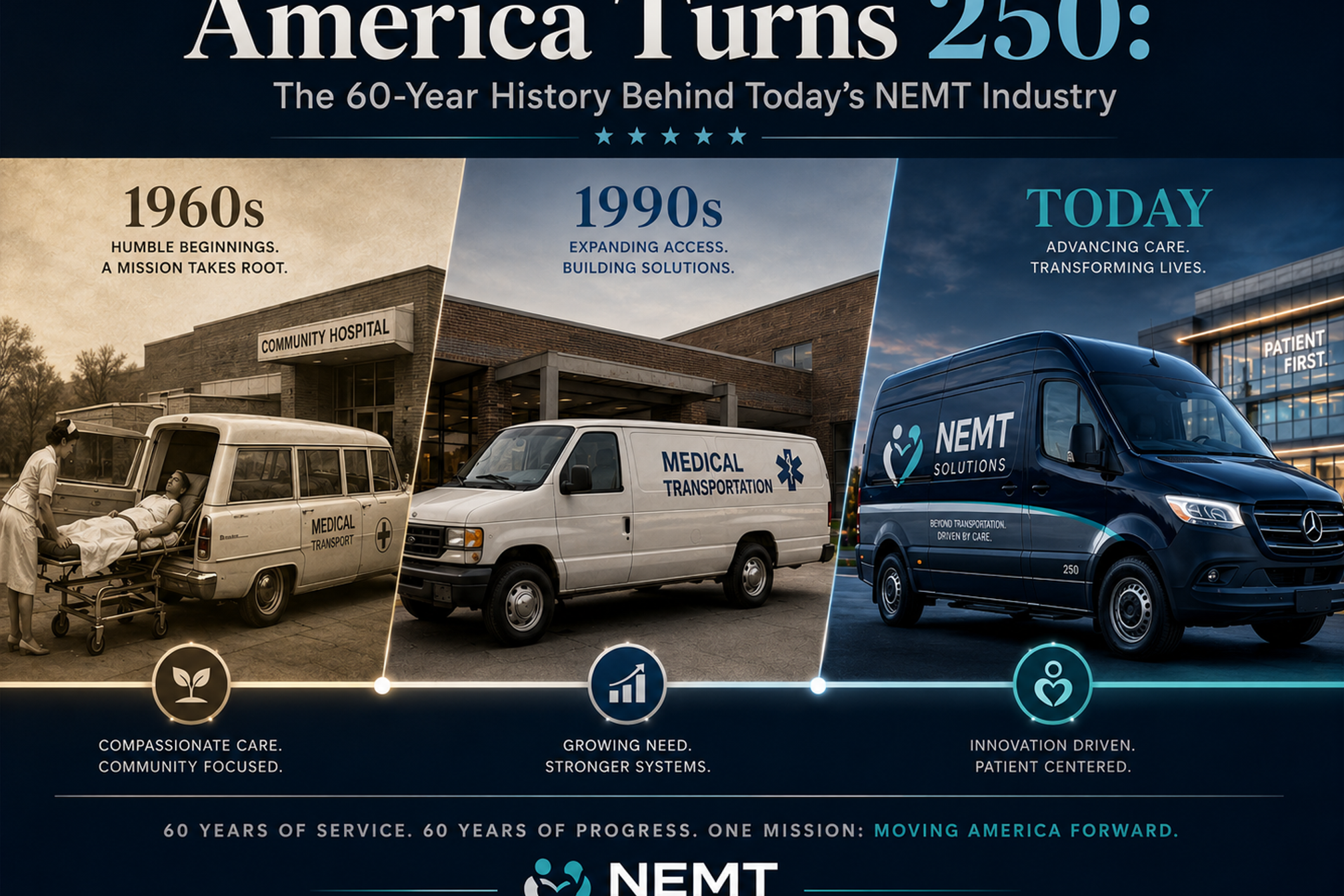
On July 4, 2026, the United States marks 250 years of independence. The non-emergency medical transportation industry is a much younger institution. Almost all of its legal foundation was built in the 60 years between 1965 and today, starting with Medicaid itself. NEMT is not one of the country's oldest systems. It is one of its newest, and its history explains a lot about how it operates now.
This post walks through that history and connects it to what NEMT operators deal with today: broker credentialing, compliance audits, dispatch pressure, and a fast-growing demand base with flat funding behind it.
This post is for NEMT operators, dispatch managers, and fleet owners who want context on how the industry they work in came to exist. It is also useful for new operators researching the regulatory foundation of NEMT before starting a business, and for broker-facing staff who want a clear timeline of the laws that shaped today's broker model.
Before Medicaid existed, there was no formal system for getting people to medical appointments if they could not drive themselves or afford a taxi. Families, churches, and volunteer groups filled the gap where they could. Rural areas and people with disabilities were hit hardest, since public transit rarely reached the clinics and hospitals they needed.
Healthcare access for these populations depended almost entirely on where you lived and who was willing to help. There was no right to transportation, and no funding mechanism behind it.
Medicaid was created in 1965 under Title XIX of the Social Security Act, signed into law by President Lyndon Johnson (Brain Injury Association of America). Transportation was not part of the original mandatory benefits list. States were expected to help beneficiaries reach care, but the requirement was vague and inconsistently enforced.
The first real mention of NEMT appeared in 1966 in the Handbook of Public Assistance, tied to the Early and Periodic Screening, Diagnostic, and Treatment benefit for children under 21. ( Adults were largely left out. This narrow version of the benefit stayed in place for almost a decade.
In 1974, a Medicaid recipient in Texas sued the state after being denied transportation to rehabilitation appointments for chronic health conditions. In Smith v. Vowell, Senior District Judge Thomas Clary ruled that states had a responsibility to provide adequate transportation access to Medicaid recipients. This ruling became the legal foundation for the transportation assurance requirement that still governs Medicaid today.
That requirement now lives in federal regulation at 42 CFR 431.53, which requires state Medicaid plans to specify the methods they use to assure necessary transportation for beneficiaries. Worth noting for operators: NEMT still is not on the statutory list of core mandatory Medicaid benefits. It is required through this long-standing regulation instead, which is part of why NEMT policy varies so much from state to state.
For 30 years after Smith v. Vowell, states handled NEMT directly, mostly on a fee-for-service basis. That changed with the Deficit Reduction Act of 2005, signed by President Bush, which gave states the authority to set up NEMT brokerage programs under a capitated budget instead of paying claim by claim.
This is the law that created the broker landscape operators deal with today. ModivCare (formerly LogistiCare), MTM, and similar broker networks grew directly out of this shift. Brokers took on responsibility for building provider networks, managing credentialing, and controlling costs under a fixed budget, while providers took on the job of proving compliance, meeting response times, and passing audits to stay in-network.
The tradeoff has been debated ever since. Capitated budgets have controlled state spending, but they have also meant brokers scrutinize provider performance closely, and a bad on-time or complaint record can cost a provider their contract.
Discover how an all-in-one NEMT solution can automate scheduling, plan routes and simplify billing so you can focus on delivering exceptional care.
Near the end of 2020, the Consolidated Appropriations Act (H.R. 133) further codified NEMT as an essential Medicaid benefit nationwide, reducing the amount of interpretation left to individual states. Combined with the 2022 and 2023 CMS reports to Congress on NEMT utilization, this period marked the first time the federal government systematically tracked how many beneficiaries actually used the benefit and for what kind of care.
NEMT still runs on a lean budget relative to the population it serves. One widely cited estimate from the Transit Cooperative Research Program put total NEMT spending at roughly 3 billion dollars a year, less than one percent of total Medicaid expenditures. That figure is dated, but it illustrates a pattern operators already know well: NEMT is a small line item next to hospital and pharmacy spending, yet it directly determines whether millions of people can get to dialysis, chemotherapy, or a follow-up visit at all.
Demand keeps climbing anyway. The U.S. NEMT market was valued at over 9.4 billion dollars in 2022 with a projected annual growth rate above 9 percent, driven by an aging population and the expansion of Medicare Advantage transportation benefits. More seniors, more chronic disease management, and more managed care plans offering transportation as a supplemental benefit all point the same direction: more trips, not fewer, over the next decade.
The legal right to transportation existed decades before the operational tools to deliver it well. Through the 1990s, states shifted toward managed care organizations coordinating NEMT, which pushed the industry toward more formal scheduling systems and centralized broker oversight. But for most operators, day-to-day work still meant paper trip logs, phone-based dispatch, and manual mileage tracking well into the 2010s.
The gap between what the law requires and what a small operator can realistically manage by hand is exactly where dispatch software stepped in. Digitized trip scheduling, GPS tracking, electronic signature capture, and broker API connections replaced the clipboard model, not because regulators mandated it, but because brokers started requiring performance data that paper systems could not produce fast enough.
This is where a platform like NEMT Platform fits into the story. Tools such as an NEMT dispatch software system, a provider panel, and a driver app exist to close the exact gap that opened up in the 1990s and 2000s, between a legal mandate for transportation and the operational reality of running it at scale.
Looking ahead, three shifts are already visible in how NEMT operates day to day:
NEMT Platform's AI Receptionist, Olivia, and its route planning tools sit inside this trend directly. They are built to handle the volume of scheduling and communication that a growing, aging Medicaid and Medicare Advantage population is going to generate, without requiring operators to keep adding headcount at the same rate as trip volume.
Discover how an all-in-one NEMT solution can automate scheduling, plan routes and simplify billing so you can focus on delivering exceptional care.
If your dispatch, billing, or broker reporting still runs the way NEMT did in the 1990s, it may be time to change that. See how NEMT Platform handles dispatch, billing, and broker integrations in one system by scheduling a free demo.
When did NEMT become a required Medicaid benefit?
NEMT has been required since shortly after Medicaid's creation in 1965, but the modern legal foundation comes from the 1974 Smith v. Vowell ruling and the federal regulation at 42 CFR 431.53. It was further codified as an essential benefit nationwide by the Consolidated Appropriations Act at the end of 2020.
What law created the NEMT broker system?
The Deficit Reduction Act of 2005 gave states the authority to set up NEMT brokerage programs under capitated budgets instead of paying providers on a fee-for-service basis. This is the law behind the broker model used by ModivCare, MTM, and other major brokers today.
Is NEMT a federally mandated Medicaid benefit?
NEMT is required through federal regulation, specifically 42 CFR 431.53, rather than being listed among Medicaid's core statutory mandatory benefits. States have flexibility in how they administer it, which is why NEMT policy differs significantly from state to state.
How much does Medicaid spend on NEMT each year?
A widely cited estimate from the Transit Cooperative Research Program puts NEMT spending at roughly 3 billion dollars annually, less than 1 percent of total Medicaid expenditures. Actual figures vary by state and are not comprehensively reported at the federal level.
Why did NEMT software become necessary?
As brokers began requiring detailed, timely performance and trip data after the 2005 shift to capitated budgets, paper logs and phone dispatch could not keep up. Software became necessary to meet broker reporting requirements, manage growing trip volume, and stay compliant during audits.
What does the future of NEMT look like?
Growth is expected to continue as the population ages and Medicare Advantage plans expand transportation benefits. Operationally, the trend is toward AI-assisted dispatch and route planning, deeper broker API integrations, and automated member communication to reduce no-shows and call center load.
Medi-Cal pays for Uber and Lyft rides under the NMT benefit for ambulatory members, but wheelchair and gurney patients require a certified NEMT provider.
How NEMT billing really works in 2026: the claim lifecycle, why claims get denied, EVV and compliance, and how the right billing software gets you paid faster.
For NEMT leadership: why margins are compressing, the three exposures the C-suite owns, and how technology decisions protect the P&L at enterprise scale.
NEMT operators in 2026 can reach 20-35% margins via hospital discharge contracts, stretcher and bariatric transport, long-distance trips, and private concierge accounts beyond standard broker rides.
See NEMT Platform in Action
Get a free, personalized walkthrough of dispatch, billing & scheduling built for NEMT providers.