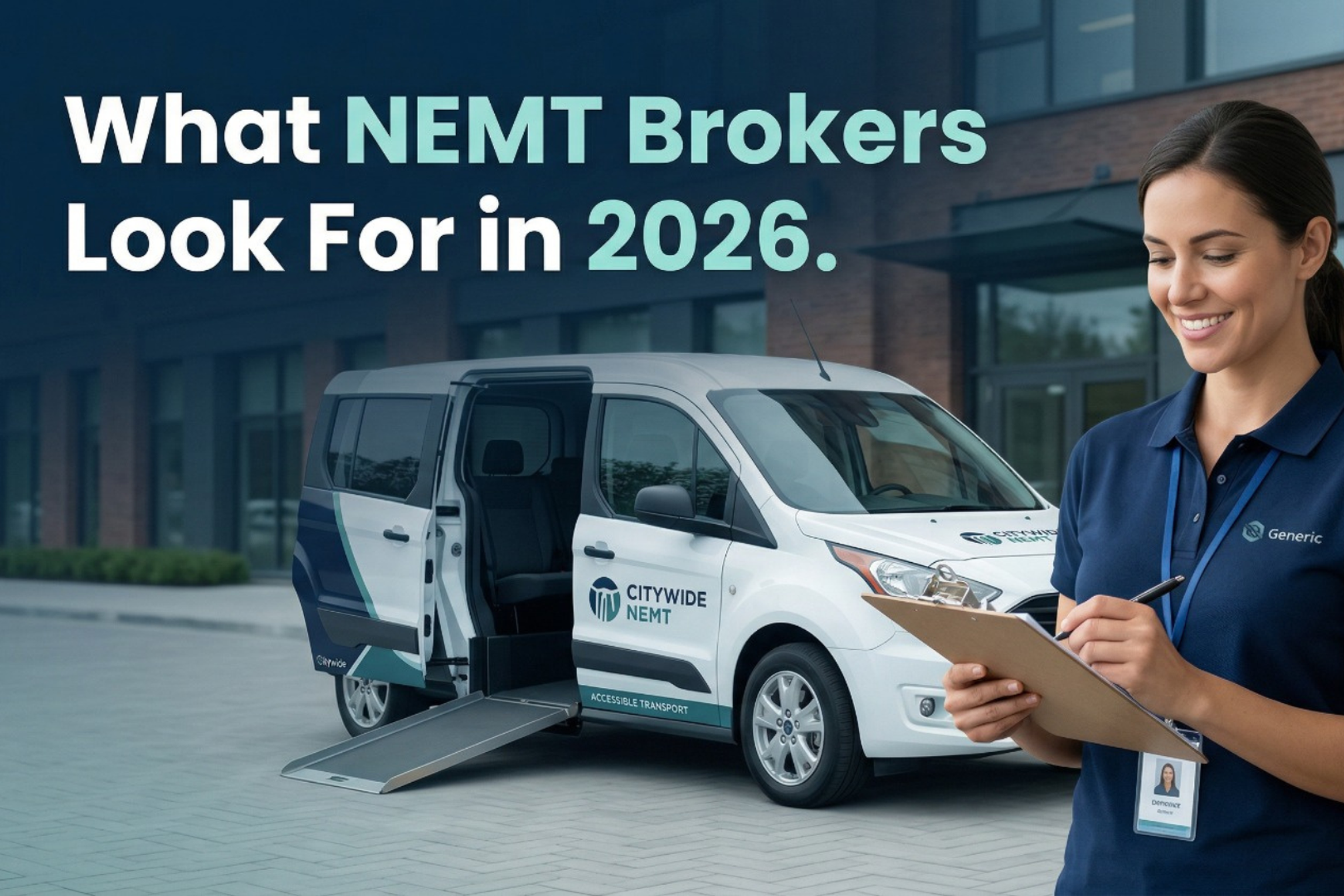
Most NEMT operators apply to broker networks and hear nothing back. Or they get approved, receive a handful of trips, and then watch volume disappear without explanation. The problem is almost always the same. They did not know what brokers actually evaluate.
NEMT brokers like Modivcare, MTM, SafeRide Health, Veyo, and Access2Care manage millions of trips every year for Medicaid and Medicare Advantage plans. Brokers manage roughly 70% of all Medicaid transportation trips in the United States, and that percentage keeps climbing. These companies are not looking for operators with a van and a license. They are looking for businesses that can perform to measurable standards, stay compliant under audit, integrate with their technology, and protect their reputation with health plans.
This post tells you exactly what they evaluate, the real numbers they use, and what you need to do before you submit a single application.
Why Broker Approval Is So Competitive in 2026
The NEMT industry is growing fast. Medicaid transportation spending exceeds $3 billion annually in the United States, and the Medicare Advantage market adds further volume. SafeRide Health alone is projected to coordinate more than 12 million rides in 2026, with 1,116% revenue growth between 2021 and 2024.
That growth sounds like opportunity. It is, but only for providers who meet broker standards. Broker consolidation means fewer, larger networks with stricter requirements. Modivcare coordinates 35 million trips annually across more than 6,500 providers and maintains a 98% trip completion rate. That number is what they report to state Medicaid agencies. Every provider in their network either supports it or threatens it. Providers who threaten it do not stay in the network.
The bar is high and getting higher. Here is what brokers measure.
1. Performance Metrics That Brokers Track in Real Time
Performance data is the first thing brokers examine. Every major broker runs a scorecard system. The thresholds are written into your provider agreement. Fall below them and you face reduced trip volume, a corrective action plan, or outright termination.
SafeRide Health publishes their standards openly. To remain in their network, you must maintain:
· 100% ride response rate
· 95% ride acceptance rate
· 95% on-time performance rate
· Below 1% complaints rate
· Below 5% kickback rate
SafeRide manages to keep their own network-wide complaints and grievances rate at 0.13% of fulfilled rides. That is the environment your performance will be measured against.
Modivcare reviews provider performance quarterly through their scorecard system. Falling below thresholds triggers a corrective action plan first, then probation, then contract termination. MTM operates similarly across their 35-plus state network.
If you do not already track your on-time rate, acceptance rate, and complaint rate every week, start today. You cannot apply with confidence if you do not know your own numbers.
Key Performance Metrics to Track Weekly
· On-time pickup rate (target: 95% or above)
· Trip acceptance rate (target: 95% or above)
· Trip completion rate (target: 98% or above)
· No-show and cancel-at-door rate (target: below 5%)
· Patient complaint rate (target: below 1%)
Bring 90 days of documented performance data to every broker application. Operators who can hand a broker a clean performance report stand out from those who cannot answer basic questions about their own business.
2. Insurance Requirements That Must Be in Place Before Day One
Insurance is the first document every broker requests. Before you can transport a single patient, your coverage must meet the broker's minimums, and the broker must be listed as an additional insured.
SafeRide Health requires:
· Commercial General Liability: $1,000,000 per occurrence, $2,000,000 aggregate
· Auto Liability: $500,000 minimum
· SafeRide listed as additional insured on both policies
Modivcare and MTM require General Liability, Sexual Abuse and Molestation coverage, Auto, and Workers' Compensation insurance. MTM specifically requires an abuse and molestation rider as a separate policy endorsement.
The insurance hierarchy works on a strictest-standard-applies rule. If your state requires $500,000 auto liability but Modivcare requires $1,500,000, you carry $1,500,000. Non-compliance at any level blocks Medicaid reimbursement, not just broker approval.
One critical point: if you plan to transport wheelchair or stretcher patients, tell your insurer before you start. Transporting non-ambulatory patients without the correct coverage classification voids your policy in a claim.
Ready to streamline your transportation workflow?
Discover how an all-in-one NEMT solution can automate scheduling, plan routes and simplify billing so you can focus on delivering exceptional care.
3. Driver Credentials That Every Broker Verifies
Brokers are legally responsible for the drivers in their network. Every driver you employ must clear a specific set of requirements before they touch a single trip. One non-compliant driver can cost you your entire contract.
Required for every driver at every major broker:
· National criminal background check
· National Sex Offender Registry check
· Motor Vehicle Report (MVR)
· Pre-employment drug screening
· Valid driver's license appropriate to vehicle class
· CPR and First Aid certification
· Defensive driving certification
· Wheelchair securement training
Modivcare specifically requires PASS Wheelchair certification. Some state programs add further requirements on top of these. California requires DOJ and FBI LiveScan fingerprinting. Minnesota requires STS certification through MnDOT. Always confirm your state's requirements directly with the Medicaid agency and your target broker before onboarding any driver.
Build a compliance calendar. Track expiration dates for every certification and license in your driver roster. A single expired CPR card during a broker audit can pause your entire trip volume. Brokers check these documents at credentialing and re-check them periodically.
4. Technology Integration That Brokers Require
Phone-based dispatching is not compatible with major broker operations in 2026. Brokers send trips through digital platforms and expect providers to accept, confirm, and update trip status in real time. Providers without integrated dispatch software cannot access full trip volume.
What Modivcare Requires
Modivcare uses two core platforms. The Mobility Access Platform manages real-time ride tracking and integrates with client systems. WellRyde is their proprietary dispatch tool for providers. Every trip generates multiple data points: GPS coordinates, timestamps, and digital signatures. Modivcare's system checks all of these before approving payment. Clean data means fast payment. Missing data means denied claims.
Getting credentialed with Modivcare takes 4 to 8 weeks when you submit complete documentation. Any missing documents reset the clock.
What SafeRide Health Requires
SafeRide Health requires compatible Automated Transportation Management System (ATMS) software. Their approved platforms include RouteGenie, WellRyde, TripMaster, and RoutingBox. Providers without compatible software cannot qualify for their Tier 1 program, which offers priority trip volume and faster payment processing.
SafeRide's platform carries HITRUST r2 Certification, renewed May 2025, which means they hold their provider technology partners to high data security standards as well.
The Business Case for Integration
Providers using broker-integrated software process claims 40% faster, report 65% fewer billing errors, and see reimbursement cycles drop from 45 to 60 days down to 15 to 30 days. Providers operating without integration face manual data entry errors at 15% error rates, delayed trip assignments, and claim rejections that trigger 30 to 60 day payment delays.
The right technology is not optional for competitive providers. It is the difference between steady cash flow and constant financial pressure.
5. Vehicle Standards and Fleet Capacity
Brokers evaluate your fleet before they send you trips. They need to know your vehicles meet safety and accessibility standards, and that your capacity matches the volume they plan to assign.
Every vehicle in your fleet must have:
· Current registration and state inspection certification
· ADA compliance per 49 CFR Part 38 for wheelchair-accessible vehicles
· Wheelchair lift or ramp with securement systems per 49 CFR Section 38.23
· GPS tracking with real-time location visibility (required by all major brokers)
· Two-way communication device
· Business name and phone number in 3-inch minimum letters on both exterior sides
MTM automatically deactivates vehicles from their system at 10 years or 250,000 to 300,000 miles. Check your target broker's specific age and mileage limits before purchasing any vehicle.
Wheelchair and Stretcher Capacity as a Competitive Advantage
Most operators focus on ambulatory trips because the vehicle requirements are simpler. That is exactly why accessible transport is a competitive advantage. Reimbursement rates for wheelchair and stretcher trips are significantly higher than ambulatory. Competition for those trips is lower. Brokers in most markets are short on accessible capacity.
If you have wheelchair-accessible vehicles, list them prominently in your application. Providers who fill that gap get preferential approval and faster volume assignment.
6. Service Area Coverage and Geographic Reach
Brokers think in terms of coverage gaps. If they have concentrated trip demand in a zip code with no reliable provider, they have an operational problem. Operators who fill underserved areas have more leverage than those competing for the same dense urban routes.
When you apply, list every county and zip code you can cover reliably. Do not overstate your reach and then decline trips. Brokers track acceptance rates by geography, and a pattern of rejecting specific areas will cost you volume.
Rural coverage is particularly valued. Research published by Health Management Associates in March 2025 identified network capacity in rural areas as one of the most persistent challenges brokers face nationally. Providers who can cover rural routes reliably receive faster approvals and more consistent assignments.
Ready to streamline your transportation workflow?
Discover how an all-in-one NEMT solution can automate scheduling, plan routes and simplify billing so you can focus on delivering exceptional care.
7. Patient Experience and Complaint Management
Brokers report patient satisfaction data directly to Medicaid agencies and managed care organizations. A sustained complaint trend triggers an audit. Enough complaints trigger a contract review.
SafeRide Health maintains a network-wide complaints and grievances rate of 0.13% of fulfilled rides. Their published provider minimum is below 1%. The gap between those two numbers shows how much room for error actually exists in practice. Very little.
The most common NEMT complaint sources include:
· Late pickups without communication to the patient
· Drivers not trained in proper wheelchair securement
· Incorrect pickup address or trip detail errors
· Drivers who do not assist patients to the door
Every one of these is preventable. Driver training on securement and patient communication, pre-trip confirmation calls, and electronic signature capture at pickup addresses all reduce complaint rates. Brokers notice when your complaint rate improves over time, and they reward it with more trip volume.
8. Business Credentials and Credentialing Timeline
Before you apply to any broker, your business credentials must be in order. Without these, the application will not advance.
· Active National Provider Identifier (NPI) from the NPPES registry
· Federal Employer Identification Number (EIN)
· State Medicaid enrollment as a transportation provider
· SAM.gov registration with a current Unique Entity ID (UEI)
· Medicaid operating authority for every state where you plan to accept trips
The credentialing process at most large brokers takes 90 to 120 days from application to approval. Missing one document resets the clock. Have everything ready before you submit.
What to Do Before You Apply
Run through this checklist before submitting to any major broker.
· Confirm your NPI, EIN, and SAM.gov registration are active
· Verify all driver credentials are current and documented
· Confirm insurance meets the broker's minimums (most require $1M CGL per occurrence)
· Set up dispatch software compatible with the broker's platform
· Prepare a 90-day performance report showing on-time rate and completion rate
· List your full service area by county and zip code
· Document your wheelchair-accessible vehicle capacity separately
· Request a copy of the broker's provider agreement before signing anything
Brokers receive dozens of applications every month. The ones that get approved come from operators with clean documentation, measurable performance history, and the right technology already in place. Your job before you apply is to look like the kind of provider they want more of.
Frequently Asked Questions
Q1. How long does it take to get approved by a major NEMT broker?
Most major brokers take 90 to 120 days to complete the credentialing process from the date you submit a complete application. Modivcare runs faster, at 4 to 8 weeks, when documentation is complete. Missing any required document resets the timeline. Submit everything at once. Do not wait for the broker to ask for missing items.
Q2. Can a new NEMT business with no trip history get approved by brokers?
Yes, but it is harder. Brokers prefer providers with documented performance data. If you are brand new, focus on getting your compliance and insurance in perfect order, your technology integrated, and your fleet verified. Some brokers, including SafeRide Health, consider geographic coverage gaps and accessible vehicle capacity more heavily than trip history. If you cover an underserved area or offer wheelchair transport in a shortage market, that improves your approval chances significantly.
Q3. Do NEMT brokers look at credit scores or financial history?
Brokers do not typically pull business credit scores. What they do evaluate is your insurance, your compliance documentation, your vehicle condition, and your driver credentials. Financial stability is indirectly assessed through your insurance coverage levels and your ability to meet equipment standards. Providers who cannot meet the vehicle or insurance minimums signal financial risk without brokers needing a credit report.
Q4. What happens if my performance drops below the broker's thresholds?
Each broker handles this differently, but the sequence is generally the same. First, you receive a written notice identifying which metric fell below the minimum. Then, you are placed on a corrective action plan with a defined improvement window. If your performance does not recover, the broker reduces your trip volume. If it continues to decline, they terminate your contract. SafeRide Health, Modivcare, and MTM all use scorecard systems that flag performance trends before they reach the termination level. Regular internal reviews of your own metrics give you time to correct before the broker does.
Q5. Is it worth joining multiple broker networks at once?
Yes, and most experienced NEMT operators do. Different brokers serve different health plans and geographic areas. Modivcare operates in 20-plus states. MTM covers 35-plus states. SafeRide Health covers all 48 contiguous states plus Hawaii, Alaska, and U.S. territories. Joining multiple networks increases trip volume and reduces your dependence on any single payer relationship. The key is using dispatch software that can manage multiple broker platforms in a single dashboard, so your team is not manually toggling between systems. Managing multiple contracts without integrated software creates the kind of manual data entry errors that lead to claim denials.
Q6. What is a Tier 1 provider and how do you qualify?
SafeRide Health's Tier 1 program connects top-performing providers directly with health plans, giving them priority trip volume and faster payment processing. High-volume Tier 1 providers can earn up to $380,000 annually through the program. Qualification is based on sustained performance above the standard thresholds: response rate, acceptance rate, on-time performance, and complaint rate. The program is not available to new providers. You build toward it by consistently hitting your numbers over time and maintaining clean documentation. Other brokers use similar tiering systems under different names, with preferred volume status as the reward for top performance.
Disclaimer
The information in this blog post is for general informational purposes only. It does not constitute legal, financial, or regulatory advice. NEMT regulations, Medicaid policies, and compliance requirements vary by state and change frequently. The statistics and figures cited reflect publicly available data and industry reports at the time of publication. Always consult a licensed attorney, compliance officer, or regulatory specialist before making decisions based on this content. NEMT Platform makes no representations or warranties regarding the accuracy, completeness, or applicability of this information to your specific operation or jurisdiction.
Related Articles
Discover why NEMT Platform is the best NEMT software in California, offering live OVERSIGHT dispatch, multi-broker auto-billing, and a 24/7 multilingual AI receptionist.
Medi-Cal pays for Uber and Lyft rides under the NMT benefit for ambulatory members, but wheelchair and gurney patients require a certified NEMT provider.
How NEMT billing really works in 2026: the claim lifecycle, why claims get denied, EVV and compliance, and how the right billing software gets you paid faster.
For NEMT leadership: why margins are compressing, the three exposures the C-suite owns, and how technology decisions protect the P&L at enterprise scale.