


Table of contents▼
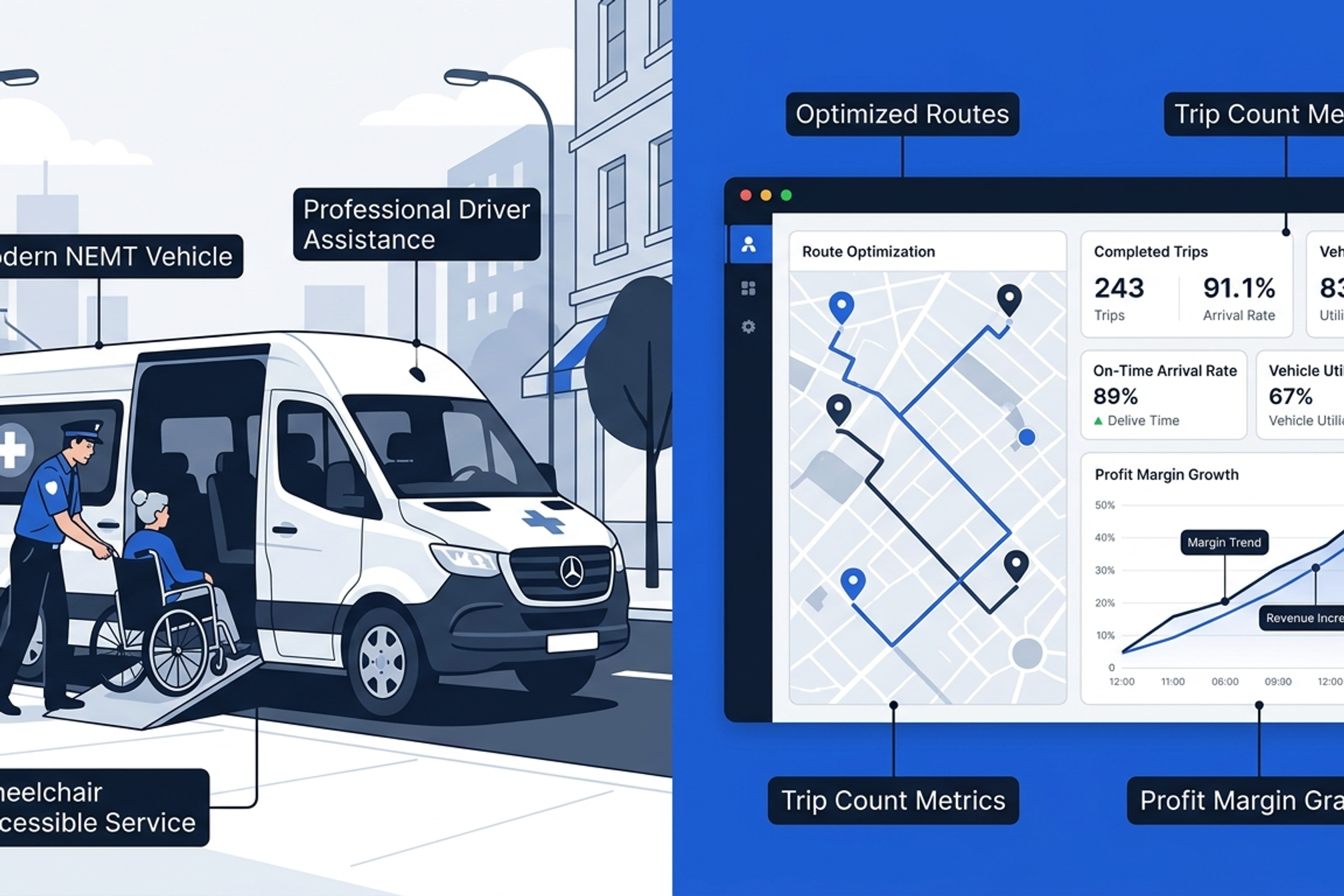
Who this is for: Aspiring healthcare entrepreneurs evaluating NEMT as their first business entry point, current fleet owners or logistics operators considering diversification into medical transport, and medical logistics investors benchmarking the NEMT market against other healthcare services opportunities in 2026. If you're deciding whether to commit capital and time to a NEMT company, this post gives you an evidence-based answer.
Is NEMT a Good Business to Start in 2026?
Direct answer:
- Yes, under specific conditions. NEMT is a structurally sound business with recurring government-backed demand, low product obsolescence risk, and a clear path to profitability within 12–18 months for operators who enter with adequate capital and the right software infrastructure.
- Market size: The U.S. NEMT market is valued at approximately $12.5 billion in 2026 and growing at a 5.5% CAGR, driven by Medicaid expansion, an ageing population, and value-based care models that mandate transportation as a covered benefit.
- Profit margins: Broker-reimbursed trips (Medicaid, Medicare Advantage) generate net margins of 8–15% for well-run operators. Private pay and healthcare facility contracts produce margins of 20–35%. Operators running both revenue streams typically land between 12–22% net.
- Startup capital required: $40,000–$120,000 for a two-to-three vehicle launch, depending on vehicle acquisition strategy (new vs. used) and state licensing costs.
- Primary risk: Undercapitalisation at launch, over-reliance on a single broker contract, and failure to control dispatch and fuel overhead in the first 12 months.
NEMT is not a passive business. It rewards operators with operational discipline — those who manage routes efficiently, maintain compliance, and diversify revenue sources. It punishes those who treat it as a simple logistics play.
The 2026 NEMT Market: Why Demand Is Structurally Durable
The demand side of the NEMT business is not speculative. It is legislated.
Medicaid is the primary payer in NEMT, and federal law requires states to provide transportation to Medicaid-eligible individuals who have no other means of reaching covered services. That mandate does not disappear in a recession, does not get disrupted by technology, and does not get commoditised away. It is a floor of demand that no other transportation segment can claim.
Demographic pressure reinforces it. By 2030, one in five Americans will be over 65. Adults over 65 generate four times as many medical appointments per year as adults under 45 and are significantly more likely to require wheelchair-accessible or assisted transport. That cohort is already the primary driver of NEMT trip volume and will continue to grow through the next decade.
Additional structural demand drivers in 2026:
- Medicaid managed care organisations (MCOs) are increasingly contracting NEMT directly with regional providers rather than routing exclusively through national brokers — creating more favourable margin structures for mid-size operators
- Hospital discharge planners and dialysis centres are actively partnering with NEMT companies on facility-direct contracts, bypassing broker reimbursement entirely
- Value-based care models incentivise healthcare systems to reduce missed appointments — and NEMT is the direct operational solution
The NEMT market is not going to get smaller. The question is whether a specific NEMT company can capture a profitable share of it.
Ready to streamline your transportation workflow?
Discover how an all-in-one NEMT solution can automate scheduling, plan routes and simplify billing so you can focus on delivering exceptional care.
The Case For: Why NEMT Is a Strong Business Model
Recurring, Government-Backed Revenue
Medicaid reimbursement is not guaranteed per trip, but it is contractually structured through broker agreements that provide predictable volume and rate schedules. An operator with three active broker contracts — MTM, ModivCare, and a regional MCO — has a diversified revenue base that is more stable than most small business models.
Trip demand is also non-discretionary. Dialysis patients need transport three times a week regardless of economic conditions. Cancer treatment patients don't defer appointments because of inflation. The recession-resistance of NEMT revenue is a meaningful differentiator from most small business categories.
Low Product Obsolescence Risk
NEMT does not face the disruption risk of ride-share platforms in standard transportation. Medicaid-funded NEMT requires ADA compliance, credentialed drivers, and liability insurance structures that consumer ride-share cannot meet. Uber Health and Lyft Medical exist in the NEMT adjacent space but operate primarily for ambulatory, non-Medicaid passengers — they are not meaningful competitive threats to a compliant NEMT business serving complex mobility passengers.
Scalable Revenue Model
A single-vehicle NEMT operation running 12–15 trips per day at an average reimbursement of $28–$45 per trip generates $120,000–$195,000 in gross annual revenue. Net margin at 12–15% produces $14,400–$29,000 per vehicle per year. Each additional vehicle, assuming similar utilisation, adds proportionally — and fixed overhead costs (insurance, software, office) are spread across a larger revenue base.
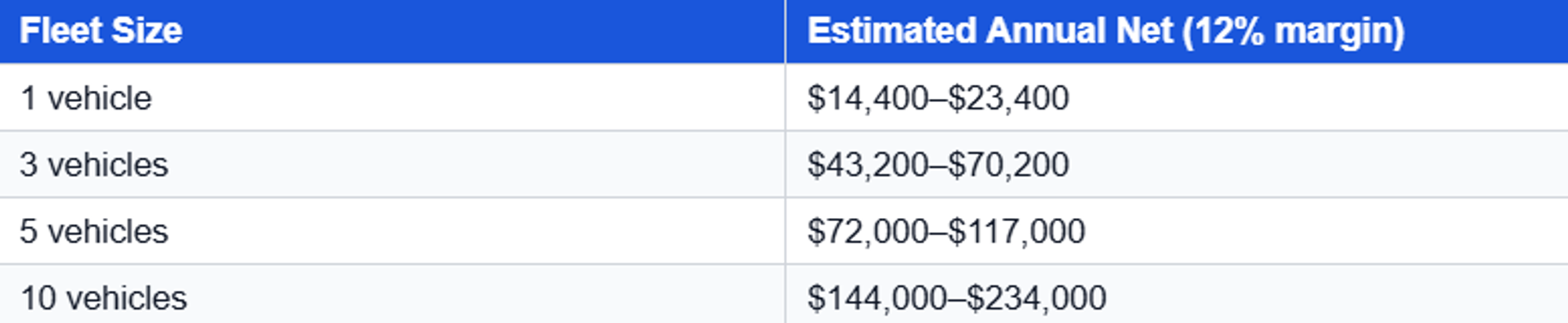
These are conservative figures based on broker reimbursement rates. Operators who successfully add private pay or facility-direct contracts alongside broker volume see materially higher net outcomes.
Multiple Revenue Streams
A well-structured NEMT company doesn't rely solely on Medicaid broker reimbursement. The most profitable operators run three to four revenue channels in parallel:
- Medicaid broker trips: High volume, lower margin (8–15% net), predictable
- Private pay: Lower volume, higher margin (25–40% net), requires direct marketing
- Healthcare facility contracts: Dialysis centres, cancer treatment facilities, nursing homes — often structured as monthly retainers or per-trip guarantees
- Veterans Affairs (VA) transport: Separate federal programme with its own reimbursement structure; accessible to credentialed NEMT operators
The Case Against: Where NEMT Businesses Fail
Rising Insurance Premiums
Commercial auto insurance for NEMT vehicles with passenger liability coverage has increased 18–24% since 2022. In 2026, operators should budget $4,800–$9,600 per vehicle per year depending on state, driver history, and passenger classification. For a three-vehicle startup, that's $14,400–$28,800 annually in insurance alone — before a single trip is run.
Insurers have tightened underwriting criteria for new NEMT operators. A company with less than 12 months of operating history and no documented safety programme will pay at the upper end of that range or face declination from standard carriers.
Driver Retention
Driver turnover in the NEMT segment runs at 60–80% annually for operators who don't invest in retention. The work is physically demanding, the pay range is $16–$22/hour for most markets, and competition from Amazon DSP, gig logistics, and other transportation employers is constant.
The operational cost of driver turnover is significant: recruiting, background checks, DMV checks, and training typically cost $800–$1,400 per driver hire. An operator losing eight drivers a year on a 10-driver team is spending $6,400–$11,200 annually just to stay staffed.
Operators who solve driver retention — through consistent scheduling, vehicle quality, route optimisation that reduces deadhead and wait time, and reliable pay processes — have a meaningful structural advantage over those who don't.
Broker Reimbursement Rate Pressure
Medicaid broker reimbursement rates are set by state contracts and renegotiated periodically. In several states, rates have not kept pace with fuel and insurance cost increases. Operators who built their unit economics on 2021–2022 reimbursement assumptions and haven't adjusted for the 2024–2026 cost environment are operating at compressed or negative margins on broker-only trips.
This is not a fatal flaw — it's a structural reality that requires diversification. Operators who treat broker reimbursement as a base and build private pay or facility contracts on top are structurally protected. Those who remain broker-only are exposed.
Regulatory and Compliance Overhead
NEMT is a regulated industry. State DOT vehicle inspections, Medicaid provider credentialing, broker-specific compliance requirements, and driver background check mandates create administrative overhead that catches new operators off guard. Budget 5–8 hours per week of administrative time for a three-vehicle operation, or the cost of a part-time compliance coordinator.
Ready to streamline your transportation workflow?
Discover how an all-in-one NEMT solution can automate scheduling, plan routes and simplify billing so you can focus on delivering exceptional care.
Realistic Timeline to Profitability
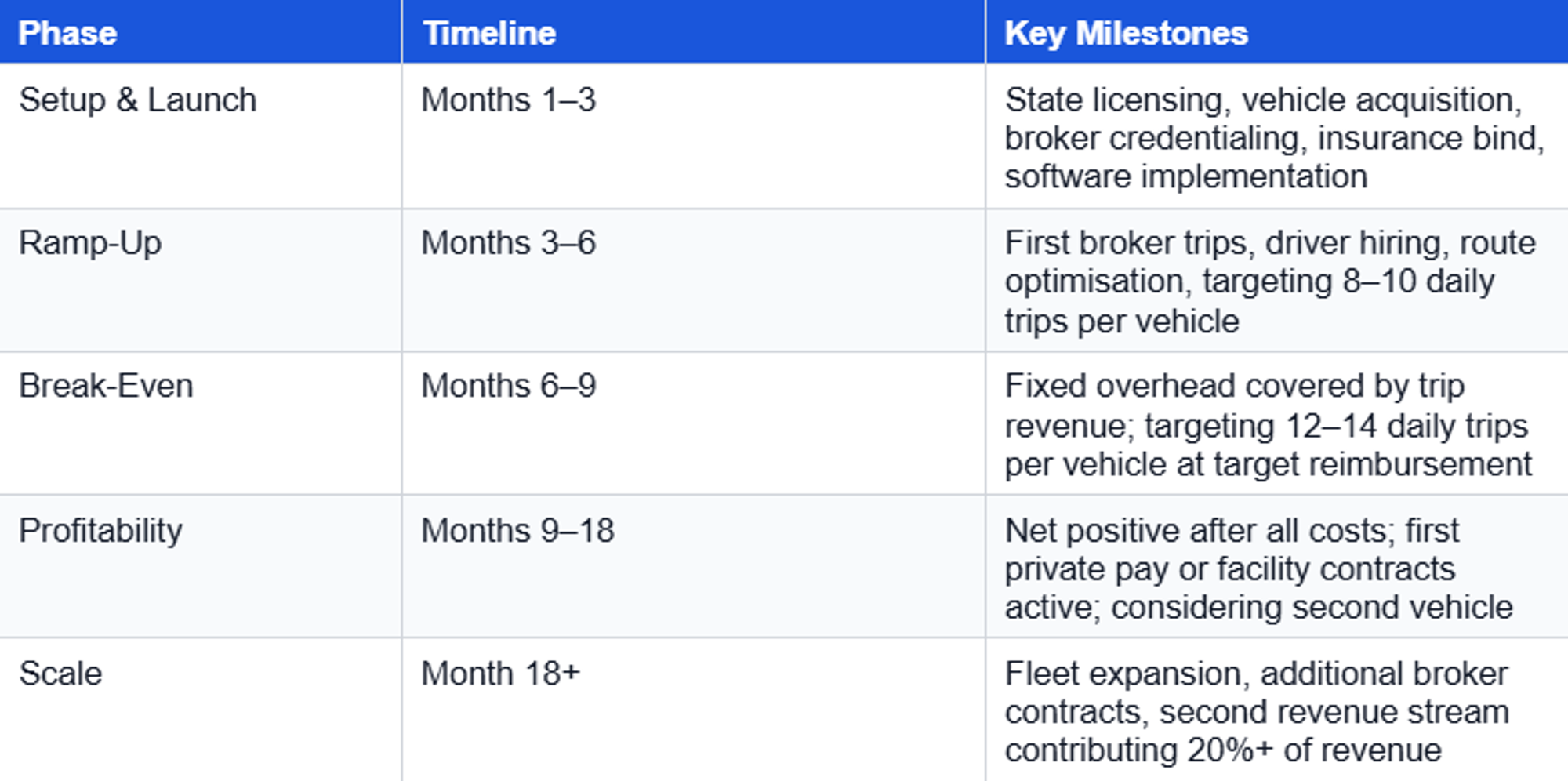
Operators who enter with $80,000+ in working capital, two vehicles ready to run on day one, and active broker applications filed before launch consistently reach break-even inside nine months. Undercapitalised operators — launching with one vehicle and insufficient cash reserve — typically extend this timeline to 18–24 months or exit the market.
What Does It Actually Cost to Start a NEMT Business in 2026?
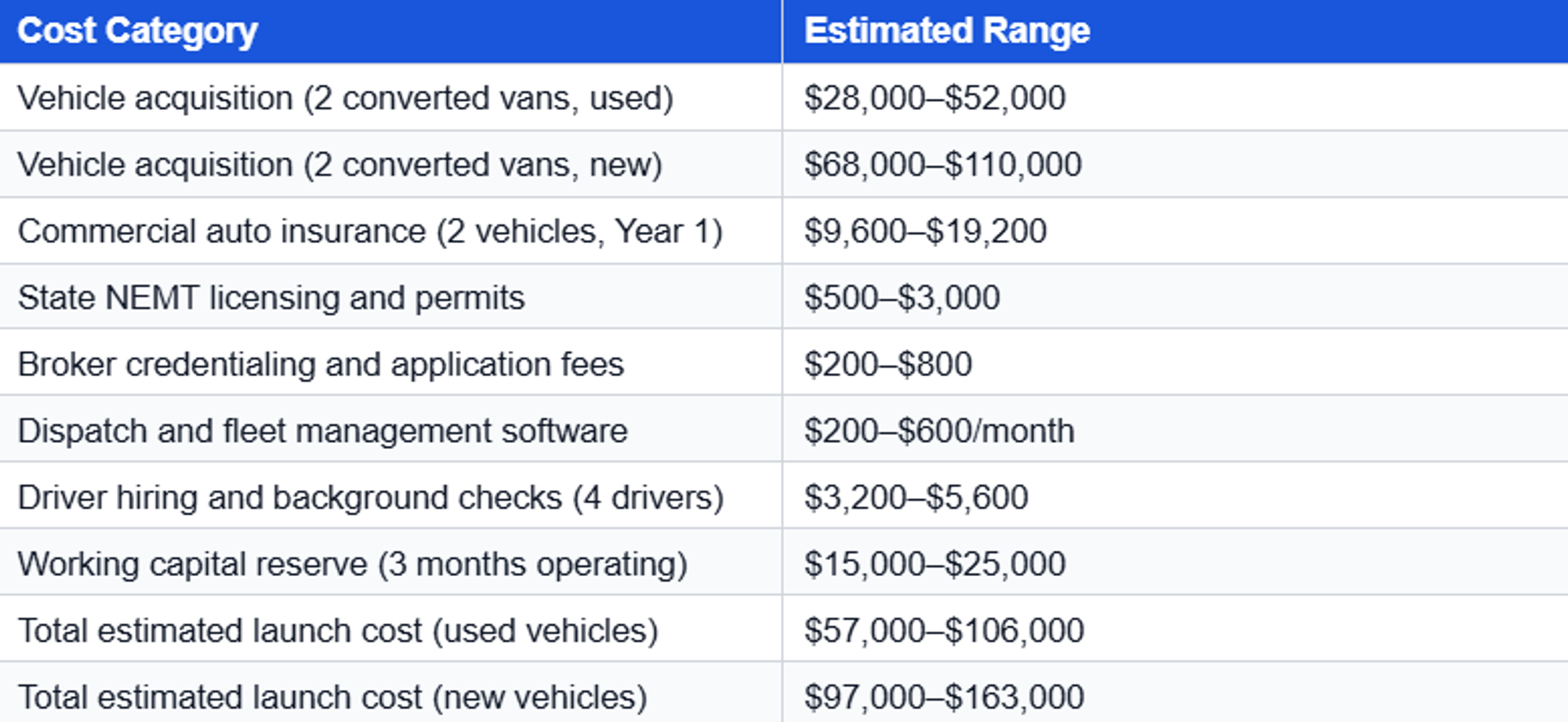
These figures assume a two-vehicle launch in a mid-sized U.S. market. States with higher Medicaid reimbursement rates (e.g., New York, Massachusetts, California) justify higher acquisition costs. States with lower rates (e.g., Mississippi, Alabama) require tighter cost control to reach viable margins.
FAQ
What profit margin should I expect from a NEMT business?
Broker-reimbursed NEMT trips (Medicaid, Medicare Advantage) produce net margins of 8–15% for operationally disciplined companies. Private pay trips and facility-direct contracts produce 20–35% net. Operators running a blended model — broker volume as the base, private pay and facility contracts layered on top — typically achieve 12–22% net margin once past the break-even phase. Year one margins are typically lower (5–10%) due to ramp-up costs and suboptimal route density.
How long does it take to get credentialed as a NEMT broker provider?
Broker credentialing timelines vary significantly. MTM and ModivCare typically process new provider applications in 30–60 days if documentation is complete. State Medicaid direct credentialing can take 60–120 days. Regional MCO contracting is often faster — 30–45 days — but requires a state-enrolled provider number first. Build at least 60–90 days of credentialing time into your launch plan before expecting first trip assignment.
Is NEMT a good business in rural areas or only urban markets?
Rural NEMT markets have lower trip density but often face less competition and may carry higher per-mile reimbursement rates to account for distance. The economics are different: fewer trips per day, longer average trip distance, and higher fuel cost per trip. Rural operators who serve dialysis and oncology patients — high-frequency, non-discretionary trips — can build viable businesses, but the path to scale is slower. Urban markets offer higher trip density and faster break-even but more competition and higher insurance costs.
What are the biggest mistakes new NEMT business owners make?
The four most common failure patterns: launching undercapitalised without a three-month cash reserve; relying on a single broker contract for 80%+ of revenue; ignoring driver retention until turnover becomes a crisis; and manual dispatching that fails to scale past four to five vehicles. Each of these is avoidable with planning — but each is common enough that they collectively account for the majority of NEMT business failures in the first 18 months.
How can NEMT Platform assist entrepreneurs starting an NEMT business?
NEMT Platform addresses the four operational variables that most directly affect whether a new NEMT company reaches profitability or stalls.
Scheduling automation eliminates the manual dispatch overhead that consumes 15–25 hours per week at a three-to-five vehicle operation. The AI Auto Route Planner assigns trips by vehicle capacity, geographic clustering, and driver availability — reducing deadhead miles and increasing daily trip completions per vehicle without adding headcount.
Multi-broker billing integration pulls trip assignments from MTM, ModivCare, LogistiCare, and regional MCOs into a single queue and generates submission-ready claims from verified trip data. New operators typically lose 8–12% of billable revenue in their first year through billing errors and missed submissions. NEMT Platform closes that gap from day one.
The NEMT Max driver app captures per-trip data — mileage, fuel, completion timestamps — that feeds directly into billing and compliance reporting. Operators don't need to reconstruct trip records from driver memory or paper logs.
For a new NEMT company, the combined effect is a lower break-even point, faster credentialing compliance, and an operational infrastructure that scales from two vehicles to twenty without a proportional increase in administrative overhead. Most new operators using NEMT Platform report reaching operational break-even 60–90 days faster than their manual-dispatch counterparts.
NEMT is a good business for operators who enter it with clear eyes. The demand is real, the revenue is recurring, and the path to profitability is well-defined. The operators who fail are almost uniformly those who underestimate the capital requirements, overestimate early margins, or try to manage a multi-vehicle operation on manual processes. Get the fundamentals right — capitalisation, diversified revenue, and operational software from day one — and NEMT is one of the more defensible small business models in the healthcare services sector.
Related Articles
Medi-Cal NEMT vs Uber/Lyft: California CalHHS Policy Guide
Medi-Cal pays for Uber and Lyft rides under the NMT benefit for ambulatory members, but wheelchair and gurney patients require a certified NEMT provider.
NEMT Billing Explained: From Trip to Paid Claim (2026)
How NEMT billing really works in 2026: the claim lifecycle, why claims get denied, EVV and compliance, and how the right billing software gets you paid faster.
Executive Guide to NEMT: Margin, Risk & Technology
For NEMT leadership: why margins are compressing, the three exposures the C-suite owns, and how technology decisions protect the P&L at enterprise scale.
Starting an NEMT Business in 2026: Where the Real Profit Comes From
NEMT operators in 2026 can reach 20-35% margins via hospital discharge contracts, stretcher and bariatric transport, long-distance trips, and private concierge accounts beyond standard broker rides.