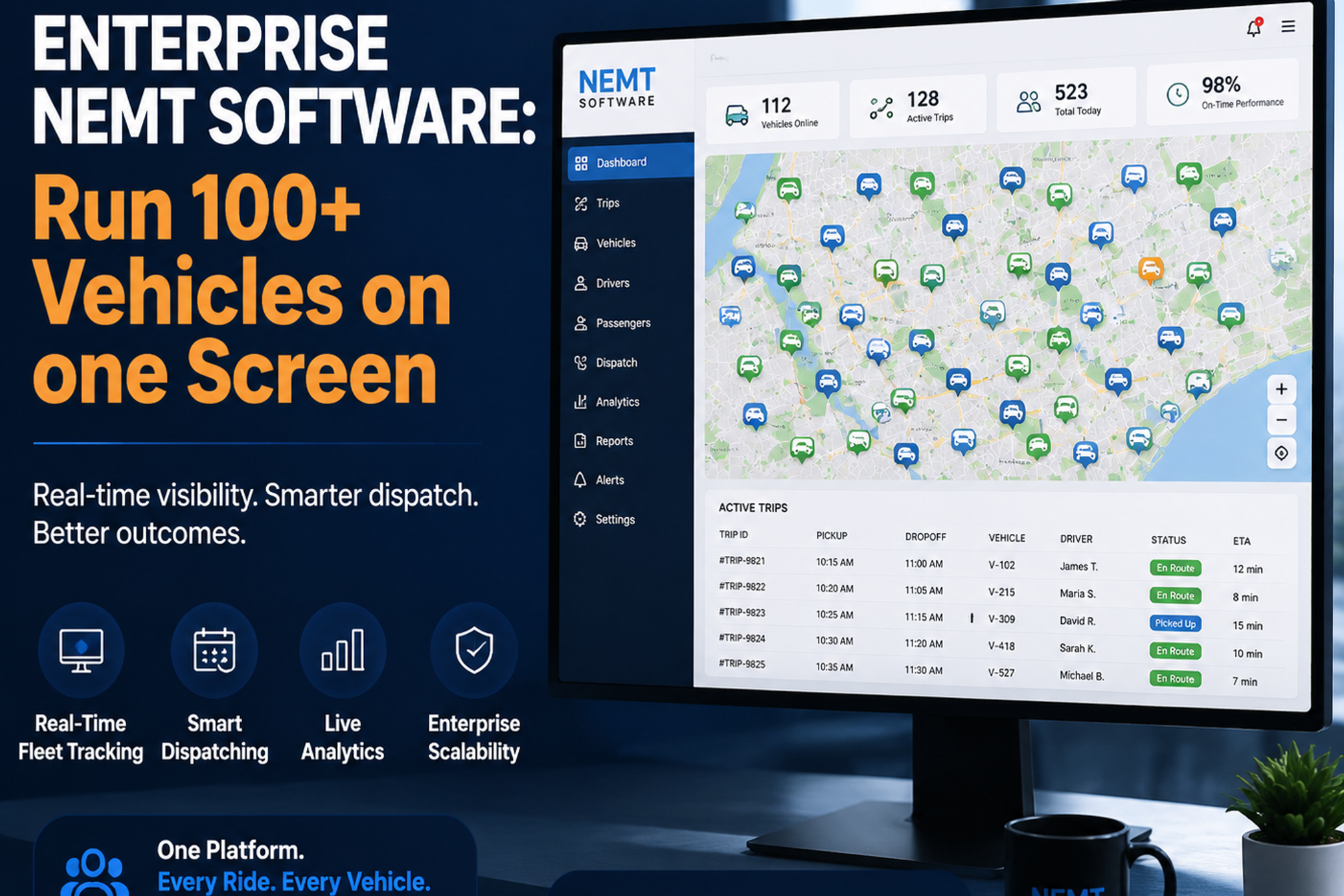
The short answer: Enterprise NEMT software is a unified platform that runs dispatch, billing, compliance, and multi-location oversight for large non-emergency medical transportation operations from one system. At enterprise scale, the biggest threat to margin is not manual work, it is fragmentation. When each location, broker, and function runs on its own tool, no one has a single source of truth. Enterprise NEMT software closes that gap so leadership can see and control the whole operation.
If you run a large NEMT operation, you have already solved the problems that fill most industry blogs. You know how to win a broker contract, hire drivers, and bill Medicaid. Your challenge is different and rarely written about honestly: keeping a 100-vehicle, multi-location operation coordinated, compliant, and profitable when complexity is compounding faster than your systems can handle it. This guide is written for that operator, and it covers what actually breaks at scale and what to look for in a platform built to run an operation of your size.
What is enterprise NEMT software?
Enterprise NEMT software is transportation management software built to run large, multi-location NEMT operations on one unified system, covering dispatch, routing, billing, compliance, and cross-location reporting.
The difference between enterprise NEMT software and a small-business tool is not a longer feature list. It is the ability to run complexity at scale: managing many vehicles across multiple locations, absorbing several broker contracts at once, enforcing compliance uniformly, and giving leadership a live view of the entire operation. A tool that works for a five-vehicle operator does not automatically work for a 150-vehicle operation across four sites, because the enterprise problem is coordination and visibility, not basic dispatch.
Why enterprise NEMT breaks differently than small operations
Enterprise NEMT operations fail from complexity that scales faster than visibility, not from the problems that challenge small providers.
A five-vehicle operator can hold their entire business in their head. A 100-plus vehicle operation across multiple locations cannot be held in anyone's head, and that is precisely the problem. When no single person can see the whole picture, gaps open in the spaces between systems, locations, and shifts, and those gaps are where money leaks.
The failure mode is almost never one catastrophic event. It is the steady accumulation of small, invisible losses: a location running a slightly worse on-time rate that no one notices for a quarter, a broker's claims formatted wrong at one site but not another, deadhead miles that are individually trivial and collectively enormous, a compliance gap that only surfaces during an audit. None of these is visible from inside a single location. They are only visible from above, and most enterprise NEMT operations have no vantage point that sees the whole operation at once.
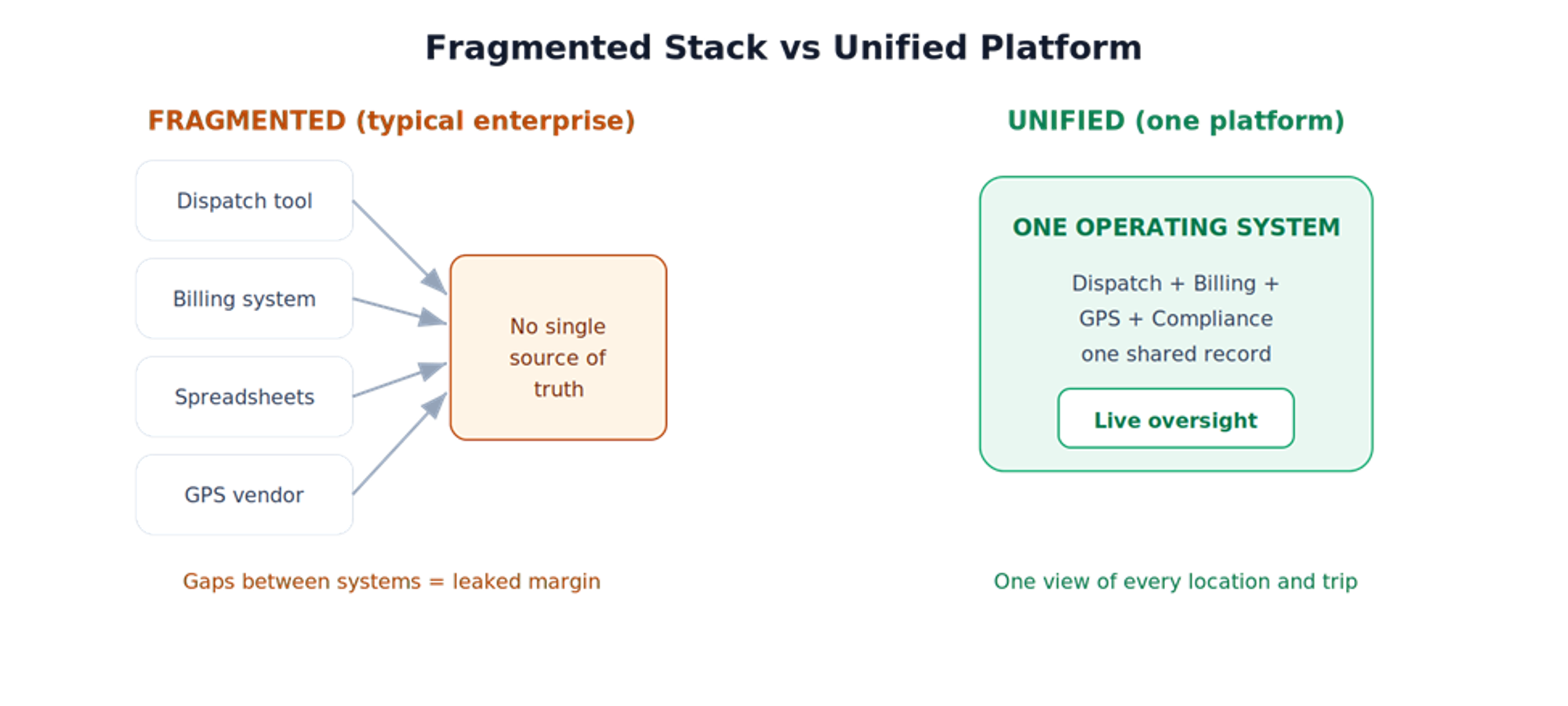
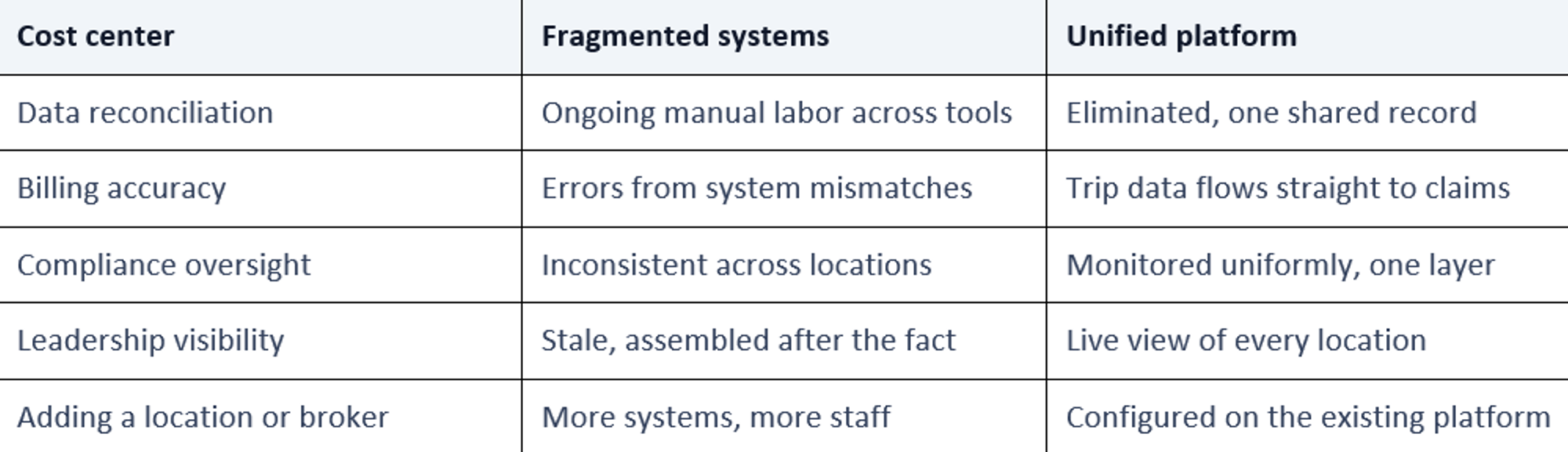
Figure 1: At scale, the cost is in the gaps between disconnected systems. A unified platform closes them by writing everything to one shared record.
What is the hidden cost of fragmentation at scale?
Fragmentation is expensive in direct proportion to size, because every disconnect between systems is multiplied by trip volume.
When your dispatch, billing, GPS, and compliance functions live in separate tools that do not share data, your team spends its time reconciling systems instead of running the operation. At five vehicles that reconciliation is an annoyance. At 100-plus vehicles across multiple sites, it is a full cost center that produces nothing. Staff hours go to manually moving data between systems and chasing discrepancies. Billing errors slip through because the trip data in the dispatch tool does not match what reaches the billing system. Compliance risk grows because no one is watching every location's EVV capture consistently. And leadership makes decisions on stale, partial data pulled together after the fact.
Consolidation is a margin play, not a convenience upgrade. Every function you pull onto a single platform removes a reconciliation cost, closes a data gap, and gives you cleaner information to run on. Verified platform benchmarks: 66 percent reduction in manual workload and 99.2 percent first-submission claim approval. At enterprise volume, points of claim approval and percentages of manual workload are the difference between a healthy operation and a struggling one.
What does multi-location control actually require?
Multi-location control requires managing each site's operation independently while seeing all of them through one lens.
You need each location to run its own dispatch, drivers, and daily reality, and you need leadership to compare locations, spot the underperformer, and enforce standards across all of them from a single vantage point. Concretely, that means role-based access so a site manager sees their location while a regional director sees several and the owner sees everything. It means standardized reporting so you can put every location's on-time rate, claim approval, and utilization side by side. It means shifting resources and setting consistent rules across locations without rebuilding the wheel at each one.
This is where platform architecture matters more than any single feature. The NEMT Platform is built as a set of connected panels: a Provider Panel for the operational core, a Broker Panel for network-level management, and a Corporate Panel for organizations managing transportation across departments and sites. For a multi-location enterprise, that architecture lets the operation scale by configuration rather than by bolting on disconnected tools every time you grow.
How do enterprise operations handle multi-broker complexity?
Enterprise operations tame multi-broker complexity by letting the platform apply each broker's rules automatically instead of relying on staff to remember them.
A large provider is rarely serving one broker. You are running trips for several at once, each with its own authorization rules, formatting requirements, EVV expectations, and claim formats. At your volume, the administrative burden of keeping these straight by hand is enormous, and every mistake is a denied claim or a compliance flag. A platform built for scale imports trips from each broker and understands, per trip, which rule set applies, routing each trip through the correct compliance and billing logic without a person holding the differences in their head.
This breaks the link between adding brokers and adding back-office staff. The NEMT Platform integrates directly with the major brokers, including ModivCare, MTM, Saferide, Call the Car, VectorCare, and Kaiser Permanente, with more than 40 integrations across brokers and healthcare systems. For an enterprise operator, integration breadth determines whether new contracts slot into your existing operation cleanly or force a new manual process each time.
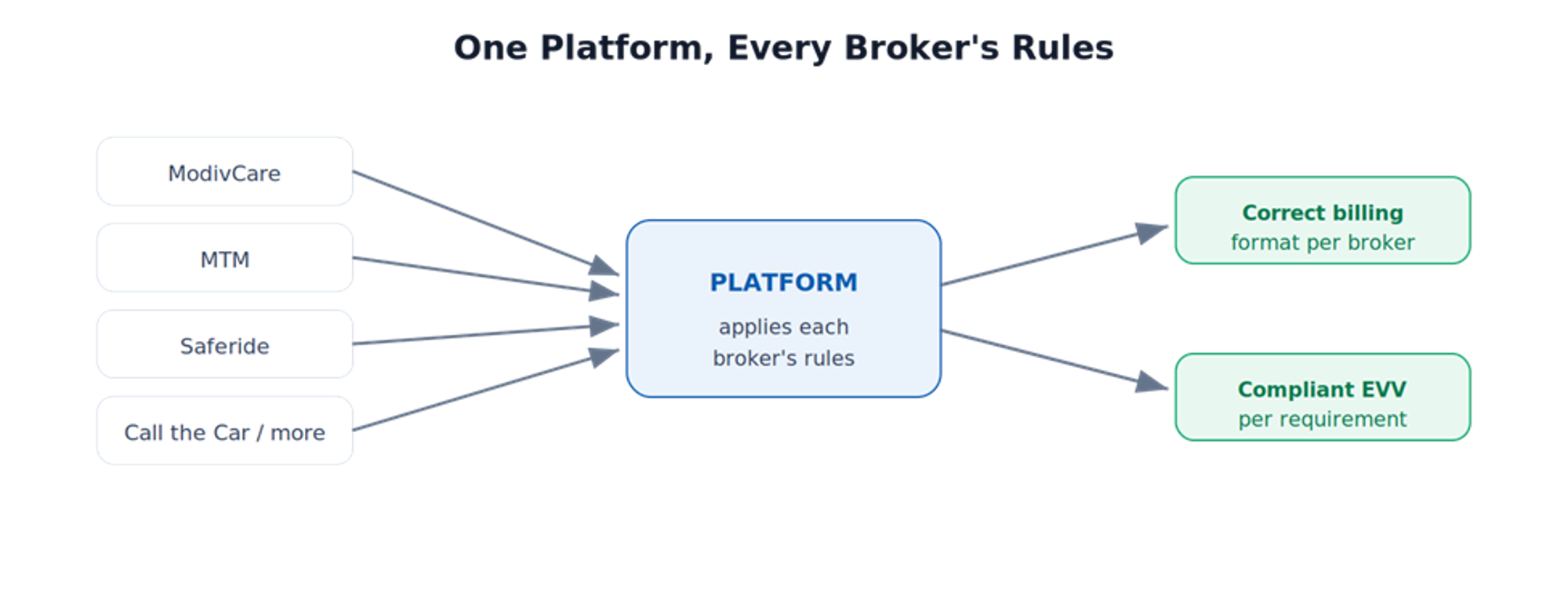
Figure 2: Multi-broker complexity is absorbed by the platform. Each trip is routed through its own broker's rules automatically, so growth does not require proportional back-office headcount.
How does enterprise NEMT software reduce compliance risk?
At enterprise scale, a systemic compliance gap is a pattern repeated across every location and thousands of trips, so uniform, automated monitoring is the only reliable defense.
A small provider with a compliance miss has a problem. An enterprise provider with a systemic compliance gap has that same problem happening thousands of times a month, often invisibly, until an audit surfaces it. An intelligence layer like Oversight on the NEMT Platform continuously compares live trip data against scheduled parameters across every location. It monitors GPS against planned routes, checks EVV capture, and flags late trips, missed pickups, and route deviations before they become denied claims or audit findings.
The enterprise value is uniformity. Every location is held to the same standard automatically, so compliance does not depend on which site manager happens to be diligent. When every trip carries verifiable GPS, timestamps, and EVV, the record defends itself in an audit. Verified example: Helping Hands Transportation reached 100 percent compliance and 80 percent paperwork reduction on the platform. At enterprise scale, losing a major broker contract over a compliance failure is an existential event, and systematic monitoring is what prevents it.
How to evaluate an enterprise NEMT Platform
Evaluate enterprise NEMT software on scale, consolidation, and risk, not on feature checklists every vendor can pass.
Small-business buyers compare features. Enterprise buyers should compare a platform's ability to run their specific complexity. These are the questions that separate a real enterprise platform from a scaled-up startup tool.
Does it unify the core functions? Dispatch, billing, GPS, and compliance writing to one shared record, or four tools you still have to reconcile.
Can it manage multiple locations from one view? Role-based access and standardized cross-location reporting, not several single-site installs.
Does it absorb your broker mix? Direct integrations with your actual brokers and automatic per-broker rule handling.
Is compliance systematic? Continuous, uniform monitoring across every location, not periodic manual review.
Has it proven it operates at your scale? Evidence of handling volume comparable to yours, not just small-operator case studies.
What is the migration path? How the platform moves you off your current systems without halting operations.
On the scale question, track record is the evidence that matters. The NEMT Platform serves 450+ providers and manages over 1M trips per month across 40+ integrations. For an enterprise operator, that volume is proof the system does not buckle under the load you would put on it.
See it run at your scale
Get a walkthrough built around your locations, your broker mix, and your volume, and see how the operation looks on one platform instead of five.
What is enterprise NEMT software?
Enterprise NEMT software is transportation management software built to run large, multi-location NEMT operations on one unified system. It combines dispatch, routing, billing, compliance, and cross-location reporting, and it is distinguished from small-business tools by its ability to run complexity at scale rather than by having more features.
How is enterprise NEMT software different from regular NEMT software?
Enterprise NEMT software adds multi-location management from a single view, direct integration with multiple brokers, uniform compliance monitoring across sites, and proven high-volume throughput. Regular NEMT software handles a single operation; enterprise software coordinates many locations and broker relationships as one system.
Can one platform handle multiple brokers at enterprise volume?
Yes, when the platform applies each broker's rules automatically. It imports trips from each broker and routes them through the correct authorization, EVV, and billing logic, which breaks the link between adding brokers and adding back-office staff.
How does enterprise NEMT software protect margin?
By consolidating fragmented systems onto one shared record, which eliminates reconciliation labor, reduces billing errors, and gives leadership live visibility. At enterprise volume, small percentage improvements in claim approval and manual workload translate into significant absolute margin.
Is it worth migrating a large NEMT operation to a new platform?
The case rests on consolidation savings: eliminating reconciliation labor, reducing billing errors, and gaining live visibility across locations. At enterprise volume these add up quickly, but you should evaluate the migration path carefully and model the gains against your own numbers before committing.
Related Articles
Discover why NEMT Platform is the best NEMT software in California, offering live OVERSIGHT dispatch, multi-broker auto-billing, and a 24/7 multilingual AI receptionist.
OVERSIGHT is NEMT Platform's dispatch intelligence framework — real-time GPS tracking, automated scheduling, multi-broker reconciliation, and billing automation in one system. Learn how it works.
Florida is one of the strongest NEMT markets in the country — 4.7 million Medicaid enrollees, the oldest median age of any large US state, and a wait-time billing provision most operators never use. But it also has county-level licensing rules that catch new providers off guard, insurance costs that rank among the highest nationally, and two dominant brokers you must be credentialed with before you run a single Medicaid trip. This guide covers everything you need to start and operate an NEMT business in Florida in 2026.
CMS 2026 quality reporting requirements are tightening Medicaid compliance standards for all NEMT providers. If you run a 7 to 10 vehicle fleet, this guide covers the exact documentation, billing, and performance standards you need to meet before audits arrive. Backed by real data.