


Table of contents▼
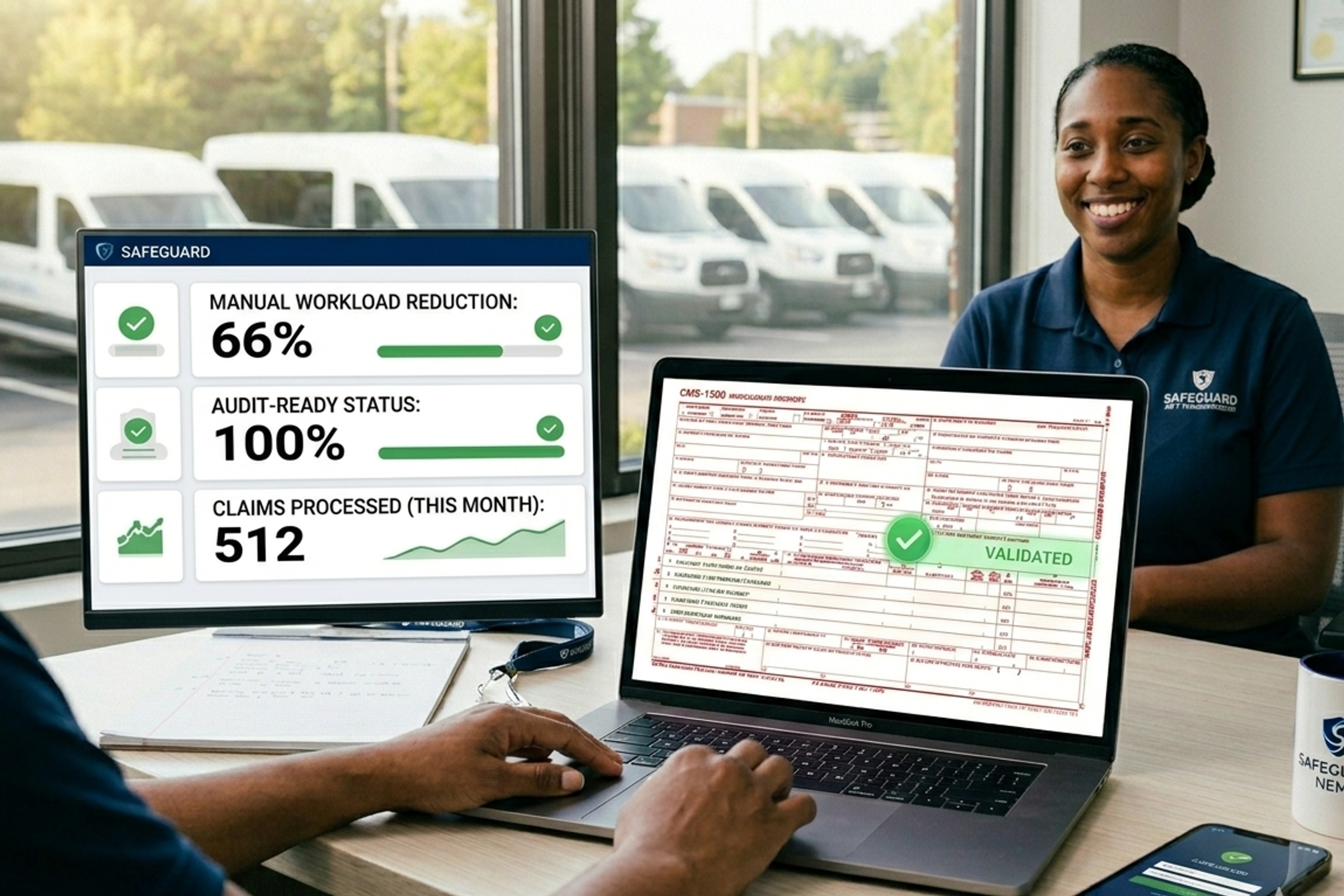
If you run a fleet of 7 to 10 NEMT vehicles (Mid Sized), 2026 is not a year to take compliance lightly. CMS has tightened quality reporting across all Medicaid programs, and the pressure is now flowing directly to NEMT providers through state Medicaid agencies, managed care organizations, and broker contracts.
The 2022 OIG audit of New York's NEMT program uncovered $196 million in improper payments. Auditors found 72 percent of reviewed claims non-compliant. Most of those failures did not come from intentional fraud. They came from documentation gaps that providers did not know existed.
That is what makes 2026 different. CMS now uses AI-powered surveillance to flag billing anomalies in real time. Audit readiness is no longer something you prepare for once a year. It is a continuous operational requirement.
If your operation relies on spreadsheets, manual trip logs, or disconnected billing tools, you are carrying risk right now. This guide explains exactly what CMS 2026 quality reporting means for a 7 to 10 vehicle NEMT fleet, which specific standards apply to you, and what you need to do to be ready.
What CMS 2026 Quality Reporting Actually Means for NEMT Providers
CMS does not regulate NEMT providers directly in the way it regulates hospitals or physician groups. But its 2026 requirements affect your business through a clear chain: CMS sets quality standards, states must meet those standards to qualify for federal Medicaid funding, states hold managed care organizations and brokers accountable, and brokers hold you accountable through your contracts.
This is not abstract. When CMS raises its documentation and quality data standards, your broker contracts get updated to reflect those standards. When your broker updates its standards, your reimbursements, your contract renewals, and your ability to receive trips all depend on whether your operation meets them.
The 2026 Medicaid Core Set Requirements
CMS has issued mandatory Core Set quality measure reporting requirements for 2026, with a submission deadline of December 31, 2026. These measures are submitted by states, but they are calculated from the trip-level data that NEMT providers like you generate and submit.
For 2026, states are required to stratify mandatory quality measures by race, ethnicity, sex, and geography. This means your documentation must capture enough patient-level detail to feed into state reporting systems accurately. If your trip records are incomplete, the state's data is incomplete. Incomplete data creates compliance risk all the way up the reporting chain.
Ready to streamline your transportation workflow?
Discover how an all-in-one NEMT solution can automate scheduling, plan routes and simplify billing so you can focus on delivering exceptional care.
AI-Powered Audit Surveillance Is Active Now
CMS has deployed algorithmic tools that cross-reference GPS records, billing claims, trip logs, and operational data in real time. Providers with denial rates above 15 to 20 percent, GPS data that does not match claimed pickup and dropoff points, or inconsistent mileage records are now flagged automatically.
A 10-vehicle fleet completing 500 trips per month at a $40 average reimbursement generates $20,000 in potential monthly revenue. A 20 percent denial rate eliminates $4,000 per month. That is $48,000 lost per year, not including any recoupments from audits on claims already paid.
Industry data shows that providers using purpose-built NEMT software achieve clean claim rates above 95 percent. Providers using manual processes or generic tools regularly see denial rates above 20 percent.
The Six Compliance Areas CMS and Brokers Are Watching in 2026
1. Trip Documentation Accuracy
CMS and Medicaid brokers now require GPS coordinates within 0.1 miles of the claimed pickup and dropoff locations. Every trip record must include a timestamped patient signature, driver attestation, and vehicle identification. Missing any one of these elements causes a claim to deny.
For a 7 to 10 vehicle fleet completing 100 to 200 trips per day, manual documentation is nearly impossible to execute consistently. One missing signature or a GPS record that does not reconcile with the billed mileage can trigger an audit across your entire account.
2. Prior Authorization Compliance
Every Medicaid trip requires prior authorization before you dispatch the vehicle. The authorization must match the specific trip type, the vehicle type, the member's eligibility status on the day of the trip, and the medical necessity documentation on file. Authorization requirements vary by state and by broker.
Providers who dispatch trips before authorization is confirmed are submitting claims that will deny and, in repeat patterns, attract fraud investigation. Pre-authorization tracking must be built into your dispatch workflow, not handled as a separate administrative task.
3. Driver Credential Verification
Every driver on every trip must hold a valid commercial license appropriate for the vehicle type, current CPR and first aid certification, ADA training documentation, and a clean background check. Drivers must also not appear on the HHS Office of Inspector General's List of Excluded Individuals and Entities, known as the LEIE.
A 10-vehicle fleet generates hundreds of credential expiration dates annually. If one driver's CPR certification expired and you dispatched a trip without catching it, every claim from that driver on that day is at risk. Manual tracking across even a 10-vehicle operation creates real exposure.
4. CMS-1500 Billing Accuracy
NEMT providers bill Medicaid services using the CMS-1500 form. The form requires accurate HCPCS procedure codes, origin and destination modifiers specific to the trip type, correct member ID and provider information, and documentation that matches the trip record exactly.
Errors in coding are one of the top causes of claim denials and audit findings. CMS-1500 instructions carry an explicit warning that knowingly filing false or incomplete information is a criminal offense. For billing staff processing dozens or hundreds of claims per day, manual entry multiplies error risk.
5. HIPAA Documentation in Mobile Environments
In 2026, CMS and auditors are paying closer attention to how NEMT providers handle protected health information in transit. The member's destination address is PHI when it identifies a healthcare facility visit. GPS coordinates that track a medical appointment are PHI. Your drivers, your dispatch system, and your billing software are all part of your HIPAA compliance perimeter.
Drivers must only see the information they need for the specific trip. Full medical records must not appear in driver-facing apps. Your software vendor must be HIPAA-compliant and provide a signed Business Associate Agreement. Violations carry fines of up to $50,000 per incident under the HITECH Act.
6. Billing Record Retention
State Medicaid rules require NEMT billing records to be retained for 7 to 10 years, depending on the state and payer contracts. During an audit, you must be able to retrieve any trip record from any point in that window. Paper-based or spreadsheet systems cannot reliably meet this requirement.
In 2026, auditors request records quickly and expect digital retrieval. A provider that cannot produce documentation within the requested timeframe is treated as non-compliant even if the underlying trips were legitimate.
Ready to streamline your transportation workflow?
Discover how an all-in-one NEMT solution can automate scheduling, plan routes and simplify billing so you can focus on delivering exceptional care.
Why 7 to 10 Vehicle Fleets Face Greater Risk Than Larger Operations
Large NEMT operations with 50 or more vehicles typically have dedicated compliance officers, billing teams, and fleet managers. Each function has a person assigned to it. Documentation processes are standardized, and software systems enforce the standards automatically.
A 7 to 10 vehicle operation usually does not have that structure. The owner or a senior dispatcher handles scheduling, billing, driver management, and compliance simultaneously. This is where gaps appear. Not because the provider is careless, but because the volume of compliance requirements across a 10-vehicle fleet is genuinely significant.
A 10-vehicle fleet generates hundreds of credential expiration dates, prior authorization requirements, GPS verification records, and billing submissions every single month. Without a centralized system, managing all of these manually is not sustainable.
According to NEMT compliance research, providers with organized compliance programs report 70 percent fewer major audit findings and 85 percent lower recoupment amounts compared to those who operate reactively. The investment in systems and processes pays back directly in protected revenue.
The good news is that purpose-built NEMT software now makes enterprise-level compliance management accessible to fleets of any size. You do not need a compliance department. You need the right tools and a clear process for using them.
A Step-by-Step Preparation Plan for 2026 Compliance
Step 1: Audit Your Current Documentation Process
Start by pulling 30 recent trip records and checking each one against the full documentation requirement: GPS record, timestamped patient signature, driver attestation, vehicle ID, authorization number, and billing code accuracy. Count how many pass every check without exception.
If fewer than 95 percent pass, you have a documentation problem that needs to be fixed before an official audit finds it. This exercise also tells you exactly where the gaps are so you can address them specifically.
Step 2: Build a Driver Credential Tracking System
Create a record for every driver that includes every expiration date: driver's license, CDL endorsements if applicable, CPR certification, first aid certification, ADA training completion, and background check date. Set alerts at 60 days and 30 days before each expiration.
Check every driver against the OIG LEIE database at hire and every six months. Document the date of each check. This documentation is what you show an auditor when your driver enrollment compliance is questioned.
Step 3: Verify Your GPS Coverage and Precision
Your GPS system must generate records that place each vehicle within 0.1 miles of the claimed pickup and dropoff coordinates. Test this by reviewing the GPS logs from your last 50 trips against the addresses billed. If the margin of error exceeds the required threshold on any trips, address the equipment or software issue before submitting those claims.
Step 4: Standardize Your Pre-Authorization Workflow
Every dispatcher must verify authorization before the vehicle is dispatched, not after the trip is completed. Build a checklist that requires authorization number confirmation as a mandatory step in the trip assignment process. If your dispatch software does not enforce this as a locked step, the workflow will break under pressure.
Step 5: Connect Your Billing to Your Trip Documentation
Your CMS-1500 submissions must match your trip documentation exactly. Mileage on the claim must match the GPS record. The procedure code must match the authorized trip type. The member ID must match the Medicaid eligibility verification from the day of the trip.
If your billing staff is manually transferring data from trip sheets to billing forms, the error rate will be high enough to hurt your clean claim rate. Automated billing that pulls directly from verified trip records is the only way to eliminate this category of error at volume.
Step 6: Set Up a Document Retention System
Every trip record must be stored digitally and retrievable by trip date, member ID, driver, and vehicle. Your retention system must cover 7 to 10 years of records depending on your state and broker contracts. Cloud-based systems with automatic backup satisfy this requirement. Physical files and local hard drives do not.
Ready to streamline your transportation workflow?
Discover how an all-in-one NEMT solution can automate scheduling, plan routes and simplify billing so you can focus on delivering exceptional care.
What Broker Contracts Are Requiring in 2026
Brokers like ModivCare, MTM, and Call the Car align their provider performance requirements with CMS standards. In 2026, those requirements are more specific than they were two years ago.
On-time pickup rates must consistently meet or exceed 95 percent. Providers below this threshold face trip reductions or contract review.
Clean claim rates must stay above 95 percent. Providers with repeated denials are flagged for billing audits.
GPS verification must confirm pickups and dropoffs within 0.1 miles of the documented address for every trip.
Driver credentialing records must be current and available for audit at any time.
Member complaint rates are tracked. Patterns of member-reported no-shows or late arrivals affect contract scoring.
Prior authorization must be confirmed and documented before dispatch on every trip.
Failing on any one of these consistently puts your broker contract at risk. Losing a broker contract as a 7 to 10 vehicle operation is not a minor setback. It can remove a substantial portion of your trip volume overnight.
The Financial Impact of Non-Compliance at the 7 to 10 Vehicle Scale
The numbers are specific and they are significant. A 10-vehicle fleet running 500 monthly trips at $40 per trip generates $20,000 in potential monthly revenue. A 20 percent denial rate costs $4,000 per month, or $48,000 annually. A 5 percent denial rate costs $1,000 per month, or $12,000 annually. The difference between those two scenarios is $36,000 per year.
Add audit recoupments and the math gets worse. The 2022 OIG audit of New York's program resulted in recoupments where providers had to repay Medicaid funds already received for claims found non-compliant. Recoupments at a 7 to 10 vehicle scale can be enough to close an operation.
Providers that invest in compliance infrastructure typically see denial rates drop to 5 to 8 percent. That recovery pays for most compliance tools many times over.
How to Read Your Current Denial Rate and What to Do About It
Your denial rate is the percentage of submitted claims that are rejected on first submission. Pull your last three months of claims data and calculate it. If you do not have easy access to this number, that itself is a compliance problem.
A denial rate below 5 percent means your documentation and billing processes are working. Focus on maintaining them.
A denial rate of 5 to 10 percent means specific errors are repeating. Identify the denial codes and address the source.
A denial rate of 10 to 20 percent means your process has a structural problem. Manual entry errors, authorization misses, or coding inconsistencies are common causes.
A denial rate above 20 percent requires immediate attention. At this level, you are losing tens of thousands of dollars annually and you are likely on a broker's watch list.
Every denial comes with a code that tells you exactly why the claim was rejected. Categorize your denials by code for the last 90 days. The top three codes reveal where your workflow is breaking down. Fix those three and your denial rate will drop significantly.
Frequently Asked Questions
What are the CMS 2026 quality reporting requirements that affect NEMT providers?
CMS 2026 quality reporting requirements flow to NEMT providers through the Medicaid program. States are required to report Medicaid Core Set quality measures to CMS by December 31, 2026, and those measures are calculated from provider-level trip data. Additionally, CMS now uses AI-powered tools to monitor billing patterns, GPS verification, and documentation accuracy in real time. For NEMT providers, this means your trip records, authorization documentation, driver credentials, and CMS-1500 billing submissions are subject to algorithmic review. Gaps in any of these areas create audit exposure and direct financial risk through claim denials and potential recoupments.
What documentation does CMS require for each NEMT trip in 2026?
Each NEMT trip must be documented with a confirmed prior authorization number, a GPS record placing the vehicle within 0.1 miles of the pickup and dropoff address, a timestamped patient signature, a driver attestation confirming the trip was completed, the vehicle identification number, the member's Medicaid eligibility verification for the date of service, and a CMS-1500 claim that matches all of the above exactly. Missing any one element causes the claim to deny. All records must be retained for 7 to 10 years depending on your state and broker contracts.
How does a 7 to 10 vehicle NEMT fleet prepare for a Medicaid audit in 2026?
Start by pulling 30 recent trip records and testing each one against the full documentation checklist. Calculate your current denial rate from the last 90 days and identify the top three denial codes. Check every driver's credential expiration dates and verify each driver against the OIG LEIE database. Confirm your GPS system meets the 0.1-mile verification standard. Establish a digital document retention system that stores all trip records with search and retrieval by date, member ID, driver, and vehicle. Then build a pre-authorization confirmation step into your dispatch workflow that cannot be skipped. Address each of these areas before an audit notice arrives.
What happens if a NEMT provider fails a Medicaid audit in 2026?
A failed audit can result in recoupment of Medicaid payments already received for non-compliant claims, suspension of reimbursements until compliance is demonstrated, termination of broker contracts, exclusion from Medicaid programs, and in cases of repeated or deliberate non-compliance, referral to the OIG for fraud investigation. For a 7 to 10 vehicle operation, even a moderate recoupment can create serious financial pressure. The 2022 OIG audit of New York's NEMT program found 72 percent of audited claims non-compliant, resulting in $196 million in identified improper payments across the program. Provider-level consequences from audits like that are severe and difficult to recover from without the right documentation in place.
How Can NEMT Platform Help 7 to 10 Vehicle Fleets Meet CMS 2026 Quality Reporting Requirements?
NEMT Platform was built to give providers the operational infrastructure that makes compliance sustainable at any fleet size, from a single vehicle to large multi-state operations. For a 7 to 10 vehicle fleet facing CMS 2026 requirements, the platform addresses each compliance area directly.
Trip documentation is handled automatically. Every trip generates a GPS record, captures a timestamped patient signature through the driver app, and stores vehicle and driver identification in a centralized record. Your documentation is complete before the driver leaves the dropoff location.
Billing is integrated directly with trip records. NEMT Platform supports EDI, CMS-1500, and broker-specific billing formats for ModivCare, MTM, and Call the Car. Claims are generated from verified trip data, which eliminates manual entry errors. Providers using the platform report a 99.2 percent claim approval rate.
Driver credential tracking is built into the system with customizable expiration alerts. Your team knows when a license, CPR certification, or background check is approaching expiration before it lapses. Dispatchers can see driver eligibility status before assigning a trip.
The platform reduces manual workload by up to 66 percent. For an operation where the owner or dispatcher is handling everything, that reduction in administrative burden is what makes consistent compliance achievable on a daily basis.
NEMT Platform is HIPAA compliant and SOC 2 Type II certified. It integrates with FTS GPS for real-time vehicle tracking and connects directly with leading Medicaid brokers. Whether you run 7 vehicles today or plan to grow beyond that, the platform scales with your operation without requiring you to rebuild your processes. To see how it works for your fleet size, visit nemtplatform.com and schedule a demo.
Disclaimer
The rates, figures, and statistics in this article are sourced from publicly available industry data, national broker rate schedules, and general market research. They reflect national averages and broad benchmarks as of 2024-2025. Actual rates in your area may differ depending on your state, broker network, payer contracts, and local market conditions. Before setting your charge and pay structure, verify current rates directly with your state’s Medicaid broker, local MCOs, and any private insurance partners you plan to work with. This article is intended for general informational purposes only and does not constitute financial, legal, or business advice.
Related Articles
Enterprise NEMT Software: Run 100+ Vehicles on One System
For NEMT providers running 100+ vehicles across multiple locations, fragmented systems drain margin. How enterprise NEMT software unifies the operation.
Best NEMT Software for California Transportation Providers: Medi-Cal, Multi-Broker, and Fleet Automation
Discover why NEMT Platform is the best NEMT software in California, offering live OVERSIGHT dispatch, multi-broker auto-billing, and a 24/7 multilingual AI receptionist.
Starting an NEMT Business in 2026: Where the Real Profit Comes From
NEMT operators in 2026 can reach 20-35% margins via hospital discharge contracts, stretcher and bariatric transport, long-distance trips, and private concierge accounts beyond standard broker rides.
NEMT Brokers in California
California is the largest Medi-Cal market in the country, with more than 14 million enrollees and a county-based managed care model that routes all NEMT trips through contracted transportation brokers, not the state directly. To run a compliant NEMT business in California, you need a CPUC Charter-Party Carrier (TCP) permit, Medi-Cal enrolment through the DHCS PAVE portal, and credentialing with the brokers serving your target counties, primarily ModivCare, MTM and SafeRide Health. Our 2026 guide covers California-specific insurance requirements under CPUC General Order 115, the Physician Certification Statement (PCS) compliance framework, the 180-day Medi-Cal FFS timely filing limit, and how to build a multi-county operation across California's fragmented broker landscape.