


Table of contents▼

Replacing a single NEMT driver costs between $1,500 and $2,700 when you factor in job postings, background checks, training hours, and the productivity loss during the first 60 days. If you run a 7 to 10 (mid-sized) vehicle fleet and lose three drivers in a year, that is $4,500 to $8,100 gone before you account for the missed trips, late patients, and dispatcher stress that come with it.
Most articles on driver retention assume you have an HR department, an employee experience team, and a budget for benefits packages. You do not. You have a dispatch phone, a tight margin, and a handful of drivers you cannot afford to lose.
This post covers driver retention strategies built specifically for small to mid-sized NEMT operations. Every strategy here can be managed by one person. None of them require a consultant or an HR software subscription.
What the Data Says About NEMT Driver Turnover
The trucking and transportation industry as a whole sees annual driver turnover rates between 50% and 90%, according to the American Trucking Associations. NEMT-specific operations tend to sit at the lower end of that range, around 40% to 60%, but for a 7 to 10 vehicle fleet, even a 40% turnover rate means replacing 3 to 4 drivers every year.
A 2022 report from the National Rural Health Association identified driver availability as the second most common reason NEMT providers failed to complete trips. The first was vehicle maintenance issues. Both are directly tied to retention and operational systems, not market conditions you cannot control.
The Society for Human Resource Management estimates that replacing a non-managerial employee costs 50% to 60% of their annual salary. For a NEMT driver earning $35,000 per year, that is $17,500 to $21,000. Even at the conservative end, turnover is one of the most expensive line items in a small fleet operation.
The reason most small NEMT operators do not treat it as a financial problem is that the costs are scattered. You do not see a single invoice labeled 'turnover.' You see a job posting fee here, extra dispatcher hours there, a missed trip reimbursement somewhere else. The total adds up fast.
Why NEMT Drivers Actually Leave
Exit interviews at larger transportation companies consistently point to three root causes. These same causes apply to small NEMT fleets.
Unpredictable Schedules
NEMT drivers deal with last-minute trip additions, route changes mid-shift, and inconsistent start times. A driver who cannot reliably plan their personal life around their work schedule will find a job that lets them do that. The Bureau of Labor Statistics reports that schedule unpredictability is a top-three reason for voluntary separation in the transportation sector.
For a 7 to 10 vehicle fleet, this is manageable. You have enough drivers to build consistent weekly schedules. The problem is most small operators build schedules around trips rather than around drivers, which creates different working hours each week.
Feeling Like a Number
Drivers at small companies often report that they expected closer relationships with management than they get. When a dispatcher only calls to add a trip or flag a complaint, drivers feel used rather than valued. A Gallup workplace study found that employees who feel their manager does not care about them as a person are 3.7 times more likely to be actively job searching.
At your fleet size, you have a direct advantage over large carriers: you can actually know your drivers. Most large NEMT companies cannot. That personal connection is a retention tool you already own and may not be using.
Ready to streamline your transportation workflow?
Discover how an all-in-one NEMT solution can automate scheduling, plan routes and simplify billing so you can focus on delivering exceptional care.
Pay That Does Not Keep Up
Drivers compare their pay against what they can earn with rideshare apps, delivery services, and competing NEMT providers. Rideshare flexibility and delivery pay have increased significantly since 2020. If your base pay has not moved in two years, your most capable drivers are doing the math.
The Bureau of Labor Statistics reported that median pay for light truck drivers increased 11.4% between 2021 and 2023. A driver who joined your fleet at $14.50 per hour in 2021 and is still at $14.50 in 2024 has effectively taken a pay cut relative to the market.
The Real Cost of Replacing One Driver
Here is a realistic breakdown of what one driver turnover event costs a small NEMT operation:
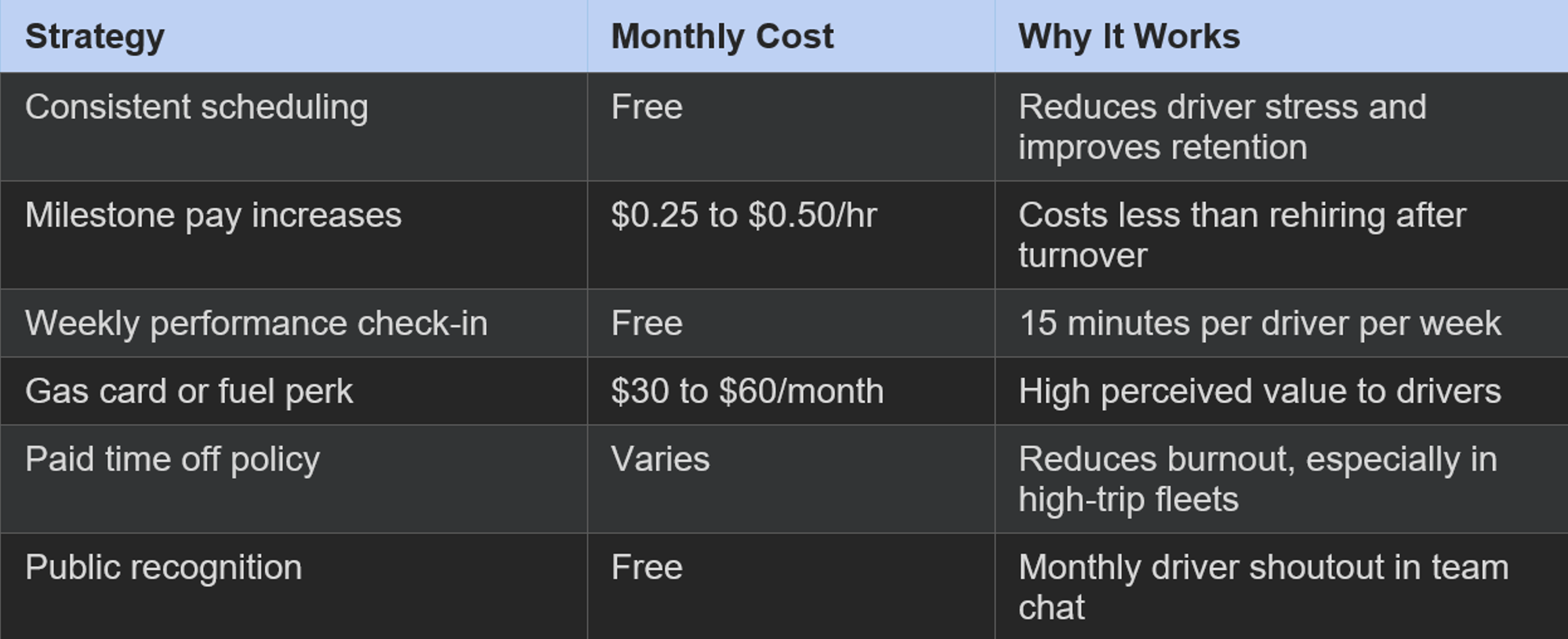
Keep that $1,585 to $2,730 number in mind as you read the strategies below. Every dollar you spend on retention is measured against that cost. Most of what follows costs far less than one replacement hire.
Driver Retention Strategies That Work at Your Fleet Size
1. Build and Publish Weekly Schedules at Least 5 Days in Advance
This is the single highest-impact change most small NEMT fleets can make. Set a day each week, typically Thursday or Friday, where you finalize and share the following week's schedule. Drivers can plan childcare, appointments, and rest around a predictable calendar.
You do not need scheduling software to do this. A shared Google Calendar or a simple PDF sent to each driver works. What matters is the consistency of the process, not the tool.
Fleets that implement advance scheduling report fewer last-minute call-outs, according to a 2023 small fleet operations survey by Transportation Topics. When drivers feel their time is respected, they extend more flexibility when genuine emergencies require schedule changes.
2. Set Up a Milestone Pay Structure
A milestone pay structure gives drivers a clear financial reason to stay. It does not require a formal HR system. You need a simple policy written down and shared with every driver at hiring.
A workable structure for a small fleet:
90 days: $0.25 per hour increase
6 months: $0.25 per hour increase
1 year: $0.50 per hour increase and one additional paid day off
2 years: $0.50 per hour increase and first choice on scheduling preferences
The total cost for a driver who reaches the 2-year mark is roughly $1.50 per hour above starting pay, or approximately $3,120 per year for a full-time driver. That is less than the cost of replacing them once.
More importantly, the structure gives your best drivers a visible path forward. Drivers who can see exactly what staying looks like are far less likely to browse job boards for something better.
Ready to streamline your transportation workflow?
Discover how an all-in-one NEMT solution can automate scheduling, plan routes and simplify billing so you can focus on delivering exceptional care.
3. Do a 15-Minute Check-In Every Week
Not a performance review. Not a complaint session. A brief, one-on-one conversation each week where you ask two questions: how is the route working for you, and is there anything you need from me this week.
This takes 15 minutes per driver per week. For a 7-vehicle fleet, that is under two hours total. It creates a channel for problems to surface before they become resignations. Drivers who feel heard do not need to leave to feel respected.
You can do these check-ins by phone, text, or in person. The format matters less than the consistency. Pick a day, stick to it, and do not skip it when the week gets busy.
4. Address Complaints Within 24 Hours
When a driver reports a problem, a difficult patient, a broken vehicle feature, a scheduling conflict, the speed of your response sends a signal about how much you value them. A complaint that goes unanswered for three days tells your driver that their experience is not a priority.
You do not need to resolve every issue in 24 hours. You need to acknowledge it and give a clear timeline. Drivers understand that some problems take time. They do not accept being ignored.
Set a simple policy for yourself: every driver complaint gets a response by the next business day, even if that response is just confirming you received it and are working on it.
5. Create a Simple Performance Recognition System
Recognition does not require a budget. It requires consistency and specificity.
Once a month, identify one driver who demonstrated something worth noting: zero late pickups for the month, positive patient feedback, handled a difficult situation well, covered a last-minute shift. Call them directly or send a personal message. Specific recognition lands better than generic praise.
You can also create a low-cost perk: a $25 gas card for the driver of the month. At $300 per year for a 7 to 10 vehicle fleet, that is a measurable cost with a measurable impact on how valued your team feels.
6. Invest in Vehicle Comfort and Reliability
Drivers spend 6 to 8 hours per day in your vehicles. A vehicle with a broken seat adjustment, a faulty AC system, or a check engine light that never gets addressed tells your driver that their physical comfort is not worth fixing.
You do not need a new fleet. You need a maintenance log and a clear policy: driver-reported vehicle issues get addressed within 5 business days. That timeline shows drivers their working conditions matter without requiring a major capital spend.
AAA estimates that deferred vehicle maintenance costs fleet operators 23% more over the life of a vehicle compared to proactive maintenance schedules. Keeping your vehicles in good shape is both a retention strategy and a cost reduction strategy.
7. Offer Schedule Preferences as an Earned Perk
Route and schedule preferences are something every driver cares about and they cost you nothing to offer. Build a system where senior drivers get first choice on schedule preferences before newer hires.
This gives long-tenure drivers a tangible benefit that cannot be replicated by a competing employer without matching your total package. A driver who has earned the Tuesday-to-Saturday schedule they prefer because they have been with you for 18 months has a real financial and lifestyle reason to stay.
Ready to streamline your transportation workflow?
Discover how an all-in-one NEMT solution can automate scheduling, plan routes and simplify billing so you can focus on delivering exceptional care.
What Not to Do: Common Retention Mistakes in Small Fleets
Waiting for good drivers to ask for a raise. By the time a driver asks, they have often already started looking elsewhere. Proactive pay adjustments tied to your milestone structure prevent that conversation from happening in the worst way.
Only communicating when something is wrong. If your drivers only hear from you when there is a complaint or a change, they learn to associate you with stress. Build in positive touchpoints through your weekly check-ins and monthly recognition.
Treating retention as a cost instead of an investment. Every dollar spent on a consistent schedule, a milestone raise, or a gas card perk reduces the probability of a $2,700 replacement event. The math strongly favors retention spending.
Ignoring the onboarding period. The first 90 days are when most drivers decide whether they are staying long-term. A driver who feels confused, unsupported, or undervalued in the first month is unlikely to reach the 6-month milestone. Assign a buddy driver for the first two weeks and schedule a 30-day check-in specifically to address any concerns.
A Retention Scorecard for Small NEMT Fleets
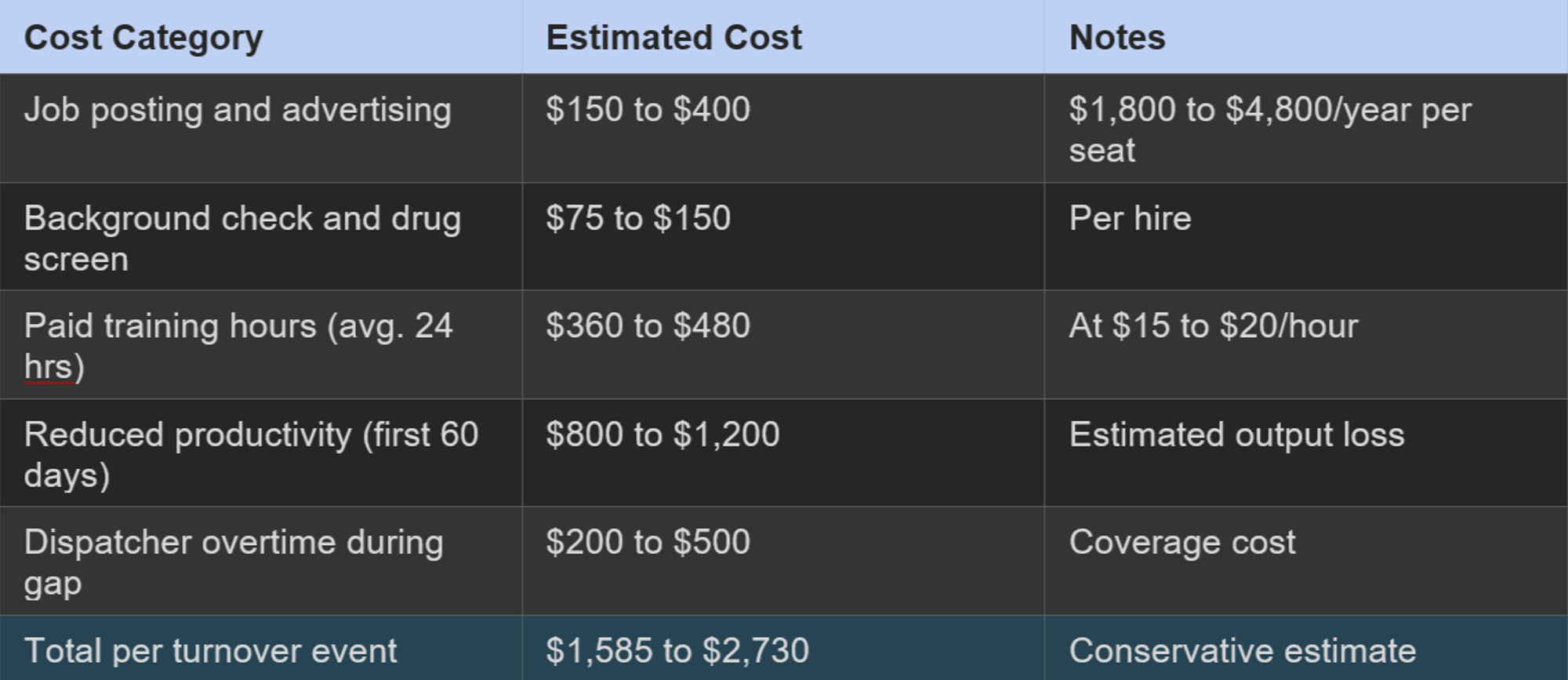
Use this table to assess where your retention efforts stand today and where to start:
Metrics to Track Driver Retention Progress
You do not need HR software to track the numbers that matter. A simple spreadsheet updated monthly covers everything you need.
Monthly turnover rate: drivers who left divided by total drivers, multiplied by 100
Average driver tenure: total months of employment across all drivers divided by number of drivers
Time to fill: days from a driver's notice to a replacement driver's first day
90-day retention rate: percentage of new hires who reach the 90-day milestone
Complaint response rate: percentage of driver complaints acknowledged within 24 hours
Review these numbers at the start of each month. If your average tenure is dropping or your 90-day retention rate falls below 70%, those are signals to act before the turnover accelerates.
Ready to streamline your transportation workflow?
Discover how an all-in-one NEMT solution can automate scheduling, plan routes and simplify billing so you can focus on delivering exceptional care.
Frequently Asked Questions
Q1: What is the average cost of replacing a NEMT driver for a small fleet?
For a 7 to 10 vehicle NEMT fleet, replacing one driver realistically costs between $1,585 and $2,730 when you add up job posting fees, background check costs, training hours, reduced productivity during the first 60 days, and any dispatcher overtime needed to cover the gap. That number does not include the indirect cost of missed trips or patient complaints during the coverage gap. Fleets that lose three or more drivers per year are spending $5,000 to $8,000 annually on turnover before accounting for those downstream costs.
Q2: How do small NEMT operators compete with rideshare and delivery apps for drivers?
You compete on predictability, relationships, and stability. Rideshare and delivery pay fluctuates with demand. Your drivers know what they earn each week. They work set routes with familiar patients rather than unpredictable passenger pickups. They have a direct relationship with an owner who knows their name. None of those things are available at a gig platform. Lean into those differences when hiring and reinforce them through consistent scheduling and personal check-ins.
Q3: How often should a small NEMT fleet review driver pay rates?
At a minimum, review your pay rates every 12 months against local market data. The Bureau of Labor Statistics Occupational Employment Statistics tool is free and gives you current median pay for light truck drivers in your metro area. If your starting rate is more than 8% below the local median, you are losing applicants before the interview and experienced drivers to competitors. A milestone pay structure that delivers automatic increases at 90 days, 6 months, and 12 months reduces the frequency of reactive pay conversations.
Q4: Can a single dispatcher manage driver retention for a 7-10 vehicle fleet?
Yes. The retention strategies in this post are designed for exactly that scenario. Weekly check-ins take less than two hours total per week for a 7 to 10 vehicle fleet. A milestone pay structure runs itself once the policy is written. Advance scheduling requires one focused block of time each week, typically under an hour. The monthly recognition system takes 15 minutes. None of these require a dedicated HR role. They require consistency from whoever manages the drivers, whether that is the owner, a lead dispatcher, or an operations manager.
Q5: How can NEMT Platform help small and mid-sized fleets with driver retention and scheduling?
One of the root causes of driver turnover in NEMT operations is scheduling chaos. Last-minute trip insertions, route changes mid-shift, and inconsistent daily workloads all contribute to driver frustration. NEMT Platform helps address this directly through automated scheduling, real-time trip management, and driver mobile apps that give your team clear, predictable routes each day.
For fleets in the 7 to 50 vehicle range, NEMT Platform reduces the dispatcher workload that leads to reactive scheduling. When trips are organized and communicated clearly through a mobile app, drivers spend less time confused about their next stop and more time focused on patient pickups. That clarity reduces frustration and contributes to a better daily experience.
Smaller fleets with 5 to 10 vehicles benefit from the same core tools. You do not need to be a large operation to use the platform. Whether you run 7 vehicles today and plan to grow, or you are at 40 vehicles across multiple zones, NEMT Platform works at your current size and adjusts as you add capacity. If scheduling predictability and driver communication are problems in your operation right now, the platform is worth exploring.
Start With One Change This Week
You do not need to build a full retention program this week. Pick one thing from this post and implement it before Friday.
If your drivers do not have a schedule more than two days in advance, fix that first. If you have not had a one-on-one conversation with a driver in the past month, make three calls today. If your pay rates have not changed in two years, draft a milestone structure and share it with your team by end of week.
Driver retention for a 7 to 10 vehicle NEMT fleet is not complicated. It is consistent. The operators who keep their best drivers for two and three years do the same small things every week, every month, without skipping when things get busy. Start there.
Disclaimer
The rates, figures, and statistics in this article are sourced from publicly available industry data, national broker rate schedules, and general market research. They reflect national averages and broad benchmarks as of 2024-2025. Actual rates in your area may differ depending on your state, broker network, payer contracts, and local market conditions. Before setting your charge and pay structure, verify current rates directly with your state’s Medicaid broker, local MCOs, and any private insurance partners you plan to work with. This article is intended for general informational purposes only and does not constitute financial, legal, or business advice.
Related Articles
Starting an NEMT Business in 2026: Where the Real Profit Comes From
NEMT operators in 2026 can reach 20-35% margins via hospital discharge contracts, stretcher and bariatric transport, long-distance trips, and private concierge accounts beyond standard broker rides.
NEMT Brokers in California
California is the largest Medi-Cal market in the country, with more than 14 million enrollees and a county-based managed care model that routes all NEMT trips through contracted transportation brokers, not the state directly. To run a compliant NEMT business in California, you need a CPUC Charter-Party Carrier (TCP) permit, Medi-Cal enrolment through the DHCS PAVE portal, and credentialing with the brokers serving your target counties, primarily ModivCare, MTM and SafeRide Health. Our 2026 guide covers California-specific insurance requirements under CPUC General Order 115, the Physician Certification Statement (PCS) compliance framework, the 180-day Medi-Cal FFS timely filing limit, and how to build a multi-county operation across California's fragmented broker landscape.
How to Market Your NEMT Business Effectively
Discover proven NEMT marketing strategies for 2026, from local SEO to facility contracts, that help providers win high-value institutional healthcare business.
How to Find Clients for Your NEMT Business: The 2026 Growth Playbook
Learn how NEMT providers secure private pay contracts in 2026 through local SEO, facility partnerships, and referrals, bypassing low-margin Medicaid brokers.