NEMT Software and Broker Contracts: What Your Business Actually Needs at Each Growth Stage
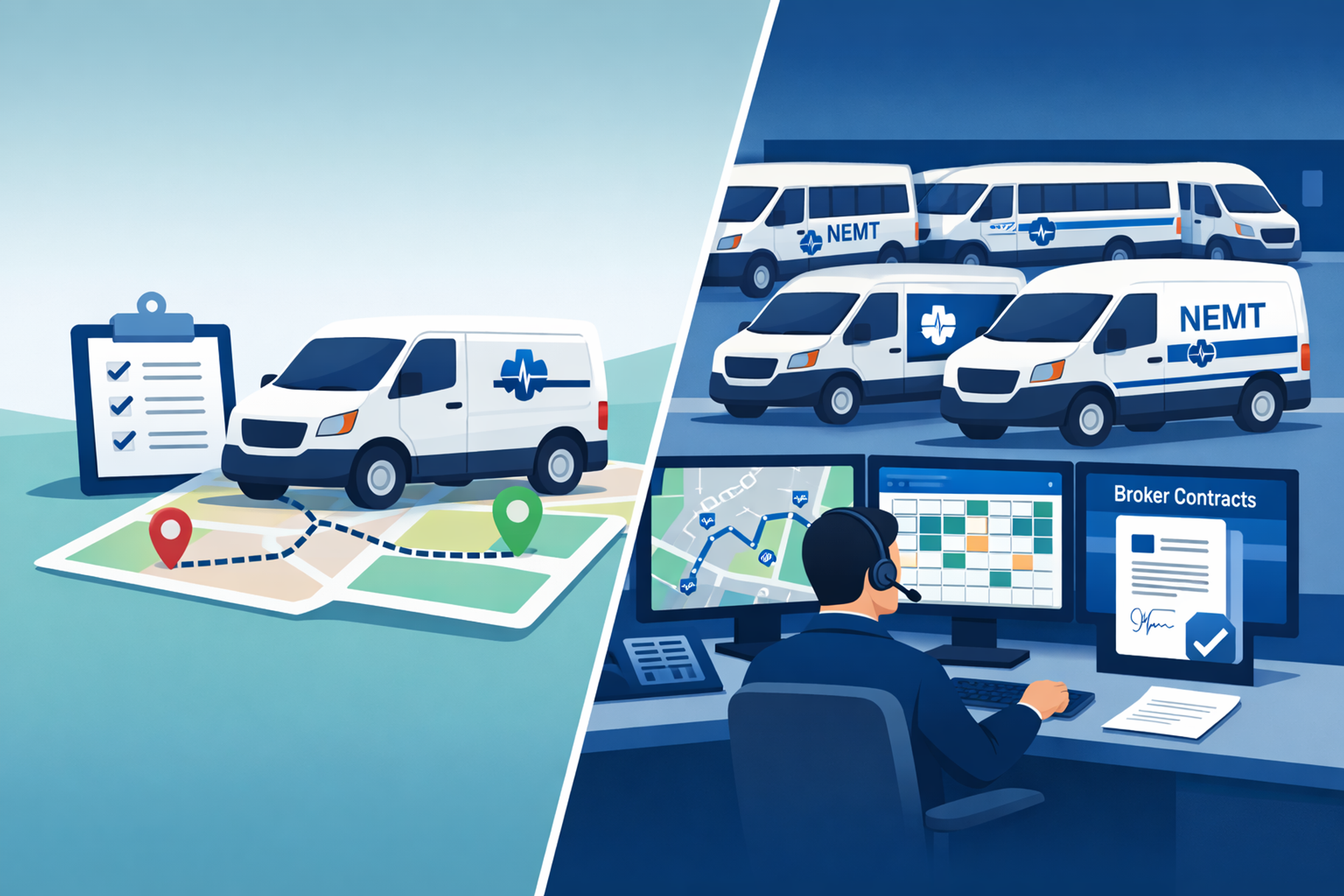
If you have been running a non-emergency medical transportation business for any length of time, you have probably asked yourself whether broker contracts are worth it. The short answer is: it depends on where your business stands right now.
Not every NEMT operator is in the same position. A company with three vehicles has completely different priorities than one managing a fleet of 40. The strategies that keep a startup afloat are not the same ones that help an established operator expand into new markets. And somewhere in the middle, growing operators are trying to figure out how to stop leaving money on the table.
This article walks through how broker contracts, NEMT software, and private pay strategies interact at each stage of business growth — and what you should actually be focused on depending on where you are.
Starting Out: Why Broker Contracts Are Non-Negotiable for New NEMT Operators
When you are just getting started in the NEMT industry, your number one problem is not branding or long-term positioning. It is cash flow. Vehicles are financed. Insurance premiums are due. Drivers need to be paid every week. You need trips coming in before any of that becomes a crisis.
Broker contracts solve this problem faster than almost anything else. Once you are approved and onboarded with a broker, trips start flowing. You get predictable weekly billing, a steady volume of assignments, and you do not have to spend months cold-calling hospitals or knocking on doors at assisted living facilities to build a client base from scratch. That relationship-building takes time — time that early-stage operators simply do not have.
The reality is that most new NEMT businesses cannot afford to wait on private pay clients to materialize. Brokers give you a foundation while you figure everything else out.
That said, getting approved by a broker is not just about submitting paperwork. Brokers want to see that you can operate reliably. They evaluate your compliance documentation, driver credentials, insurance coverage, and your ability to show up on time and report accurately. If your operations are disorganized, you will either be denied or lose the contract quickly after winning it.
This is where your dispatch software becomes critical from day one. A good NEMT software platform lets you track every trip, manage driver assignments, maintain clean records, and produce the kind of billing reports brokers expect. Without it, you are operating on spreadsheets and phone calls — and that creates errors that cost you contracts.
The trade-off at this stage is that broker rates are not generous. Margins are thin, and you are essentially trading profitability for stability. That is the right trade to make early on. Covering your operating costs consistently while you build volume is what keeps the business alive long enough to grow.
Growing Past Survival: How Mid-Size NEMT Operators Should Think About Contracts
Once you have five to twenty vehicles on the road, the questions you are asking start to change. Volume is no longer your only concern. You are looking at profit per trip, fuel costs, deadhead miles, driver utilization, and whether your current setup is actually making you money or just keeping you busy.
At this stage, complete dependence on broker contracts becomes a real liability. The rates are fixed, there is limited room to negotiate, and the administrative burden grows as trip volume increases. Payment cycles can create cash flow tension, and any change in broker policy or reimbursement rates directly affects your bottom line in ways you cannot control.
The move at this stage is to build a blended model. Broker contracts stay in the mix — they still provide reliable volume — but you start layering in private pay clients alongside them. Direct partnerships with dialysis centers, assisted living communities, and outpatient surgical facilities tend to carry better margins and allow you to build genuine relationships rather than just processing assignments from a third party.
Private pay is not a quick win. It requires consistent service quality, a professional reputation, and some investment in marketing and outreach. But the margins are meaningfully higher, and over time, those clients become anchors for your business that are far more stable than broker volume alone.
What makes this balancing act possible is having NEMT software that can handle both sides of the operation cleanly. You need route optimization that accounts for multiple trip types, real-time driver tracking, performance reporting, and financial analytics that break down revenue by source. Without that visibility, you are guessing at which parts of your business are actually profitable.
The operators who grow well through this middle stage are the ones who stop treating software as an administrative tool and start treating it as a management tool. When you can see exactly where your margin is going, you can make better decisions about which contracts to prioritize, which routes to cut, and where private pay growth will have the most impact.
For mid-size operators, broker contracts are still important but they are not the whole strategy anymore. Diversification is.
Ready to streamline your transportation workflow?
Discover how an all-in-one NEMT solution can automate scheduling, plan routes and simplify billing so you can focus on delivering exceptional care.
Operating at Scale: How Large NEMT Companies Use Broker Contracts Strategically
When your fleet is large and you are operating across multiple regions or service areas, the entire conversation around broker contracts shifts. You are no longer asking how to get broker contracts. You are asking which broker contracts align with your long-term positioning and whether the terms actually make sense for a company of your size.
At this level, dependence on brokers for survival is essentially gone. You have private pay volume, direct facility contracts, and likely some form of healthcare network integration already in place. Brokers become one tool among many rather than the lifeline they were in the early days.
What large operators tend to use broker contracts for is territorial expansion. When you move into a new market, a broker relationship can anchor your initial volume while you build the local private pay presence that will eventually sustain operations there. It is a calculated use of broker partnerships rather than a reactive one.
The competitive advantage for enterprise-level NEMT companies does not come from having broker contracts. It comes from technology, compliance, and brand reputation. If your dispatch infrastructure is modern, your compliance record is clean, and your service quality is consistently high, you can command premium pricing from private clients who are willing to pay for reliability. That is where the real margin lives.
Enterprise NEMT software at this stage needs to support API integrations with healthcare systems, automated reporting across multiple locations, compliance dashboards, and scalable dispatch infrastructure that does not require a proportional increase in administrative staff as trip volume grows. A well-built platform makes it possible to manage a large operation without the chaos that usually comes with growth.
The companies that reach this level successfully are rarely the ones who just signed the most broker contracts. They are the ones who built real operational systems early and treated technology as infrastructure rather than an afterthought.
The Role of NEMT Software Across Every Stage
Regardless of how large your fleet is or what mix of broker and private pay business you are running, the quality of your dispatch and management software directly affects your outcomes.
For new operators, it is what makes broker compliance manageable and prevents the operational errors that cost you contracts. For mid-size operators, it is the tool that reveals where margin is being lost and makes it possible to scale without proportionally scaling your administrative headcount. For large operators, it is the infrastructure that ties everything together across multiple vehicles, drivers, and revenue streams.
A modern NEMT dispatch platform should handle smart scheduling, driver allocation, real-time trip tracking, and financial reporting without requiring your staff to stitch together multiple disconnected tools. Drivers need a mobile app that gives them clear trip assignments, allows them to confirm pickups and drop-offs, and captures signatures digitally. When that layer works well, it reduces dispatch confusion, improves on-time performance, and makes your operation look professional to both brokers and private clients.
Technology is not a differentiator only at the enterprise level. It is foundational at every stage. If you are trying to grow and your software is slowing you down, that is a problem worth solving sooner rather than later.
Thinking About Private Pay? Here Is How to Build That Side of Your Business
Private pay clients represent the highest-margin segment of most NEMT businesses, but they do not come automatically. Building that revenue stream takes intentional effort.
The most reliable starting point is developing relationships with facilities rather than chasing individual patients. Dialysis centers have consistent, recurring transportation needs. Assisted living communities have residents who need reliable rides to medical appointments on a predictable schedule. Outpatient surgical centers need transportation coordination for patients who cannot drive themselves home. These are ongoing relationships that generate steady volume once established.
Getting in the door with these facilities usually comes down to two things: demonstrating that your operation is reliable and making it easy for their staff to work with you. That means showing up on time, handling scheduling changes gracefully, and providing the kind of communication and transparency that makes their jobs easier rather than harder.
Digital lead generation and direct patient marketing can supplement facility partnerships over time, but the facility relationships tend to be more durable. A single dialysis center contract can produce more consistent revenue than many individual patient relationships combined.
Reputation matters enormously in private pay. Patients and facilities talk to each other. If your service quality is high, referrals happen naturally. If it is inconsistent, word spreads just as quickly in the other direction.
Getting Broker Contracts: What the Approval Process Actually Requires
If you are at an early stage and broker contracts are part of your immediate plan, the preparation process matters more than most new operators realize.
Brokers are not just checking a box when they evaluate applications. They are assessing whether your operation can handle volume reliably without creating problems for them. That means they want to see complete compliance documentation, current insurance certificates, driver credentialing records, and evidence that you have the systems in place to dispatch, track, and report accurately.
Coming into that process with organized records and a functional dispatch system tells a broker something different than showing up with incomplete paperwork and a verbal promise to get things sorted out. The operators who get approved quickly and maintain those contracts long-term are the ones who demonstrate operational seriousness from the start.
Your NEMT software plays a role here too. Being able to pull clean trip history reports and performance data during an approval or renewal conversation is the kind of thing that separates operators who win contracts from those who lose them to a competitor.
Final Thoughts: Matching Your Strategy to Where You Actually Are
The NEMT industry rewards operators who understand their current stage and make decisions accordingly. Broker contracts are essential early on, important but not dominant in the middle, and strategic tools at scale. Private pay growth becomes increasingly central as your operation matures. Technology underpins all of it.
If your business is just getting started, prioritize broker approval and build your operational systems to support that. If you are past the survival stage, start actively building private pay volume alongside your existing contracts. If you are operating at scale, focus on the technology and brand positioning that lets you compete for premium clients and long-term partnerships.
The common thread is operational structure. Whether you are chasing cashflow or premium positioning, a solid dispatch and management platform is what makes the rest of the strategy work.
If you are building or scaling a NEMT business and want to understand how the right software fits your current stage, visit nemtplatform.com to explore platform capabilities, or schedule a personalized walkthrough to see how it applies to your specific operation.
Related Articles
NEMT operators in 2026 can reach 20-35% margins via hospital discharge contracts, stretcher and bariatric transport, long-distance trips, and private concierge accounts beyond standard broker rides.
California is the largest Medi-Cal market in the country, with more than 14 million enrollees and a county-based managed care model that routes all NEMT trips through contracted transportation brokers, not the state directly. To run a compliant NEMT business in California, you need a CPUC Charter-Party Carrier (TCP) permit, Medi-Cal enrolment through the DHCS PAVE portal, and credentialing with the brokers serving your target counties, primarily ModivCare, MTM and SafeRide Health. Our 2026 guide covers California-specific insurance requirements under CPUC General Order 115, the Physician Certification Statement (PCS) compliance framework, the 180-day Medi-Cal FFS timely filing limit, and how to build a multi-county operation across California's fragmented broker landscape.
Discover proven NEMT marketing strategies for 2026, from local SEO to facility contracts, that help providers win high-value institutional healthcare business.
Learn how NEMT providers secure private pay contracts in 2026 through local SEO, facility partnerships, and referrals, bypassing low-margin Medicaid brokers.