NEMT Brokers in Georgia (2026): Verida, the Five Regions, and How to Get Approved

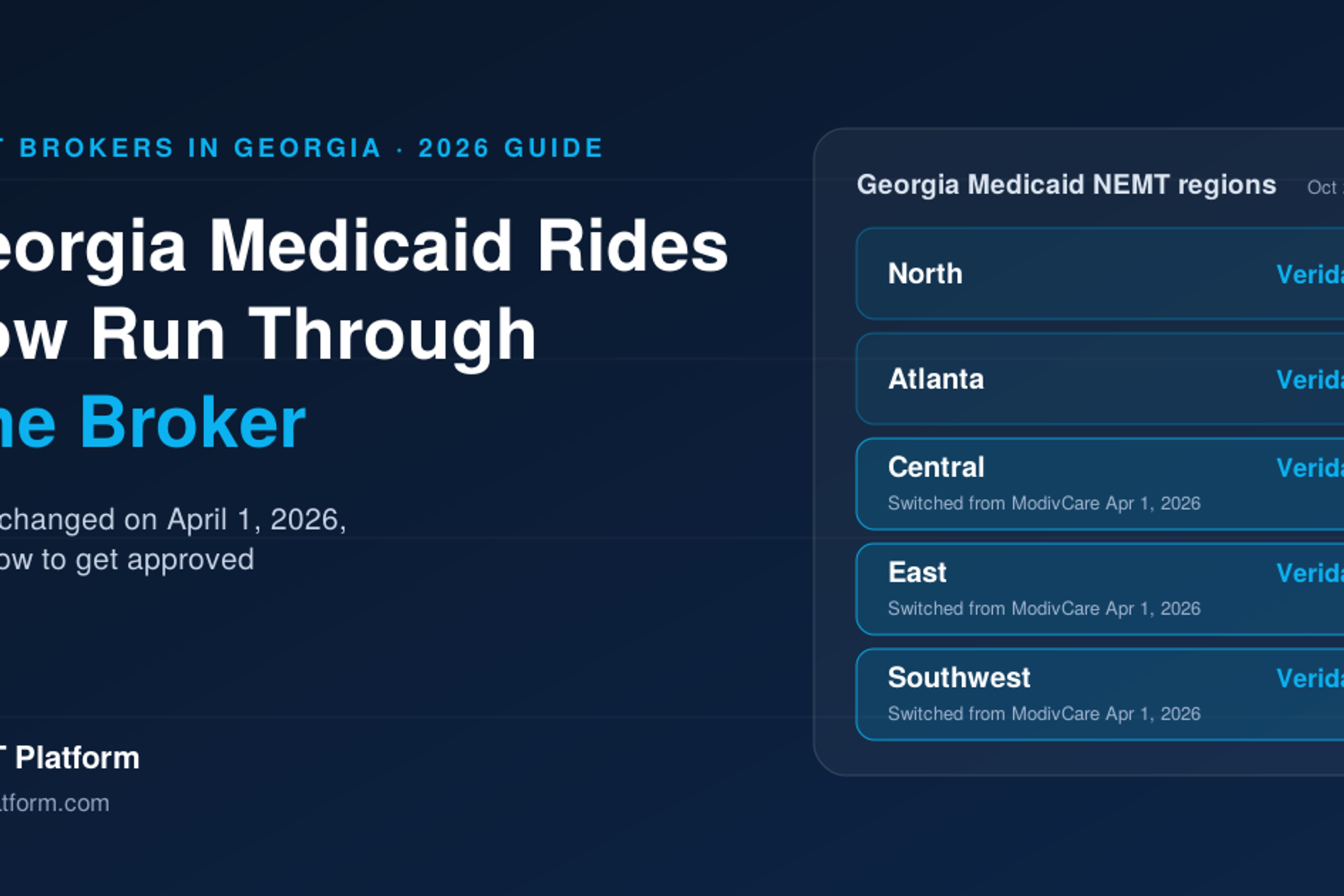
Quick summary: Since April 1, 2026, one broker arranges Medicaid non-emergency medical transportation in all five Georgia regions: Verida, formerly Southeastrans. ModivCare no longer provides Medicaid NEMT in the Central, East, and Southwest regions. To run Georgia Medicaid trips, you need a contract with Verida, which adds providers based on regional need and enforces Georgia Department of Community Health standards for drivers, vehicles, and trip records. With a single Medicaid broker, the providers who grow fastest are the ones who protect that relationship and build revenue beyond it.
Who this guide is for: Georgia NEMT operators applying to Verida for the first time, providers in the Central, East, and Southwest regions who previously worked through ModivCare, out-of-state operators expanding into Georgia, and established Georgia providers who want more volume and less dependence on a single contract.
Until this spring, Georgia Medicaid transportation was split between two brokers. That ended on April 1, 2026. On that date, ModivCare stopped providing Medicaid non-emergency medical transportation in Georgia's Central, East, and Southwest regions, and Verida, which already served the North and Atlanta regions, took over all five. Georgia Medicaid's own transportation page now names Verida as the statewide Medicaid transportation broker.
If your Georgia Medicaid trips came through ModivCare, that volume did not follow you automatically. Georgia Medicaid tells transportation providers that, starting April 1, 2026, they must contact Verida to provide NEMT services. And if you are already in Verida's network, every Medicaid trip you run in the state now depends on a single contract.
This guide explains how Georgia's broker system works, what the 2026 change means for providers, how to get approved by Verida, the state rules that decide whether your trips get paid, and how growing Georgia providers build revenue that does not depend on one broker. Every requirement comes from public sources published by the Georgia Department of Community Health, Verida, and the Georgia Department of Human Services, listed at the end.
How does Medicaid transportation work in Georgia?
Georgia Medicaid provides non-emergency medical transportation through a broker program run by the Department of Community Health (DCH), separate from its managed care plans. The broker takes ride requests, confirms eligibility, chooses the type of transportation, and assigns each trip to a contracted transportation provider in one of five regions: North, Atlanta, Central, East, and Southwest.
DCH runs NEMT outside its Georgia Families managed care contracts. In the federal summary of Georgia's managed care programs, NEMT is described as a separate brokerage program operating under Section 1902(a)(70) of the Social Security Act, with brokers paid a monthly capitated rate for each eligible member in their regions. In practice, members of the Georgia Families health plans get their rides from the DCH broker, not from their health plan.
The broker is the gatekeeper. A member must have no other way to reach a Medicaid-covered service, such as medical treatment, an evaluation, or picking up prescriptions or medical equipment. Members book at least three business days ahead, and the broker chooses the mode, which can range from transit passes to sedans, wheelchair vans, and stretcher vans. Faster requests have their own rules: valid same-day requests must be met within three hours, and the broker's call center runs around the clock for hospital discharges and ride status questions. Not every enrollee qualifies. DCH's NEMT policy manual excludes PeachCare for Kids enrollees and people who qualify only as Qualified Medicare Beneficiaries.
DCH watches the program closely. It reviews required monthly, quarterly, and annual broker reports, conducts on-site reviews, may ride on NEMT vehicles, and requires brokers to commission independent annual member satisfaction surveys. Much of what DCH reviews is built from data generated on your trips.
Who is the NEMT broker in Georgia in 2026?
As of April 1, 2026, Verida is the only Georgia Medicaid NEMT broker, serving all five regions. ModivCare, which previously served the Central, East, and Southwest regions, no longer provides Medicaid NEMT in Georgia.
Before the change, Verida served the North and Atlanta regions and ModivCare served Central, East, and Southwest. Georgia Medicaid let members schedule rides with Verida for services on or after March 18, 2026, and the statewide transition took effect on April 1. Verida's 2026 Georgia rider guide now lists customer service lines for all five regions, and its Georgia provider page lists a provider relations manager for each of them.
Verida is a Georgia company. It began as Southeastrans, won its first DCH contract in 2000 to manage the Atlanta Medicaid transportation region, and changed its name to Verida on September 1, 2022. It is headquartered in Villa Rica, Georgia. Verida says it contracts with more than 900 NEMT providers, has more than 5,300 credentialed vehicles and drivers, and manages about 5.5 million trips a year across its programs.
One caution: some health plan and broker web pages still list the old regional ModivCare phone numbers for Georgia Medicaid rides. Treat Georgia Medicaid's own NEMT page as the authoritative source and check anything you read elsewhere against it.
Note: Broker assignments, contacts, and policies change. This guide reflects DCH, Verida, and state sources checked in October 2026. Confirm current details with DCH and Verida before you apply.
Moving your Georgia operation onto Verida? See how one system keeps your drivers, vehicles, and trip records organized and ready for credentialing and inspection. Book a demo →
What does the 2026 change mean for Georgia NEMT providers?
It means every Georgia Medicaid trip now flows through one contract. Providers outside Verida's network have no Medicaid broker to work with, and providers inside it carry more concentration risk than before, because there is no second Medicaid broker to fall back on.
For providers in the Central, East, and Southwest regions who worked only with ModivCare, the change was a hard stop. Their Medicaid volume ended unless they contracted with Verida, and Verida adds providers only where it sees a need. Some operators moved quickly. Others are still working through the application, or are learning that their area already has enough capacity.
For providers already in Verida's network, the opportunity is larger, and so is the risk. Any broker can reduce a provider's trip volume, revisit rates when an agreement comes up for renewal, or pull vehicles and drivers that fall short of standards. In a two-broker state, a provider in trouble with one broker could lean on the other. In Georgia today, a problem with your Verida relationship is a problem with your entire Medicaid business.
That changes the strategy for every serious Georgia operator. Protect the Verida relationship by meeting DCH standards on every trip, and build revenue that does not depend on it, from Medicare Advantage transportation to facility contracts, private pay, and state human services transportation. The rest of this guide covers both.
How do you become a Verida transportation provider in Georgia?
To become a Verida provider in Georgia, submit Verida's Request for Qualifications form with your driver and vehicle lists. If your region needs capacity, Verida will interview you, request credentialing documents, inspect your vehicles, confirm your drivers' training, and complete an owner orientation before contracting.
Verida describes a four-step process on its provider pages. The steps below follow it, with the DCH standards that apply at each stage. Requirements can change, so confirm the details with your Verida provider relations manager.
Step 1: Submit the Request for Qualifications
Every applicant starts with Verida's Request for Qualifications form, a driver list, and a vehicle list. Verida reviews each application against the need for transportation providers in the applicant's region and contacts you for an interview only if a need exists. That makes your application a pitch, not just paperwork. Show the capacity your region is most likely to be short on, such as wheelchair and stretcher vehicles, coverage in rural counties, early-morning availability for dialysis, or the ability to take same-day hospital discharges.
Step 2: Pass credentialing
If Verida moves you forward, it requests documents that include a current business license, verification of liability insurance, driver credentials, current criminal background checks for all drivers, current drug screens for all owners and drivers, and current motor vehicle reports for all drivers. Verida's general insurance overview calls for carriers rated A- or better, a general liability policy with $1 million in sexual abuse and molestation (SAM) coverage and a $2 million aggregate, and an auto liability policy that covers all owned, hired, and non-owned vehicles. Confirm the exact limits with your provider relations manager before you buy or change a policy, and see our NEMT insurance cost guide for what this coverage typically costs and how to bring premiums down.
DCH adds its own checks behind the scenes. Brokers must screen providers against federal exclusion lists and the Death Master File before a service agreement begins, and must send DCH a copy of each executed service agreement, with driver qualification records, within five business days.
Step 3: Meet DCH driver standards
DCH sets minimum driver qualifications that brokers enforce. Drivers must be at least 21 years old and hold a valid state driver's license. Drivers and attendants cannot have any prior conviction for a sexual crime or a crime of violence. A driver convicted of driving under the influence within the last five years cannot be used, and anyone convicted of a felony in the last five years may drive only after review by the broker and DCH. A suspended or revoked license within the last five years is disqualifying, with a narrow exception for child support suspensions, and a driver convicted of two moving violations or at-fault accidents must be removed from service.
Training comes next. DCH requires driver training, first aid, and spill kit and biohazard training, along with passenger assistance, safety and sensitivity, and defensive driving training. Verida's own required training list for drivers covers first aid, CPR, defensive driving, passenger sensitivity and customer service, spill kit training, proper lifting techniques, wheelchair securement, and driver orientation. One expired certificate in one driver file can stall an entire application, so audit every file before you submit.
Step 4: Prepare every vehicle for inspection
Verida inspects every vehicle before it joins the network, and DCH requires brokers to inspect each provider's vehicles before the service agreement is signed and then every six months. DCH's vehicle standards are specific. Every vehicle needs a two-way communication system linking it to your base (pagers do not count), working heat and air conditioning, a seat belt for every seat plus two seat belt extensions and a mounted seat belt cutter, child safety seats for children under eight, fire extinguishers totaling at least five pounds, three reflective triangles, a first aid kit, a spill kit, and a DCH-approved map of the NEMT regions. Each vehicle also carries a packet with its registration, insurance card, and accident procedures and forms.
Your company name, vehicle number, and the broker's phone number must be displayed inside the vehicle, and your company name must appear on the outside. Vehicles that require a step up need a retractable step or an approved step stool. Wheelchair vans must also meet ADA requirements, including at least 56 inches of floor-to-ceiling clearance, a lift interlock that keeps the vehicle from moving while the lift or ramp is deployed, and ADA-compliant securement at every wheelchair position.
Step 5: Complete orientation and sign the service agreement
Once your documents, vehicles, and drivers pass, the owner completes an orientation with Verida covering operational requirements, and you sign a service agreement. Read the payment terms closely. Under DCH policy, the broker pays providers according to the service agreement, and if the agreement does not set terms, payment for undisputed invoices is due within 15 business days of the broker receiving them.
Get credentialing-ready before Verida asks. See how NEMT Platform keeps driver and vehicle files in one place, with document expiry reminders at 30, 15, and 7 days. Book a demo →
What DCH rules decide whether your Georgia trips get paid?
DCH rules require providers to arrive on time, wait up to 10 minutes past the scheduled pickup, reach return pickups within an hour of notification, and keep a daily manifest with 17 data points for every trip. Those records also decide whether you are paid when a member does not show up.
Georgia's pickup standards are written into every broker service agreement. Arriving on time is the standard, and members cannot be required to board before their scheduled pickup time. Drivers are not required to wait more than 10 minutes past the scheduled pickup. For return trips, the vehicle must arrive within one hour of notification. On shared rides, no member may spend more than 45 minutes longer on the vehicle than a direct trip would take. A vehicle running 20 minutes behind schedule is considered excessively late, and the broker must have a backup vehicle in place within 30 minutes, which means that trip goes to someone else.
Documentation is just as strict. Every driver completes a daily vehicle manifest with 17 data points, including the member's name and Medicaid number, the scheduled pickup time, the actual arrival and departure times at pickup, the actual time of return from drop-off, and odometer readings at pickup and drop-off. On paper, each of those fields is a chance for an error, and errors turn into disputes.
One rule many providers miss covers no-shows. DCH's policy manual requires the broker to pay the provider for the first leg of a trip when a member fails to board within the pickup time frame. That payment depends on proof that your driver arrived on time and waited the required time. A driver app that records location-based timestamps turns a lost trip into a paid one. Check your Verida service agreement for how this rule is applied.
These details matter because Medicaid margins are thin. Gross margins on traditional Medicaid NEMT trips typically run about 10 to 15 percent, so a single unpaid trip can erase the profit from roughly seven to ten paid ones.
DCH also uses these records to monitor performance. Brokers send DCH a monthly report of late trips on both legs, and any vehicle that draws two or more complaints about cleanliness, heating, air conditioning, or other deficiencies within five days must be inspected and corrected.
How do you get more trips from Verida in Georgia?
Verida sends more trips to providers who accept the trips they are offered, run on time, take same-day and discharge requests, document every trip completely, and keep vehicles inspection-ready, because DCH holds Verida to the same standards.
A service agreement gets you into the network. Volume is earned after that. Five habits separate Georgia providers who grow from those who stall.
Accept trips consistently
Refusing inconvenient trips teaches a broker that your capacity is unreliable. Providers that accept a broad mix of trips, including early-morning dialysis runs and long rural trips, become the first call when Verida needs coverage.
Protect your standing orders
Recurring trips such as dialysis are the backbone of NEMT volume, and DCH requires brokers to confirm standing orders every 30 days. A provider that runs the same standing orders on time, week after week, builds the record that earns more of them. Our guide to NEMT for dialysis patients covers how to run these trips reliably.
Win same-day and discharge trips
Same-day requests and hospital discharges must be met within three hours. Providers that keep capacity open for them and can dispatch quickly solve the broker's hardest problem, and brokers remember who solves it.
Document every trip automatically
The 17-field manifest, proof for no-show payments, and DCH's late-trip reports all come from trip data. Capture that data from a driver app with GPS timestamps, not from a clipboard filled in at the end of a shift.
Stay inspection-ready
With broker inspections every six months and complaint-triggered inspections in between, a vehicle that is clean, fully equipped, and documented is a vehicle that stays in service.
For a deeper look at how brokers score providers, read What NEMT Brokers Look For When Choosing a Provider and How Mid-Size NEMT Companies Win More Broker Trips.
Running standing orders and same-day discharges on one board? See the Auto Planner assign trips automatically while Oversight tracks every active ride on one screen. Book a demo →
How can Georgia NEMT providers grow beyond one broker?
Georgia providers grow beyond one broker by adding revenue that does not run through Medicaid NEMT: Medicare Advantage transportation benefits, contracts with hospitals, dialysis centers, and senior living communities, private-pay riders, and Georgia's human services transportation system.
Medicare Advantage transportation
Many Medicare Advantage plans offer transportation as a supplemental benefit, arranged through their own vendors. ModivCare, for example, still lists a Medicare Advantage plan and a group retiree program on its Georgia member page. If you serve older Georgians, find out which transportation vendors the Medicare Advantage plans in your area use and apply to them.
Facility contracts
Hospitals need discharges moved, dialysis centers need patients in their chairs on time, and nursing homes and assisted living communities need appointment transportation for residents. Direct facility contracts are priced and paid under terms you negotiate, and those relationships survive any broker change. See our guide to building NEMT partnerships with hospitals, clinics, and assisted living.
Private pay
Families pay directly for rides Medicaid does not cover, and you set the price. A simple booking channel, clear rates, and reliable service turn one-time riders into regular ones. Our 2026 client growth playbook covers how to find them.
Georgia's DHS Coordinated Transportation System
Georgia's Department of Human Services runs a Coordinated Transportation System that is separate from Medicaid NEMT. Administered by the Transportation Services Section of the DHS Office of Facilities and Support Services, it provides rides for consumers of DHS divisions such as Aging Services, as well as the Department of Behavioral Health and Developmental Disabilities and the Georgia Vocational Rehabilitation Agency. It operates across 12 DHS regions, each served by a Regional Transportation Office that monitors providers and contract compliance.
Rides are delivered by contracted providers, which can be government agencies, nonprofits, or for-profit companies, sometimes through prime contractors that subcontract the trips. Each region's coordinating committee approves new contracts and contractors every year. To explore it, contact the Regional Transportation Office that serves your area and ask how providers join.
Each new line of business brings its own booking channel, rates, and billing rules. Run by hand, that complexity eats the margin it was supposed to add. Run in one system, it becomes a second and third engine of growth.
What software do Georgia NEMT providers need?
Georgia providers need one system that runs everything outside the broker's own tools, from facility and private-pay booking to automated dispatch, while capturing GPS timestamps, mileage, and trip status on every ride so the records hold up to DCH standards.
Verida runs its trips through its own technology. Its Georgia provider page points network providers to technical support for its Provider Portal and iPads, and its provider training includes a free mobile app and device. That covers Verida trips. It does not run your facility contracts, private-pay riders, Medicare Advantage work, or human services trips, and it does not give you one view of your fleet across all of them.
NEMT Platform is built to be that system. The Auto Planner assigns trips automatically, Route View lays out each driver's day, and Oversight shows every active trip on one screen. The driver app records status updates with GPS timestamps and logs mileage for each trip, which are the fields a Georgia manifest asks for, and Auto Time Stamp captures location-based arrival times that show your driver was on time. AI confirmation calls the day before a trip help reduce no-shows, document expiry reminders keep driver and vehicle files current, and private-pay and facility booking portals are included in every plan. Across the platform, providers see 88 percent of trips assigned automatically, 4 to 5 hours saved per dispatcher each day, and a 99.2 percent first-submission claim approval rate. NEMT Platform serves 450+ providers and manages more than 1 million trips per month, with month-to-month billing and no setup fees.
If Verida trips are a large share of your business, ask in your demo how they fit alongside the rest of your operation, so you know exactly how your full book of business will run before you commit. You can also see how NEMT Platform supports Georgia operators.
Grow Your Georgia Operation Beyond One Broker
See automated dispatch, location-based timestamps, and facility and private-pay booking in one system, trusted by 450+ providers managing more than 1 million trips a month. No long-term contracts and no setup fees.
Frequently asked questions
Who is the NEMT broker in Georgia?
Verida is the Georgia Medicaid NEMT broker for all five regions, North, Atlanta, Central, East, and Southwest, effective April 1, 2026. Verida was formerly known as Southeastrans and is headquartered in Villa Rica, Georgia.
Does ModivCare still handle Georgia Medicaid transportation?
No. Effective April 1, 2026, ModivCare no longer provides Medicaid NEMT in Georgia's Central, East, and Southwest regions, and Verida serves all five regions. ModivCare still lists some non-Medicaid programs in Georgia, such as a Medicare Advantage plan, on its member site.
How do I become a Verida transportation provider in Georgia?
Submit Verida's Request for Qualifications form with your driver and vehicle lists. If your region needs capacity, Verida will interview you, request documents such as your business license, insurance, background checks, drug screens, and motor vehicle reports, inspect your vehicles, confirm driver training, and complete an owner orientation before contracting.
What insurance does Verida require in Georgia?
Verida's general overview calls for carriers rated A- or better, general liability with $1 million in sexual abuse and molestation coverage and a $2 million aggregate, and auto liability covering all owned, hired, and non-owned vehicles. Confirm exact limits with your Verida provider relations manager.
What are the NEMT driver requirements in Georgia?
Under DCH policy, drivers must be at least 21 with a valid license, have no convictions for sexual or violent crimes, and have no DUI conviction or license suspension in the last five years. Felony convictions in the last five years require broker and DCH review, and drivers need training including first aid, passenger assistance, and defensive driving.
How quickly must a Georgia NEMT broker pay providers?
Under DCH's policy manual, the broker pays according to the service agreement. If the agreement does not set terms, payment for undisputed invoices is due within 15 business days of the broker receiving them.
Does Georgia Medicaid pay providers for member no-shows?
DCH's policy manual requires the broker to pay the provider for the first leg of a trip when the member fails to board within the pickup time frame. Getting paid depends on proof that your driver arrived on time and waited, so check how your service agreement applies the rule.
Do Georgia Families members get rides through the broker?
Yes. Georgia runs NEMT as a broker program separate from its managed care contracts, so Georgia Families members book Medicaid rides through the broker. Under DCH's NEMT policy manual, PeachCare for Kids enrollees and Qualified Medicare Beneficiary only members are not eligible.
Related Articles
See NEMT Platform in Action
Get a free, personalized walkthrough of dispatch, billing & scheduling built for NEMT providers.