


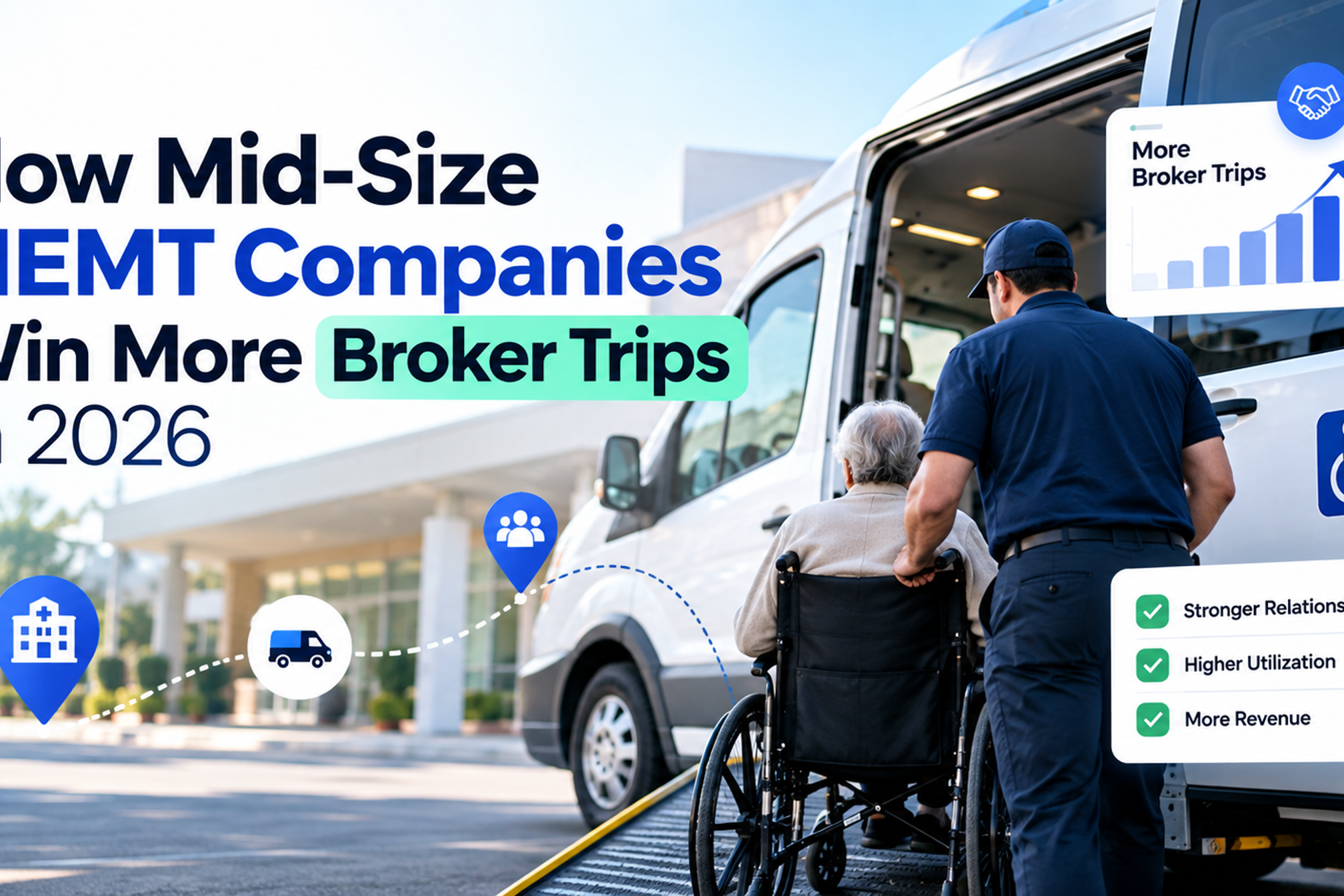
The short answer: Mid-size NEMT companies win more broker trips by performing better on the metrics brokers are judged on: on-time pickups, trip acceptance, complaints, documentation, and claim accuracy. Brokers route volume to providers who protect their scorecard. The companies that grow past this stage are the ones that replace manual dispatch, paper documentation, and spreadsheet billing with systems that keep performance high as volume rises.
If you run a growing NEMT company, you are past the hardest part of getting started. You have vehicles on the road, drivers on payroll, and at least one broker sending you trips. But this middle stage brings its own ceiling. Trip volume from your broker plateaus or swings without explanation. Adding a second broker feels like it would double your administrative work. Your dispatcher is stretched, billing runs behind, and the spreadsheets that worked at ten vehicles are cracking. This guide is for operators at that stage: how brokers actually decide who gets more trips, and what growing providers change to earn them.
Why do mid-size NEMT companies hit a growth ceiling?
Mid-size NEMT companies hit a growth ceiling because the manual processes that worked at small scale start producing late pickups, missing documentation, and billing errors as trip volume rises, which lowers broker performance scores and limits new trip volume.
At small scale, the owner can personally catch problems: a driver running late, a missing signature, a claim that looks wrong. As the fleet grows, that personal oversight stops scaling. The same dispatcher is handling twice the trips, documentation is collected inconsistently across more drivers, and billing errors multiply quietly. Brokers see the result in their data before you do. On-time rates slip, refusals rise, and claims need correction. The broker responds the way brokers always do, by routing more volume to providers who perform better. The ceiling is rarely demand. It is operational capacity showing up in your scorecard.
How do NEMT brokers decide which providers get more trips?
NEMT brokers send more trips to providers who reliably accept trips, arrive on time, generate few complaints, and submit complete documentation and accurate claims, because brokers are measured by their payers on the same outcomes.
A broker is accountable to state Medicaid programs and health plans for every ride in its network. Its own contract depends on network performance, so trip distribution follows provider performance. Most brokers track a similar set of measures.
Trip acceptance
Providers who accept the trips offered to them, including less convenient ones, become dependable capacity. Frequent refusals signal that you cannot be relied on, and offers slow down.
On-time performance
Pickups within the contracted window are usually the most visible metric on a broker scorecard. Late pickups affect patients and appointments directly, which is why brokers weight them heavily.
Complaints and incidents
Member and facility complaints, and safety incidents, are early warnings to a broker. A rising complaint rate can reduce your volume even when on-time performance looks acceptable.
Documentation and claim accuracy
Complete trip records and clean claims reduce the broker's own audit exposure and rework. Providers whose claims need repeated correction cost the broker time, and that cost shows up in how trips are allocated.
Know where your scorecard is slipping? See how NEMT Platform tracks on-time rates, trip status, and documentation in real time, so you fix problems before your broker notices them. Book a demo: [link to /schedule]
How can a mid-size NEMT company improve its broker scorecard?
A mid-size NEMT company improves its broker scorecard by automating dispatch to protect on-time performance, capturing trip documentation digitally on every ride, and validating claims before submission.
The fastest gains come from removing the manual steps where performance breaks down. Automated scheduling and dispatch let you accept more trips with confidence, because the system can see the whole day and assign each trip to the driver best positioned to arrive on time, instead of a dispatcher juggling assignments by hand. A driver app that records GPS, timestamps, and status at pickup and dropoff makes documentation complete by default rather than dependent on each driver's diligence. Billing that checks claims for errors and missing data before submission keeps accuracy high without adding staff.
These improvements compound. Better on-time performance earns more trips. More trips, handled by automation rather than added headcount, improve margin. Cleaner documentation reduces audit risk as volume grows. On NEMT Platform, providers see 88 percent of trips assigned automatically, 4 to 5 hours saved per dispatcher each day, and a 99.2 percent first-submission claim approval rate.
Should a growing NEMT company add a second or third broker?
Adding brokers reduces dependence on a single contract and adds volume, but each broker brings its own trip import, claim format, and documentation rules, so it only works if your systems can absorb the added complexity.
For a growing company, reliance on one broker is a real risk. A rate change, a contract re-bid, or a single performance dispute can hit most of your revenue at once. Adding brokers spreads that risk and opens new volume. The catch is operational. Each broker has its own portal or trip feed, its own billing requirements, and its own expectations for proof of service. Managed manually, a second broker can nearly double your administrative load and introduce errors that hurt your standing with both brokers. Managed through a platform that imports trips from each broker and applies its rules automatically, it becomes a straightforward growth lever. NEMT Platform integrates directly with ModivCare, MTM, Saferide, Call the Car, VectorCare, and Kaiser Permanente.
Thinking about adding a broker? See how multi-broker trip import and billing work in one system before you take on the extra contract. Book a demo: [link to /schedule]
What systems does a mid-size NEMT company need to keep growing?
A mid-size NEMT company needs one connected system for scheduling, dispatch, driver tracking, billing, and compliance, so growth adds trips without adding the same proportion of staff and errors.
The common pattern at this stage is a patchwork: a dispatch tool, a separate billing process, a GPS vendor, broker portals, and spreadsheets holding it together. Each handoff between them is a place where data gets re-entered, delayed, or lost. That patchwork is manageable at small scale and becomes the main constraint at mid-size. Consolidating onto one platform, where a trip is booked, dispatched, tracked, documented, and billed from a single record, removes those handoffs. It is also what lets a company keep growing toward enterprise scale without rebuilding its operations again later.
Growing providers should judge any platform against a few practical questions. Does it import trips directly from your brokers? Does it automate assignment rather than just display trips? Does the driver app capture documentation automatically? Does billing validate claims before they go out? And can it support you at two or three times your current volume? NEMT Platform serves 450+ providers and manages more than 1M trips per month, with a 66 percent reduction in manual workload across the platform.
Grow past the mid-size ceiling
See how growing NEMT companies use one platform to win more broker trips, add brokers, and keep their back office lean.
Frequently asked questions
Why is my NEMT company not getting more trips from our broker?
Brokers allocate trips based on provider performance and on where they need capacity. Low on-time rates, trip refusals, complaints, or claim errors reduce volume. Reviewing your broker scorecard and fixing the weakest metric is usually the fastest way to increase trip flow.
What metrics do NEMT brokers use to evaluate providers?
Brokers commonly evaluate trip acceptance, on-time pickup rate, complaints and incidents, documentation completeness, and claim accuracy. Exact measures and thresholds vary by broker and contract, so request your scorecard or performance report directly.
How many brokers should a mid-size NEMT company work with?
There is no fixed number. Two or more brokers reduce the risk of depending on a single contract, but each one adds billing and documentation complexity. Add brokers when your systems can handle multiple trip sources and claim formats without manual workarounds.
When should a growing NEMT company switch to NEMT software?
When growth starts requiring proportional new dispatch or billing staff, when data has to be re-entered between tools, or when broker performance slips as volume rises. Those signs mean manual processes have become the constraint on growth.