


Table of contents▼
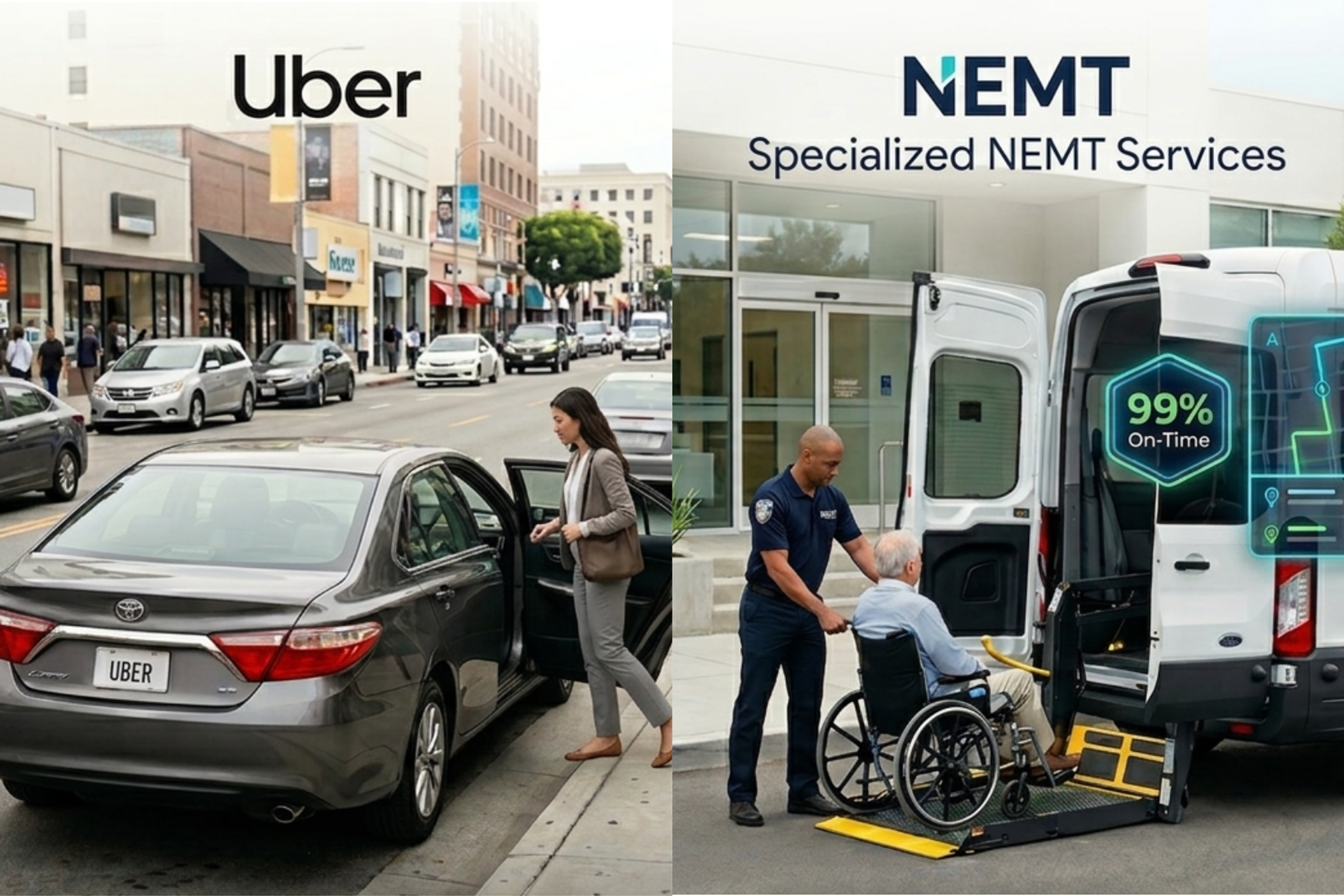
When Uber formally launched Uber Health in June 2024, a lot of small and mid-sized NEMT operators started asking the same question: can we survive this?
The short answer is yes. The longer answer is that 7 to 10 vehicle NEMT fleets are not just surviving against Uber Health. They are winning in the places that matter most, serving the patients Uber cannot reach, building the broker relationships Uber cannot replicate, and generating revenue in trip categories Uber does not even attempt.
This is not a pep talk. It is a breakdown of where Uber Health actually operates, what it cannot do, and what your 7 to 10 vehicle fleet must do right now to protect and grow your position. The NEMT market is projected to reach between $17.99 billion and $25.43 billion by 2030, depending on the source. There is room for every operator who runs their business correctly. But that window requires you to understand your advantages with precision and build on them deliberately.
Ready to streamline your transportation workflow?
Discover how an all-in-one NEMT solution can automate scheduling, plan routes and simplify billing so you can focus on delivering exceptional care.
What Uber Health Actually Is and Where It Operates
Before you can compete effectively, you need to understand what you are actually competing against. Uber Health is not a traditional NEMT provider. It is a dashboard and API that allows healthcare organizations, care coordinators, and hospitals to book rides for patients through the Uber platform. Uber describes it as a HIPAA-compliant solution for booking ambulatory and wheelchair rides directly from a centralized dashboard.
As of 2025, Uber Health operates in over 250 U.S. cities. That sounds large. But coverage in a city does not mean coverage across a city. Uber Health relies on its standard driver network for ambulatory rides and routes wheelchair and door-to-door NEMT trips through a third-party transportation partner. Wheelchair trips via Uber Health must be scheduled at least 24 hours in advance and by 4pm local time the day before. Trips cannot be booked on-demand for complex needs. Cancellations within 2 hours of a ride carry a 50% fare penalty.
Uber Health does not handle bariatric transport, stretcher transport, or oxygen-dependent patient trips. It does not have vehicles equipped for multi-stop dialysis runs, behavioral health transport requiring door-through-door escort, or pediatric medical transport requiring child safety seat certification. These are not minor gaps. They represent approximately 30% to 40% of total NEMT trip volume in most Medicaid markets. Dialysis transportation alone accounted for 29.42% of the entire NEMT market in 2024.
KEY FACT: A study published in JAMA Internal Medicine found minimal difference in appointment attendance between patients offered ride-sharing services and those not offered them, raising direct questions about whether app-based ride-hailing translates to reliable NEMT outcomes.
Uber Health primarily serves ambulatory patients in urban areas who can manage a standard vehicle ride with minimal assistance. That is a real market. It is also a clearly defined market with clear limits. Your 7 to 10 vehicle fleet likely serves patients, geographies, and trip types that fall entirely outside those limits.
Ready to streamline your transportation workflow?
Discover how an all-in-one NEMT solution can automate scheduling, plan routes and simplify billing so you can focus on delivering exceptional care.
The Six Structural Advantages Your Fleet Has Over Uber Health
Here is what the data and operational reality show about where a 7 to 10 vehicle NEMT fleet holds a structural edge.
1. You Can Transport Patients Uber Cannot
Uber Health covers ambulatory and standard wheelchair trips. Your fleet, properly equipped, handles the full spectrum: bariatric transport for patients weighing up to 700 pounds with appropriate equipment, stretcher transport for bed-bound patients, oxygen-dependent patient transport with trained staff, behavioral health transport requiring monitored escort, and dialysis runs three times per week for the same patients on the same schedule every week.
Medicaid wheelchair trip rates range from $45 to $120 in New York and $18 to $45 in Tennessee. Bariatric and stretcher rates are higher still. These are the high-reimbursement trips that Uber Health does not compete for. If your fleet carries the right vehicles and trained drivers for these categories, you hold a position in the market that no ride-hailing company threatens.
2. You Serve Geographies Uber Health Does Not Reach
Uber Health operates in over 250 cities. The United States has thousands of ZIP codes. Rural counties, suburban service corridors, and small metro areas represent significant NEMT demand with limited competition. Nearly 4 million Americans miss medical appointments every year because of transportation gaps. Many of those missed appointments are in areas where Uber has no meaningful driver supply at all.
A 7 to 10 vehicle fleet based in a mid-sized metro area or a rural county can own its service territory. Brokers need providers in those areas to fulfill their Medicaid contracts. CMS now requires brokers to certify adequate fleet and dispatch capacity. If you are the only compliant provider covering certain ZIP codes, brokers will prioritize you for trip volume regardless of what Uber Health is doing in downtown areas.
3. You Build Direct Relationships with Brokers and Facilities
NEMT brokers including Modivcare, MTM, and Call the Car operate through provider networks. They assign trips to providers based on performance history, geographic coverage, compliance scores, and relationship reliability. Uber Health participates in this system as a third-party vendor. Your fleet participates as a credentialed, accountable, local provider with a scorecard history and a direct line to the broker’s coordinator.
Dialysis centers, hospitals, and rehabilitation facilities also build direct relationships with NEMT providers they trust. When a dialysis center knows your driver always waits for the patient, always arrives within the window, and always handles the wheelchair correctly, they request your company specifically. That relationship is worth more than any algorithm. Uber Health cannot build that kind of local institutional trust at the individual facility level.
4. You Operate on Recurring Trip Volume Uber Health Cannot Lock In
Dialysis patients travel three times per week, every week, for years. A single recurring dialysis patient generates 156 trips per year. A fleet of 10 vehicles serving 50 recurring dialysis patients generates 7,800 trips per year from that patient category alone, before accounting for any other trip types. That is predictable, schedulable revenue that fills your dispatch calendar and keeps vehicles productive.
Uber Health is built for on-demand and scheduled one-time trips requested by healthcare coordinators. It does not produce recurring patient relationships. Every dialysis run you serve is a recurring trip your competitor cannot take from you as long as you perform.
Ready to streamline your transportation workflow?
Discover how an all-in-one NEMT solution can automate scheduling, plan routes and simplify billing so you can focus on delivering exceptional care.
5. Your Pricing Is Stable; Uber Health Uses Dynamic Pricing
Uber Health uses dynamic pricing based on standard Uber rates at the time of the booking. An average UberX trip in Los Angeles is $32. In Dallas it is $20. Prices fluctuate with demand, time of day, and market conditions. Healthcare organizations booking through Uber Health cannot predict their per-trip costs with certainty.
Your Medicaid reimbursement rate is set by the state Medicaid agency or negotiated through a broker contract. It is stable and predictable. When you bid for a hospital discharge contract or a long-term care facility partnership, you offer a fixed rate the facility can budget against. That predictability has real value to healthcare finance departments that need to manage transportation costs across hundreds of patients.
6. You Have Direct Medicaid Billing Authority
Your credentialed NEMT fleet bills Medicaid directly or through broker contracts. That billing relationship generates a clean paper trail, a compliance history, and a provider record that builds your standing with state agencies over time. Uber Health routes payments through healthcare organizations that have accounts with Uber. There is no provider record building under your name in the Medicaid system when an Uber Health ride is completed.
That distinction matters for contract access, audit response, and long-term business value. A credentialed Medicaid provider with six years of clean billing history and strong broker scorecards is a company with real, verifiable worth. Operators using Uber Health as a transport layer for their patients are not building that asset.
Ready to streamline your transportation workflow?
Discover how an all-in-one NEMT solution can automate scheduling, plan routes and simplify billing so you can focus on delivering exceptional care.
Where Uber Health Is Actually a Threat, and How to Respond
Being clear-eyed about your advantages requires being equally clear about where Uber Health does create competitive pressure.
Ambulatory Trips in Urban Areas
If your fleet is concentrated on ambulatory trips for mobile patients in dense urban markets, Uber Health competes directly with you. Healthcare coordinators at hospitals and clinics can now book a ride for an ambulatory patient in under two minutes through the Uber Health dashboard. They do not need to call your dispatch line. They do not need to wait for a confirmation.
The response is not to compete on speed of booking. You cannot out-tech Uber. The response is to move your fleet composition and your contract mix away from simple ambulatory trips and toward the higher-acuity, higher-reimbursement categories Uber cannot serve. Every wheelchair-accessible vehicle you add, every stretcher-capable vehicle you operate, every driver you train for door-through-door bariatric transport is a revenue stream Uber Health cannot touch.
Technology Perception with Healthcare Buyers
Uber Health benefits from name recognition. A hospital administrator who has used Uber personally may instinctively trust its product. Your fleet must close that perception gap with desmonstrable technology and documented performance.
If your dispatch system offers real-time GPS tracking, automated patient notifications, and digital billing reports, show those features to facility partners. Bring your on-time rate, your claim approval rate, and your driver credential compliance rate to every contract conversation. Numbers close perception gaps. Broker scorecards showing 97% to 99% on-time performance carry more weight with a hospital procurement team than a brand name.
Ready to streamline your transportation workflow?
Discover how an all-in-one NEMT solution can automate scheduling, plan routes and simplify billing so you can focus on delivering exceptional care.
The Five Operational Areas Where 7 to 10 Vehicle Fleets Lose Their Advantage
Your structural advantages are real. But they only hold if your operations support them. These are the five areas where mid-sized fleets most commonly erode their competitive position.
1. Credential Gaps That Trigger Dispatch Blocks and Broker Penalties
A 7 to 10 vehicle fleet might employ 12 to 20 drivers. Managing every driver’s CPR certification, background check, MVR, and state-specific training manually creates gaps. A single expired credential on a driver who performs a trip can invalidate that trip’s claim. Brokers deduct scorecard points for credential non-compliance. Two or three deductions can cost you preferred provider status. Loss of preferred status means fewer trips assigned, which directly reduces revenue.
Operators using dedicated NEMT software with automated credential tracking and dispatch blocking prevent this category of loss entirely. Fleet operators using dispatch software see monthly revenue per vehicle increase by 26% to 51% compared to manual scheduling, from roughly $3,300 monthly to between $4,160 and $5,000.
2. Claim Denial Rates That Drain Revenue
Claim denial rates of 15% to 25% are common in NEMT fleets that rely on manual documentation. For a fleet generating $40,000 to $70,000 per month, a 20% denial rate means $8,000 to $14,000 in revenue lost or delayed every month. That is not a documentation problem. It is a cash flow problem that compounds over quarters.
Pre-submission claim scrubbing that cross-checks your GPS data, your prior authorization record, and your billing code before the claim goes out catches the errors that produce denials. This is where technology directly protects revenue for a mid-sized fleet.
3. Route Inefficiency That Reduces Vehicle Productivity
A 10-vehicle fleet that runs inefficient routes completes fewer trips per vehicle per day than it should. Route optimization cuts travel time by 15% to 20% and increases productive hours per vehicle by 25%. For a fleet billing per trip, more trips completed per vehicle per day directly increases revenue without adding a single vehicle or driver.
Manual scheduling and phone-based dispatching produce routes that cost you time on every shift. Automated routing software solves this. It is not an optional efficiency tool for a competitive fleet in 2025. It is a baseline requirement.
Ready to streamline your transportation workflow?
Discover how an all-in-one NEMT solution can automate scheduling, plan routes and simplify billing so you can focus on delivering exceptional care.
4. No-Show and Cancellation Management
No-shows are one of the highest-cost events in NEMT operations. A driver dispatched to a pickup who finds no patient has wasted fuel, mileage, and time that could have generated revenue. Automated patient reminder systems reduce no-show rates significantly. Brokers tracking your cancellation and no-show data will factor those numbers into trip assignment decisions.
AI-powered dispatch platforms cut average call-center volume by 30% while lifting on-time pickup rates to 96%. For a 10-vehicle fleet, that improvement translates directly to higher daily trip completion rates and better broker scorecards.
5. Failure to Track and Present Your Own Performance Data
Your performance data is your most valuable sales tool with healthcare facilities and brokers. If you cannot produce your on-time rate, your claim approval rate, and your driver compliance rate on demand, you cannot differentiate yourself in a contract conversation. Facilities choosing between your fleet and an Uber Health account will choose the option that gives them the most confidence. Confidence comes from verifiable numbers.
Track these six metrics at minimum: on-time pickup rate by trip type, claim approval rate by payer, driver credential completion rate, vehicle inspection compliance rate, no-show and cancellation rate, and broker scorecard score by broker. If any of these numbers is not immediately accessible from your dispatch system, you are operating blind in a market where data transparency is increasingly expected.
How to Build and Protect Your Position Over the Next 24 Months
The NEMT market is growing. 11,400 Baby Boomers turn 65 every day in 2026. Mental health transportation is growing at a 10.11% CAGR, the fastest-growing NEMT segment. Home healthcare transport is growing at 10.17%. Twenty-one states increased Medicaid NEMT reimbursement rates in 2024, and 15 more are planning increases in 2026. The demand environment favors every well-run NEMT provider.
Here is where your focus should go over the next 24 months.
- Add at least one high-acuity vehicle type. If your fleet is entirely ambulatory, add one wheelchair-accessible vehicle or one stretcher-capable vehicle. Bariatric and stretcher rates run $200 to $450 per trip in many states. One specialist vehicle producing 4 trips per day generates $200 to $1,800 in daily revenue at rates Uber Health never sees.
- Lock in recurring trip contracts with dialysis centers. Contact every dialysis center within your service territory. Dialysis patients represent 29.42% of the NEMT market and generate 156 trips per patient per year. A 10-patient dialysis contract fills 1,560 trip slots annually with predictable revenue.
- Automate credential tracking and dispatch blocking. One expired driver credential can invalidate dozens of claims and trigger broker scorecard deductions. Automated dispatch blocking eliminates this risk at zero marginal cost once the system is in place.
- Pursue preferred provider status with every broker you work with. Preferred status means higher trip volume, first priority in assignment queues, and better reimbursement terms in some markets. The path to preferred status is a clean scorecard over 90 to 120 days of consistent on-time performance and documentation accuracy.
- Identify underserved ZIP codes in your region. Analyze where broker trip requests go unfulfilled due to provider unavailability. Expanding into those ZIP codes with even one additional vehicle puts you in a position where brokers need you specifically.
- Use your compliance record as a sales document. Produce a one-page provider performance summary showing your on-time rate, claim approval rate, and driver compliance rate. Bring it to every facility meeting and broker review. Numbers you can prove carry more weight than any brand.
The fragmented nature of the NEMT market is actually your protection. No single provider holds more than 5% of total market share. Uber Health entered a market that by design resists consolidation. Your 7 to 10 vehicle fleet does not need to beat Uber Health. You need to serve your territory better than anyone else in it, document that performance, and make yourself the provider brokers and facilities cannot afford to lose.
Ready to streamline your transportation workflow?
Discover how an all-in-one NEMT solution can automate scheduling, plan routes and simplify billing so you can focus on delivering exceptional care.
The Revenue Numbers That Put the Competition in Perspective
It is worth grounding this in concrete revenue figures. A 5 to 10 vehicle NEMT fleet generates between $72,000 and $120,000 annually, with higher numbers achievable through technology and smart trip mix. Large fleets of 10 or more vehicles generate $40,000 to $70,000 per month.
Operators using dedicated NEMT dispatch and routing software increase monthly revenue per vehicle by 26% to 51% over manual scheduling. For a 10-vehicle fleet earning $4,000 per vehicle monthly with manual systems, that is $4,000 to $8,000 in additional monthly revenue from the same fleet. That improvement comes from better routing, higher trip volume, fewer no-shows, and faster billing cycles.
States increased NEMT reimbursement rates significantly in 2024. Illinois implemented an average 40% rate increase. Ohio implemented a 79% increase for certain services. With 15 more states planning increases in 2026, the revenue environment for credentialed NEMT providers is improving, not deteriorating. Uber Health does not benefit directly from those rate increases. Your fleet does.
Frequently Asked Questions
1. Can Uber Health replace a traditional NEMT provider for Medicaid-funded trips?
For a narrow range of trips, yes. Uber Health can handle ambulatory Medicaid trips in urban areas where its third-party NEMT partner has coverage. For the majority of Medicaid NEMT trips, no.
Medicaid NEMT includes bariatric transport, stretcher transport, oxygen-dependent patient transport, behavioral health escort, and dialysis runs requiring trained drivers and specialized vehicles. Uber Health does not offer these services. Dialysis transport alone represents 29.42% of the total NEMT market. Any Medicaid program serving patients with complex medical transportation needs requires credentialed NEMT providers with the right vehicles and trained staff.
Uber Health also requires wheelchair trips to be scheduled at least 24 hours in advance. Many Medicaid trip needs arise with less notice. A credentialed NEMT fleet with a dispatch system handles same-day and urgent trip requests that Uber Health cannot process.
Ready to streamline your transportation workflow?
Discover how an all-in-one NEMT solution can automate scheduling, plan routes and simplify billing so you can focus on delivering exceptional care.
2. What trip types should a 7 to 10 vehicle NEMT fleet prioritize to stay competitive?
Prioritize the trips that produce higher reimbursements and that ride-hailing platforms cannot serve. In that order:
Recurring dialysis transport: 156 trips per patient per year, predictable schedule, strong reimbursement.
Wheelchair and stretcher transport: Medicaid rates range from $45 to $120 per trip in high-rate states. Requires equipped vehicles and trained drivers, which limits competition.
Behavioral and mental health transport: Growing at a 10.11% CAGR, the fastest segment in NEMT. Requires trained, patient-specific handling that a standard ride-hailing driver cannot provide.
Home healthcare transport: Growing at 10.17% CAGR. Serves the aging-in-place population that requires regular multi-specialist visit support.
Hospital discharge transport: Direct facility relationships, often private pay or MCO-funded, with stable recurring volume from hospital case managers.
Ambulatory trips remain part of your mix, but they should not be your primary revenue source if you want to stay insulated from ride-hailing competition.
3. How does broker scorecard performance affect trip volume for a small fleet?
Directly and significantly. Brokers including Modivcare and MTM assign trips through performance-weighted systems. Providers with higher on-time rates, lower complaint rates, and cleaner documentation records receive priority trip assignment. Priority assignment means your vehicles fill faster, your utilization rate stays high, and your daily revenue is more predictable.
Scorecard deductions come from late pickups, canceled trips, documentation errors, expired driver credentials, and patient complaints. Each deduction moves you down the assignment priority queue. For a 7 to 10 vehicle fleet, losing preferred status with a single major broker can reduce your trip volume by 20% to 30% overnight.
The practical standard to target is a 97% or higher on-time pickup rate and a 98% or higher claim approval rate. Reaching those numbers consistently over 90 days earns preferred status with most brokers. Maintaining them keeps it.
4. Is it worth adding a wheelchair-accessible vehicle to a 7 to 10 vehicle fleet?
Yes, with clear math behind the decision. A wheelchair-accessible vehicle (WAV) costs more to purchase and insure than a standard van. Medicaid reimbursement rates for wheelchair trips range from $45 to $120 per trip depending on the state. At 4 wheelchair trips per day, a single WAV generates between $180 and $480 in daily revenue, or between $46,800 and $124,800 annually, at 5 days per week.
WAVs also open trip categories your fleet cannot currently serve. Each WAV you add is a vehicle that competes in a segment where Uber Health has limited reach and where specialized providers are fewer in number. Before adding a WAV, confirm the wheelchair trip volume and reimbursement rates in your specific state and service territory. High-rate states like New York make the return substantially faster.
Disclaimer: The information in this blog post is for general informational purposes only. It does not constitute legal, financial, or regulatory advice. NEMT regulations, Medicaid policies, and reimbursement rates vary by state and change frequently. Statistics and figures cited reflect publicly available data and industry reports at the time of publication. Always consult a licensed attorney, compliance officer, or regulatory specialist before making decisions based on this content. NEMT Platform makes no representations or warranties regarding the accuracy, completeness, or applicability of this information to your specific operation or jurisdiction.
Related Articles
Medi-Cal NEMT vs Uber/Lyft: California CalHHS Policy Guide
Medi-Cal pays for Uber and Lyft rides under the NMT benefit for ambulatory members, but wheelchair and gurney patients require a certified NEMT provider.
NEMT Billing Explained: From Trip to Paid Claim (2026)
How NEMT billing really works in 2026: the claim lifecycle, why claims get denied, EVV and compliance, and how the right billing software gets you paid faster.
Executive Guide to NEMT: Margin, Risk & Technology
For NEMT leadership: why margins are compressing, the three exposures the C-suite owns, and how technology decisions protect the P&L at enterprise scale.
Starting an NEMT Business in 2026: Where the Real Profit Comes From
NEMT operators in 2026 can reach 20-35% margins via hospital discharge contracts, stretcher and bariatric transport, long-distance trips, and private concierge accounts beyond standard broker rides.