
Table of contents▼
Running a 10-vehicle Non-Emergency Medical Transportation fleet is not cheap. Fuel alone can cost you $8,000 to $15,000 per month depending on your region, vehicle types, and trip density. That number climbs when your drivers take inefficient routes, idle at pickup points, or backtrack across town for a single trip.
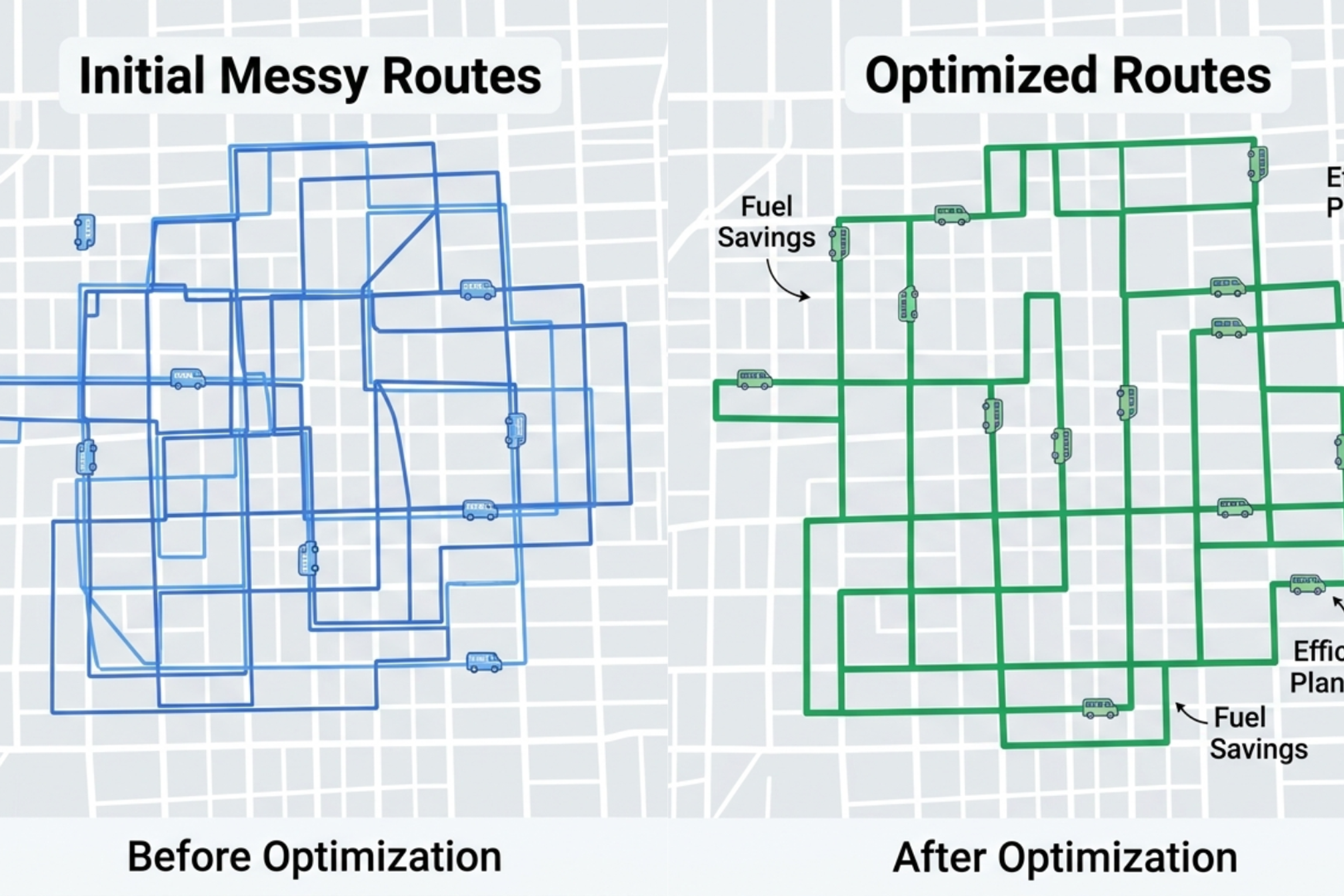
Route optimization for NEMT fleets is real. The savings are real. But the numbers you see in software brochures rarely match what a 10-vehicle operation actually experiences in the first 6 to 12 months. This post breaks down what the data actually shows, what you can expect from route planning tools, and where most mid-sized NEMT companies lose savings they could have kept.
What Fuel Actually Costs a 10-Vehicle NEMT Fleet
Before you can measure savings, you need an honest baseline.
The U.S. Energy Information Administration reported that diesel averaged $3.75 per gallon in early 2024. Regular unleaded hovered between $3.20 and $3.60 across most NEMT-heavy states. If your fleet runs 10 vehicles at an average of 150 miles per day each, that is 1,500 miles daily across your operation.
At 14 miles per gallon (a reasonable average for a transit van or modified minivan), you burn roughly 107 gallons per day. At $3.50 per gallon, that is $375 per day, or approximately $9,750 per month on fuel alone for a 26-day operating schedule.
Add oil, maintenance tied to mileage, and tire wear, and your total vehicle operating cost per mile lands between $0.65 and $0.85 for this vehicle class, according to the American Transportation Research Institute's 2023 Operational Costs Report.
That is your starting point. Any route optimization improvement comes off that number.
What Route Optimization Software Actually Promises
Route optimization tools marketed to NEMT fleets typically advertise the following:
15% to 30% reduction in total miles driven
10% to 25% reduction in fuel costs
Reduction in on-time-late trips by 20% to 40%
Driver overtime reduction of 10% to 20%
These figures come from studies conducted under controlled conditions or from large fleet operators with 50 or more vehicles. A 2022 study by the Transportation Research Board found that advanced route planning reduced vehicle miles traveled by an average of 18% across transit fleets. However, that study focused on public transit agencies with centralized dispatch, not smaller private NEMT operators.
For a 10-vehicle operation, the realistic range is narrower.
Realistic Fuel Savings for a 10-Vehicle NEMT Operation
Based on case data from NEMT software providers and independent fleet audits, a 10-vehicle NEMT company can expect the following after fully implementing route optimization:
Miles Driven Reduction: 8% to 15%
Smaller fleets have less geographic spread, fewer trips per vehicle per day, and more one-to-one patient pickups. You do not get the same consolidation benefits as a 50-vehicle operation running 300 trips per day. A realistic mileage cut of 8% to 12% is achievable in the first year.
Fuel Cost Savings: $700 to $1,400 per Month
Using the baseline of $9,750 per month in fuel, an 8% reduction saves you $780. A 15% reduction saves $1,462. Most 10-vehicle operators land somewhere in between after 3 to 6 months of consistent system use.
Annual Savings: $8,400 to $16,800 in Fuel Alone
Add reduced maintenance costs from fewer miles, and you can realistically project $12,000 to $22,000 per year in combined vehicle operating savings.
These are not the headline numbers. They are the real numbers.
Where NEMT Companies Lose Savings After Implementation
This is where most operators get surprised. The software works. The process does not.
1. Drivers Override Optimized Routes
A 2021 survey by Fleet Owner Magazine found that 43% of drivers in companies with route optimization software regularly deviate from planned routes. For NEMT, this is common because drivers build familiarity with certain routes, have preferences for certain roads, or accommodate patient requests without dispatcher approval.
Every unauthorized detour erases part of your savings. You need a system with GPS tracking and post-trip route compliance reporting to measure and address this.
2. Late Bookings Disrupt Route Plans
NEMT operations often receive same-day or next-day trip requests. Most route optimization tools build the best plan at a fixed time, usually the night before. A 7:00 AM call for a 9:00 AM pickup throws off three vehicles, not just one.
Companies that build buffer time into their schedules and use real-time re-optimization see 30% better adherence to planned routes compared to those that do not, according to RouteShift's 2023 NEMT Operations Benchmark Report.
3. Vehicles Are Not Matched to Trip Types
Sending a full-size wheelchair-accessible van on a 3-mile ambulatory trip is expensive. Sending a standard sedan to a bariatric patient causes a missed trip and a callback. Route optimization only works well when your vehicle-to-trip matching is accurate.
Fleets that correct vehicle assignment errors see an additional 5% to 8% reduction in total operating costs on top of their route savings.
4. Idle Time Is Not Tracked
The U.S. Department of Energy estimates that each hour of unnecessary idling burns approximately 0.8 gallons of fuel for a passenger van. If your vehicles wait an average of 20 minutes per trip at pickup locations, and each vehicle runs 8 trips per day, that is 2.7 hours of idle time per vehicle per day. Across 10 vehicles, that is 27 hours of idling daily.
At 0.8 gallons per hour, your fleet burns 21.6 gallons per day on idle alone. That is $75 per day, or $1,950 per month, in wasted fuel that route optimization software does not directly address. You need idle time monitoring alongside your route tool.
The Real ROI Calculation for a 10-Vehicle NEMT Fleet
Here is a straightforward breakdown of what you can expect in year one:
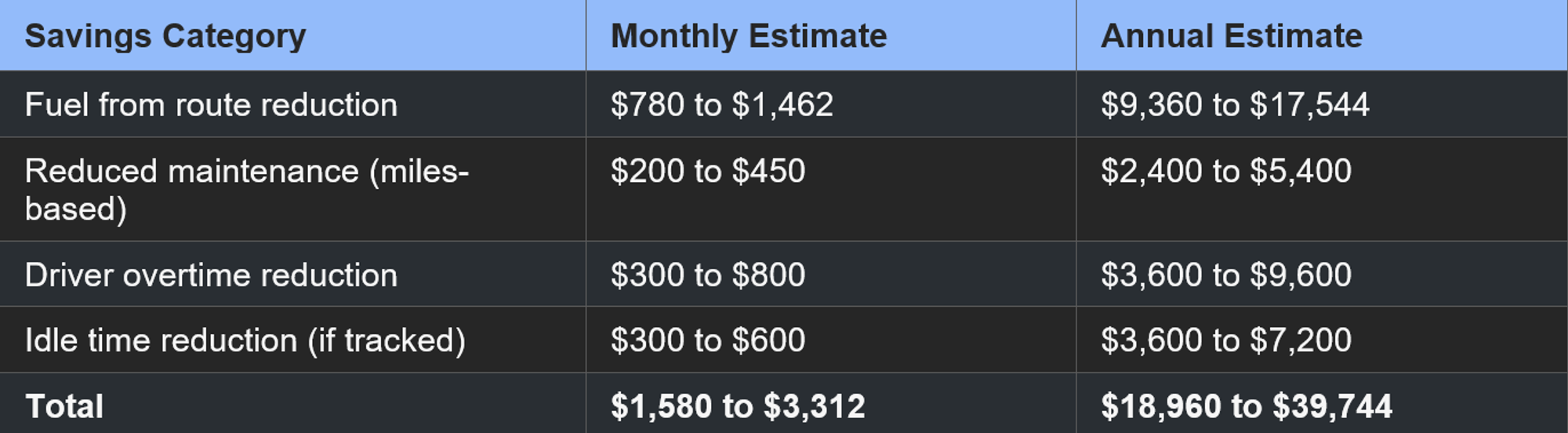
Compare that against the cost of route optimization software. Most NEMT-specific platforms charge between $300 and $800 per month for a 10-vehicle fleet. Your break-even point is typically 1 to 3 months.
What Good Route Optimization Looks Like in Practice
For a 10-vehicle operation, the features that move the needle most are:
Automated trip clustering. The software should group trips by geographic zone, not just by time window. Trips in the same 3-mile radius should land on the same vehicle whenever possible.
Real-time re-routing. When a driver reports a traffic delay or a patient cancels, the system should adjust the remaining route automatically without requiring a dispatcher to rebuild the day.
Driver mobile app with turn-by-turn compliance. If drivers navigate from the app rather than personal GPS devices, your route adherence improves significantly.
Trip-to-vehicle matching rules. The system should enforce vehicle type requirements per trip, so a bariatric trip never gets assigned to a sedan and an ambulatory trip never occupies a full WAV.
Post-trip reporting. Daily or weekly reports showing planned miles versus actual miles, idle time, and on-time performance help you identify where savings are leaking.
Common NEMT Metrics to Track After Implementation
Start tracking these numbers from day one:
Cost per trip (fuel + driver time + maintenance / total trips)
Miles per trip (actual vs. planned)
On-time pickup rate (target: 90% or higher)
Vehicle utilization rate (trips per vehicle per day)
Route adherence rate (percentage of trips completed on planned route)
Without baseline data, you cannot prove savings. Without ongoing tracking, you cannot fix leaks. Set up a simple spreadsheet or dashboard before you launch the new system, and review it weekly for the first 3 months.
Frequently Asked Questions
Q1: How much fuel can a 10-vehicle NEMT fleet realistically save per year with route optimization?
Most 10-vehicle NEMT operations see between $9,000 and $17,500 in annual fuel savings after full implementation. That range depends on your current route efficiency, how consistently your drivers follow planned routes, and whether you are also managing idle time. The first 3 months typically show smaller savings as drivers and dispatchers adjust. Months 4 through 12 usually show the full benefit.
Q2: Does route optimization software work for NEMT fleets with same-day trip requests?
Yes, but only if the platform supports real-time trip insertion and re-routing. Static overnight planning tools struggle with same-day volume. Look for a platform that lets dispatchers add a trip mid-day and automatically adjusts all affected vehicles without rebuilding the entire schedule from scratch. This feature alone can recover 5% to 10% in route efficiency that would otherwise be lost to ad-hoc scheduling.
Q3: What is the biggest mistake NEMT operators make when implementing route optimization?
Skipping driver training. The software does not save you money on its own. Drivers who do not understand why they should follow the planned route, or who do not trust the system, will default to their own navigation. A 2021 Fleet Owner survey found that driver non-compliance with optimized routes was the single largest factor in closing the gap between projected and actual savings. A 2-hour training session and a clear policy on route deviations can make a significant difference.
Q4: At what fleet size does route optimization deliver the best return on investment?
Route optimization delivers measurable ROI starting at 5 vehicles. The strongest returns come between 10 and 50 vehicles, where trip volume is high enough to enable real clustering and consolidation but the operation is still small enough for a dispatcher to act on the data daily. Fleets above 50 vehicles often need enterprise-level tools with multi-depot planning and predictive demand features. For a 10-vehicle fleet, mid-market NEMT software typically delivers a payback period of 1 to 3 months.
Q5: How can NEMT Platform help a growing NEMT fleet reduce fuel costs and improve route efficiency?
NEMT Platform at nemtplatform.com is built for NEMT companies that need more than basic scheduling. The platform includes automated route planning, real-time trip management, driver mobile apps, and vehicle matching rules that assign the right vehicle to each trip type.
For fleets in the 10 to 50 vehicle range, NEMT Platform helps dispatchers manage high trip volumes without adding headcount. The system handles trip clustering, last-minute insertions, and post-trip reporting in one place. Smaller operations running 5 to 10 vehicles also benefit from the scheduling tools, especially when same-day bookings make manual route planning difficult.
The platform is not limited by fleet size. Whether you run 8 vehicles today and plan to grow to 30 in two years, or you are already managing 40 vehicles across two service zones, NEMT Platform scales with your operation. You get the same core tools at any size, with features like multi-zone dispatching and broker integration that become more valuable as your fleet grows.
If reducing fuel costs, improving on-time performance, and cutting dispatcher workload are priorities for your operation, NEMT Platform is worth a closer look.
Start With Your Own Numbers
Route optimization for a 10-vehicle NEMT fleet will save you real money. The range is $18,000 to $40,000 per year when you account for fuel, maintenance, and driver time. But that range only applies if you track your baseline, enforce route compliance, and address idle time separately.
Pull your last 3 months of fuel receipts. Calculate your cost per trip. Then compare that number to where it should be. That gap is your target. Route optimization is one of the most direct ways to close it.
Related Articles
Enterprise NEMT Software: Run 100+ Vehicles on One System
For NEMT providers running 100+ vehicles across multiple locations, fragmented systems drain margin. How enterprise NEMT software unifies the operation.
Best NEMT Software for California Transportation Providers: Medi-Cal, Multi-Broker, and Fleet Automation
Discover why NEMT Platform is the best NEMT software in California, offering live OVERSIGHT dispatch, multi-broker auto-billing, and a 24/7 multilingual AI receptionist.
Medi-Cal NEMT vs Uber/Lyft: California CalHHS Policy Guide
Medi-Cal pays for Uber and Lyft rides under the NMT benefit for ambulatory members, but wheelchair and gurney patients require a certified NEMT provider.
NEMT Billing Explained: From Trip to Paid Claim (2026)
How NEMT billing really works in 2026: the claim lifecycle, why claims get denied, EVV and compliance, and how the right billing software gets you paid faster.