NEMT Dispatch Software vs. OVERSIGHT: Why One Screen Changes Everything

Who This Blog Is For
This blog is written for NEMT owners, operations managers, and senior dispatchers running fleets of 15 to 250 vehicles who suspect that their dispatching software is costing them more than the licence fee suggests. If your dispatchers run six browser tabs to complete a single trip, if your billing team chases missing data across three systems, or if your broker compliance reports are stitched together in Excel every Friday, this comparison is for you. Operations leads evaluating a platform switch will find the unified-view vs multi-tab analysis directly applicable to vendor scoring.
What is OVERSIGHT?
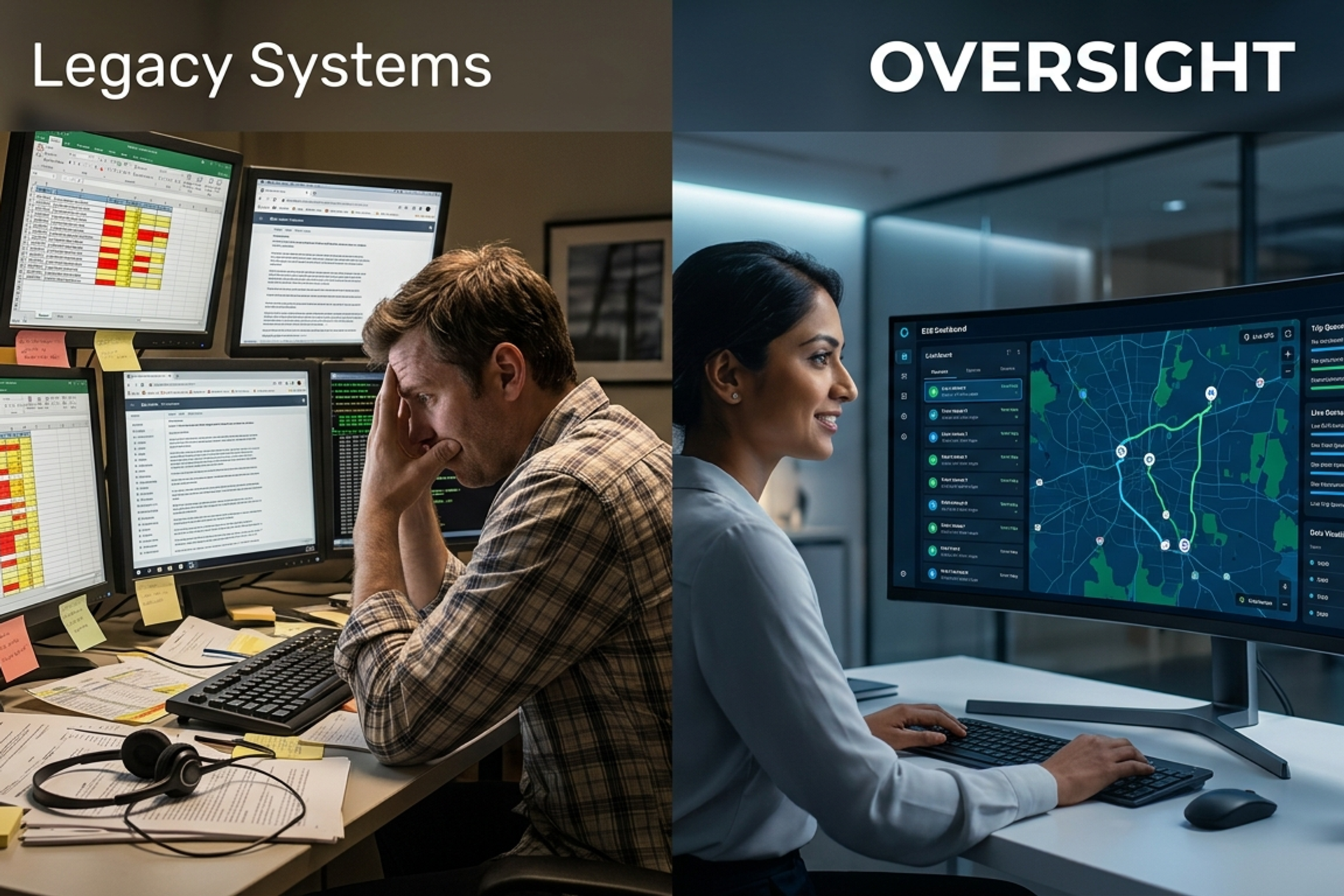
OVERSIGHT is the unified-screen dispatching environment inside NEMT Platform. It consolidates trip booking, driver assignment, GPS tracking, broker compliance, and billing reconciliation into a single workspace, replacing the multi-tab workflow that defines legacy NEMT dispatch software. Dispatchers act on one screen instead of switching between five.
Why One Screen Matters: The Productivity Cost of Context Switching
Context switching is the most expensive tax on a NEMT dispatch operation, and almost no one prices it. Microsoft research and operations studies have consistently shown that knowledge workers lose 20 to 40 percent of productive time to switching between applications and re-orienting their attention. In a dispatch role, where decisions are time-bound and error-sensitive, the cost is steeper than the average. A dispatcher who switches between a booking tab, a map tab, a broker portal, a billing screen, and a driver chat is not multitasking. They are losing 8 to 14 seconds of focus per switch, repeated 300 to 500 times per shift.
Multiply that across a five-person dispatch team and the lost productivity is the equivalent of roughly one and a half full-time positions per year. That's before counting the errors that occur during the switches: missed broker rules, mis-assigned vehicles, forgotten timestamps, and dropped trips.
OVERSIGHT exists because the unified-view problem is the real cost driver. The five ways it replaces multi-tab dispatching are below.
Legacy Multi-Tab Dispatching vs OVERSIGHT Unified View
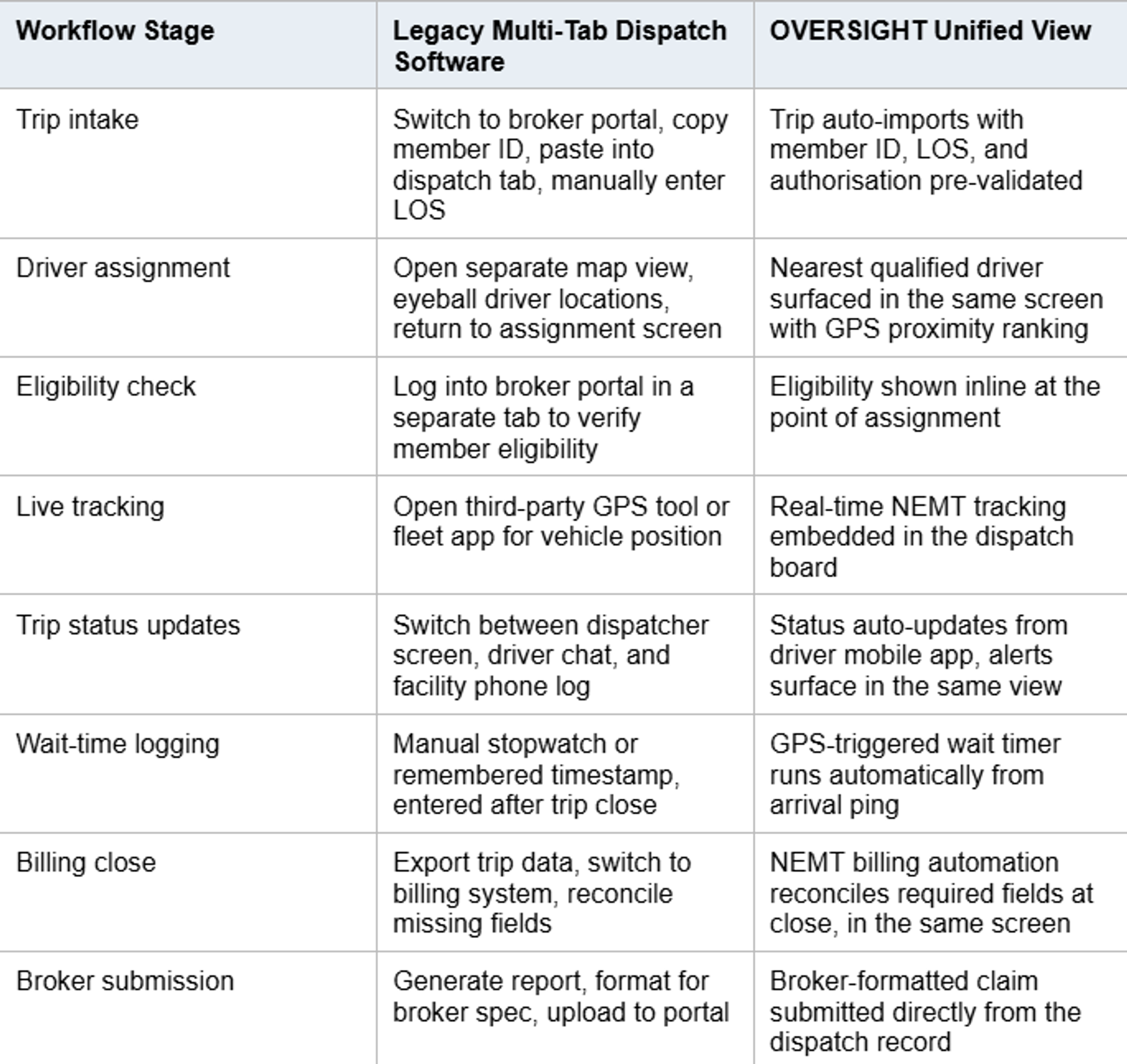
The comparison below maps the actual dispatcher journey for a single trip from intake to billing close. The legacy column represents the workflow common across most NEMT dispatch software in market today.
Ready to streamline your transportation workflow?
Discover how an all-in-one NEMT solution can automate scheduling, plan routes and simplify billing so you can focus on delivering exceptional care.
Five Differences That Actually Change the Operation
1. Trip Intake on One Screen
In legacy NEMT dispatch software, a Modivcare trip arrives in the broker portal, the dispatcher copies it across, and re-enters fields that already exist in the source system. Each manual re-entry introduces a 2 to 5 percent error rate at the field level. Across 500 trips per week, that's 50 to 125 fields with at least one error somewhere in the chain.
OVERSIGHT pulls the trip in pre-validated. The member ID, level of service, mileage band, and pickup window arrive with the trip and are checked against the authorisation before the dispatcher sees them. The dispatcher is asked to confirm, not re-enter.
2. AI-Powered NEMT Dispatching in the Same View
Assignment in legacy systems means opening a separate map, mentally ranking nearby drivers, and switching back to assign. AI-powered NEMT dispatching changes the input mechanic: the system surfaces the three best driver options ranked by GPS proximity, vehicle capability, credential validity, and shift-hours remaining. The dispatcher picks one with a single click.
The reasoning matters. Dispatchers are not bad at assignment; they're bad at holding 20 driver locations in working memory while also processing six other inputs. Removing the memory load is the productivity gain.
3. Real-Time NEMT Tracking Without Switching Tools
Legacy dispatch operations typically stitch together a separate GPS tool, often a generic fleet tracker, alongside their dispatch software. Real-time NEMT tracking inside OVERSIGHT means the driver position, ETA, and route deviation are visible on the same board as the trip queue. Late pickups generate alerts inline rather than being discovered when a facility calls.
4. Cloud-Based Medical Transport Software That Stays Synced
Multi-tab workflows fail hardest at the synchronisation layer. A trip closed in the dispatch tab doesn't immediately update the billing tab, the driver app, or the broker portal. Dispatchers patch the gap manually, which is where data loss begins. Cloud-based medical transport software with a unified backend means every action propagates to every dependent system in real time, removing the manual reconciliation step entirely.
5. NEMT Billing Automation at Trip Close
In a legacy stack, billing happens hours or days after the trip, often by a separate team working in a separate tool. By then, missing odometer readings, unrecorded wait times, and absent signatures are unrecoverable. NEMT billing automation inside OVERSIGHT enforces the required fields at the moment of trip close. A trip cannot be marked complete if its billing requirements are not met. The denial rate drops from 8 to 12 percent down to 2 to 4 percent within the first quarter for most operators.
Ready to streamline your transportation workflow?
Discover how an all-in-one NEMT solution can automate scheduling, plan routes and simplify billing so you can focus on delivering exceptional care.
What This Means in Hard Numbers
A 40-vehicle operation running 800 trips per week with a five-person dispatch team typically spends 30 to 45 percent of dispatcher time on context switching, tab navigation, and manual re-entry. OVERSIGHT compresses that to under 10 percent, freeing roughly 60 to 75 hours per week of dispatcher capacity. At a fully-loaded cost of $28 per hour, that's $87,000 to $110,000 per year in recovered labour. Add the reduction in claim denials (8-12 percent down to 2-4 percent on a $4M revenue base translates to $160,000 to $320,000 recovered annually) and the operational case is clear.
The honest tradeoff: a unified-view system is harder to customise per dispatcher. Veterans who built personal workflows around the multi-tab approach lose some of their muscle memory in the first two weeks. The break-even point is typically week three, after which dispatcher satisfaction scores rise sharply because they're not chasing data across five tools.
FAQs
How is OVERSIGHT different from other NEMT dispatch software?
Most NEMT dispatch software is a dispatch board with bolted-on integrations to tracking, billing, and broker portals. OVERSIGHT is built as a single environment from the ground up, which removes the context-switching cost that defines legacy systems. It's the unified-view architecture, not a feature list, that changes the operation.
Does the unified view work with our existing broker contracts?
Yes. OVERSIGHT supports direct integration with Modivcare, MTM, CTC, Saferide, Ride Cafe, and other major payors. Broker-specific rules, claim formats, and chargeback logic are configured per contract during onboarding, so the unified view respects each broker's submission spec without dispatcher intervention.
How long does it take to migrate from legacy NEMT dispatch software?
Typical migration runs 3 to 6 weeks depending on fleet size, broker mix, and historical data depth. The first week covers data import and broker rule configuration. Weeks two and three run parallel operations with the legacy system. Week four onward is full cutover with the legacy system kept read-only for reference.
Will my dispatchers resist a single-screen workflow?
Some will, particularly those with three or more years on the legacy system who have built personal shortcuts. The dip lasts about two weeks. Throughput typically rises 20 to 30 percent by week four, and resistance fades once dispatchers stop fielding callbacks on errors they didn't realise they were making in the multi-tab workflow.
How can NEMT Platform assist in the transition to OVERSIGHT?
NEMT Platform manages the full migration as a single engagement: data extraction from the legacy system, broker rule mapping, GPS device integration, dispatcher training, and a 30-day post-cutover audit. The team configures the unified view to match the operational shape of your business rather than forcing a generic template. Migration support includes parallel-run weeks, a named onboarding lead, and direct access to the engineering team for any broker-specific edge cases. Most operations are fully live on OVERSIGHT within 30 to 45 days of contract.
Related Articles
See NEMT Platform in Action
Get a free, personalized walkthrough of dispatch, billing & scheduling built for NEMT providers.