
Table of contents▼
Non-Emergency Medical Transportation operations run on precision. Every trip depends on timing, coordination, compliance, and communication. Yet many NEMT providers still operate with fragmented systems. Dispatch uses one tool, billing another, driver updates arrive through calls or texts, and reporting lives in spreadsheets.
This fragmentation slowly erodes control. Decisions are made with partial information. Issues surface too late. Teams spend more time reconciling data than improving service.
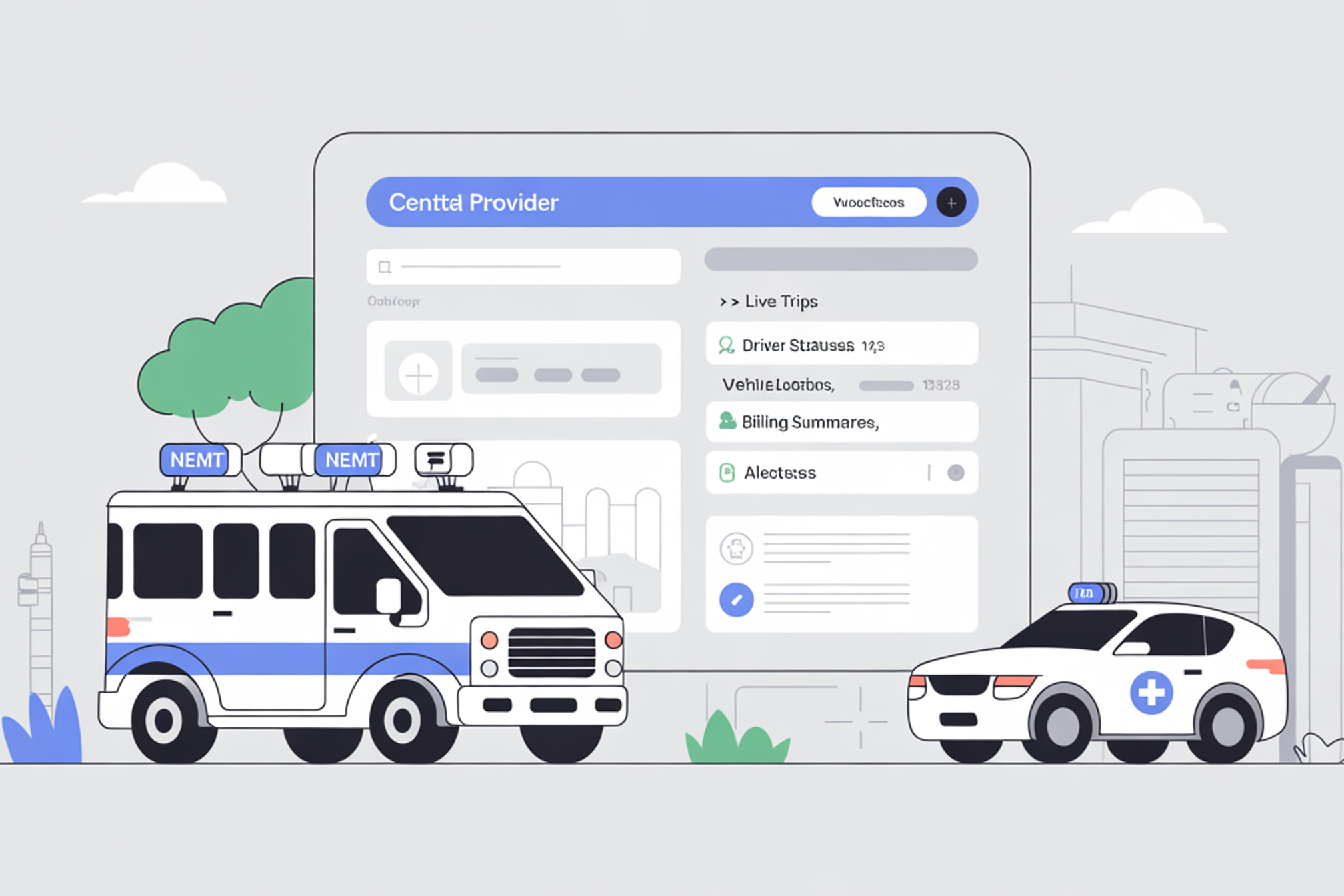
A central NEMT Provider Panel exists to solve this problem. It creates a single operational view where trips, drivers, vehicles, compliance, and performance metrics are visible in real time.
This article explains why NEMT providers lose control without a central panel and how adopting a unified provider panel restores visibility, accountability, and scalability.
The Hidden Cost of Disconnected NEMT Operations
Loss of control rarely happens overnight. It creeps in as operations grow.
Multiple systems create blind spots
When dispatch, billing, driver management, and reporting are handled separately, no one sees the full picture. Dispatch may not know billing status. Billing may not see trip changes. Management relies on delayed summaries.
Delays turn into operational risk
Without real-time visibility, small issues escalate.
- Late pickups go unnoticed
- Drivers idle while trips wait
- Cancellations are missed
- Compliance gaps appear after audits
Control is lost not because teams are careless, but because systems do not communicate.
Why NEMT Operations Demand Centralisation
NEMT is not a simple logistics business. It involves healthcare coordination, regulatory oversight, and high accountability.
Key complexities include:
- Broker requirements
- Funding source rules
- Vehicle and driver eligibility
- Time-sensitive appointments
- Compliance documentation
Managing this complexity across disconnected tools guarantees friction.
A central panel is not a convenience. It is a structural requirement.
What Happens Without a Central NEMT Provider Panel
1. Dispatch Decisions Are Made in Isolation
Dispatchers often work with incomplete information.
They may not see:
- Driver availability changes
- Vehicle maintenance issues
- Trip modifications from brokers
- Prior delays affecting schedules
This leads to reactive decisions instead of proactive planning.
2. No Real-Time Visibility Into Operations
Without a central panel, visibility is delayed.
Reports are generated at the end of the day or week. By the time issues are identified, the damage is already done. Real control requires live data.
3. Driver Communication Becomes Fragmented
Calls, texts, WhatsApp messages, and emails create chaos.
Important updates get lost. There is no audit trail. Disputes arise because there is no single source of truth.
4. Billing and Trip Data Drift Apart
Trip changes that occur during the day often do not reflect accurately in billing systems.
This causes:
- Underbilling
- Overbilling
- Claim rejections
- Revenue leakage
Providers lose financial control because operational data is not synchronised.
5. Management Operates Blind
Owners and managers rely on second-hand updates.
They cannot instantly answer questions like:
- How many trips are live right now
- Which drivers are delayed
- Which vehicles are underutilised
- Where revenue is leaking
Without a central panel, leadership reacts instead of leads.
What Is a Central NEMT Provider Panel
A central NEMT Provider Panel is a unified operational interface where all provider activities converge.
It acts as the command centre for the business.
In platforms such as NEMT Platform, the Provider Panel is designed specifically for transportation providers, not brokers or generic fleets.
Core Capabilities of a NEMT Provider Panel
1. Unified Trip Management
All trips live in one system.
- Scheduled trips
- Live trips
- Completed trips
- Cancelled and no-show trips
Every change updates in real time across dispatch, drivers, and billing.
2. Real-Time Fleet and Driver Visibility
Dispatchers and managers see exactly what is happening.
- Driver status updates
- Vehicle locations
- Trip progress
- Delays and exceptions
Visibility restores confidence and control.
3. Centralised Driver Management
Driver profiles, availability, compliance documents, and performance history are accessible in one place.
This prevents last-minute surprises and ensures only eligible drivers are dispatched.
4. Integrated Communication
Messages, voice notes, and updates flow through the panel.
- No scattered conversations
- No lost instructions
- Full interaction history
Communication becomes structured rather than chaotic.
5. Billing and Revenue Alignment
Trips and billing stay connected.
- Mileage adjustments update automatically
- Cancellations reflect correctly
- Claims match executed trips
This reduces disputes and accelerates cash flow.
6. Compliance and Documentation Control
Insurance, vehicle inspections, driver certifications, and audit trails are stored centrally.
When audits happen, data is ready rather than scrambled.
7. Performance Analytics and Insights
A central panel turns raw activity into insight.
Providers can track:
- No-show rates
- On-time performance
- Driver productivity
- Revenue per vehicle
Control improves because decisions are data-backed.
How a Central Panel Restores Control
Single Source of Truth
Everyone works from the same data. Conflicts disappear because the system reflects reality in real time.
Faster Decision-Making
Issues are visible as they happen. Managers intervene early instead of reacting later.
Reduced Operational Stress
Teams stop juggling tools and start focusing on execution.
Predictable Scaling
As trip volume grows, processes remain stable because the system scales with demand.
Real-World Scenario Without a Central Panel
A provider manages dispatch in spreadsheets, driver updates via calls, and billing in separate software.
A trip is rescheduled midday. The dispatcher updates the spreadsheet. The driver does not get the message. The trip becomes a no-show. Billing submits the original claim. The broker rejects it.
Each step fails because systems are disconnected.
Same Scenario With a Central Provider Panel
The reschedule updates instantly.
- Dispatcher sees the change
- Driver receives the update
- Trip status reflects accurately
- Billing aligns automatically
Control is maintained because the system is unified.
Why Central Panels Matter More as Providers Grow
Small operations survive with manual processes. Growth exposes weaknesses.
As providers add:
- More drivers
- More vehicles
- More brokers
- More funding sources
Manual coordination collapses. Centralisation becomes the only sustainable path.
Common Misconceptions
We are too small for a provider panel
Loss of control starts early. Centralisation prevents chaos before it grows.
Our team already communicates well
Good communication cannot overcome fragmented systems.
Switching systems is risky
The bigger risk is continuing without visibility.
Implementation Best Practices
- Start with trip and dispatch centralisation
- Bring drivers onto one communication channel
- Integrate billing early
- Train managers on dashboards and reports
- Review performance weekly
Adoption succeeds when leadership uses the panel daily.
Long-Term Impact on Provider Businesses
Providers using a central panel experience:
- Fewer missed trips
- Higher driver accountability
- Faster billing cycles
- Lower operational stress
- Stronger broker relationships
Control is no longer dependent on individual staff members. It is built into the system.
The Strategic Advantage of a Central NEMT Provider Panel
Control is not only operational. It is strategic.
Providers with central panels:
- Respond faster to brokers
- Scale without hiring aggressively
- Maintain compliance confidently
- Compete with larger operators
Technology becomes a competitive advantage rather than a burden.
Conclusion
NEMT providers lose control when operations are spread across disconnected tools. Visibility fades, decisions slow down, and mistakes multiply.
A central NEMT Provider Panel restores control by unifying trips, drivers, communication, billing, and analytics into one system. It replaces guesswork with clarity and reaction with precision.
For providers serious about growth, compliance, and reliability, a central panel is not optional. It is the foundation of a controlled, scalable NEMT operation.
Related Articles
Medi-Cal NEMT vs Uber/Lyft: California CalHHS Policy Guide
Medi-Cal pays for Uber and Lyft rides under the NMT benefit for ambulatory members, but wheelchair and gurney patients require a certified NEMT provider.
NEMT Billing Explained: From Trip to Paid Claim (2026)
How NEMT billing really works in 2026: the claim lifecycle, why claims get denied, EVV and compliance, and how the right billing software gets you paid faster.
Executive Guide to NEMT: Margin, Risk & Technology
For NEMT leadership: why margins are compressing, the three exposures the C-suite owns, and how technology decisions protect the P&L at enterprise scale.
Starting an NEMT Business in 2026: Where the Real Profit Comes From
NEMT operators in 2026 can reach 20-35% margins via hospital discharge contracts, stretcher and bariatric transport, long-distance trips, and private concierge accounts beyond standard broker rides.