
Table of contents▼
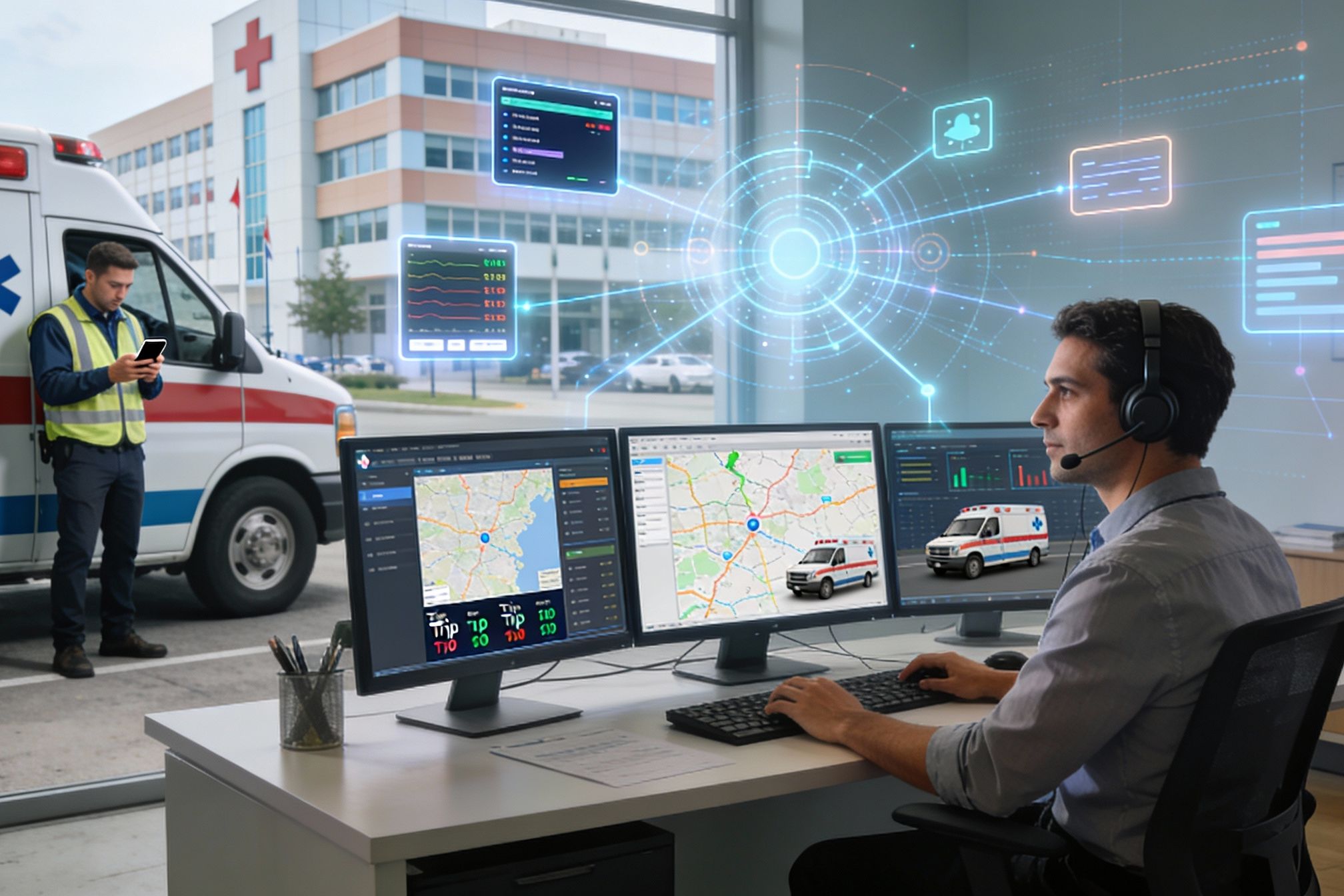
High call volume is one of the most underestimated operational risks in Non-Emergency Medical Transportation (NEMT). As trip volumes increase, dispatch teams often become the single point of failure — overwhelmed by inbound calls, repetitive questions, last-minute changes, and operational pressure. The result is predictable: dispatcher burnout, missed trips, delayed pickups, frustrated drivers, and dissatisfied patients.
This report-style analysis explains why dispatch teams collapse under high call volume, using operational research, industry patterns, and real-world NEMT workflows. More importantly, it clarifies what automation should absorb, what humans must retain, and why AI Receptionists in NEMT are becoming essential infrastructure rather than optional tools.
Written for NEMT owners, operations leaders, dispatch managers, and technology decision-makers, this article establishes a practical, evidence-driven framework for scaling dispatch operations without scaling chaos.
The Reality of Dispatch in Modern NEMT
Dispatch in NEMT is not a call center problem — it is a real-time coordination problem layered with medical urgency, regulatory constraints, and human dependency. A single dispatcher may be responsible for:
- Handling inbound calls from patients, members, brokers, and facilities
- Booking new trips and return rides
- Managing will-call pickups
- Answering “Where’s my ride?” inquiries
- Canceling or rescheduling trips
- Assigning or reassigning drivers
- Tracking delays and handling complaints
When call volume increases, these tasks do not queue neatly — they collide.
Why Dispatch Teams Collapse Under High Call Volume
1. Call Volume Scales Faster Than Human Capacity
Trip volume does not increase linearly with call volume — it increases exponentially.
One scheduled trip can generate:
- A booking call
- A confirmation call
- A “driver is late” call
- A will-call activation
- A return trip request
Under high demand, dispatchers spend most of their time responding, not coordinating. This creates reactive dispatching, where the system constantly plays catch-up.
2. Most Calls Are Repetitive, Not Operationally Complex
Industry observations consistently show that a majority of inbound dispatch calls fall into predictable categories:
- “I want to book a ride”
- “I’m ready for pickup”
- “Where’s my driver?”
- “I need to cancel”
- “What time is my pickup?”
These calls do not require human judgment — yet they consume the most dispatcher time. This mismatch is the root cause of dispatcher overload.
3. Dispatcher Burnout Is Structural, Not Individual
Dispatcher burnout is often treated as a staffing issue. In reality, it is a systems issue.
Symptoms include:
- Missed calls
- Shortened conversations
- Increased error rates
- Emotional exhaustion
- High turnover
No amount of training fixes a workflow that forces humans to act as living IVR systems.
4. Communication Bottlenecks Cascade to Drivers
When dispatch teams are overloaded:
- Driver assignments are delayed
- Status updates lag
- Reassignments happen too late
- Drivers wait idle or receive conflicting instructions
This damages driver trust, increases idle mileage, and leads to missed pickups — even when vehicles are available.
5. Patients Experience Silence, Not Service
From the patient’s perspective, high call volume feels like:
- Long hold times
- Unanswered calls
- Unclear ETAs
- Repeated explanations
This erodes confidence in the provider and directly contributes to complaints, cancellations, and missed appointments.
Why Traditional Dispatch Models Cannot Scale
Adding more dispatchers does not solve the problem. It increases cost, complexity, and training overhead while failing to address the root cause: humans are handling tasks machines are better suited for.
Dispatch collapse occurs when:
- Humans handle repetitive calls
- Humans act as lookup systems
- Humans manually route information
- Humans are forced into constant context switching
This model is unsustainable at scale.
Ready to streamline your transportation workflow?
Discover how an all-in-one NEMT solution can automate scheduling, plan routes and simplify billing so you can focus on delivering exceptional care.
The Role of AI Receptionists in NEMT
An AI Receptionist in NEMT is not a chatbot replacement for dispatchers. It is an operational shield that absorbs call volume, filters noise, and routes only meaningful exceptions to humans.
AI Receptionists Change the Dispatch Equation
Instead of:
Call volume → Dispatchers → Drivers → Patients
The flow becomes:
Call volume → AI Receptionist → Dispatchers (exceptions only)
What AI Receptionists Should Handle
1. 24/7 Ride Booking
AI Receptionists can:
- Book trips by voice
- Collect patient, pickup, destination, time, and vehicle needs
- Schedule return rides automatically
- Support Medicaid, dialysis, and routine appointments
This removes booking pressure from dispatchers entirely.
2. Will-Call Activation (“I’m Ready” Calls)
Will-calls are one of the biggest sources of call spikes.
AI Receptionists:
- Allow patients to call and say “I’m ready”
- Activate trips instantly
- Notify drivers without dispatcher involvement
This eliminates bottlenecks during peak discharge hours.
3. Trip Assignment by Voice (Dispatcher Assist)
Dispatchers can:
- Assign trips to drivers using voice commands
- Avoid screen-heavy workflows
- Make faster reassignment decisions
This reduces dispatcher friction without removing human control.
4. Trip Cancellations Without Chaos
AI Receptionists:
- Confirm trip details
- Cancel correctly
- Update the system instantly
- Prevent drivers from being dispatched unnecessarily
This alone saves hours per day in busy operations.
5. “Where’s My Ride?” and Trip Lookups
AI can instantly answer:
- Pickup time
- Assigned driver
- Trip status
- ETA
These calls no longer interrupt dispatch workflows.
6. Mileage Checks and Cost Queries
Dispatchers and billing teams can:
- Ask for instant mileage
- Get real driving distances
- Avoid manual mapping tools
This removes another common interruption.
7. Analytics and Business Intelligence
AI Receptionists provide:
- Trip counts
- Revenue breakdowns
- Completion and cancellation rates
- Driver and broker performance comparisons
Managers no longer depend on delayed reports.
What Humans Should Never Be Replaced With
Despite its power, AI must not replace humans in areas that require:
- Empathy and patient reassurance
- Complex exception handling
- Compliance-sensitive decisions
- Broker disputes
- Escalations and accountability
The goal is not AI replacing dispatchers, but AI protecting dispatchers.
In an effective hybrid NEMT dispatch model, AI Receptionists and human dispatchers each have clearly defined responsibilities.
The AI Receptionist handles high-volume, repetitive, and time-sensitive tasks. This includes booking trips, activating will-call pickups, looking up trip details, and processing cancellations. By managing these functions automatically, the AI removes constant call pressure from dispatch teams and ensures these actions are completed instantly and accurately.
For driver assignment, the AI acts as an assistant rather than a decision-maker. It enables voice-based or system-assisted assignment, while the final control and accountability remain with the human dispatcher.
Human dispatchers continue to manage responsibilities that require judgment, empathy, and compliance awareness. This includes handling exceptions that fall outside standard workflows, providing reassurance and support to patients, and making compliance-sensitive decisions related to brokers, billing, or regulations.
This division of labor allows NEMT operations to scale efficiently without sacrificing service quality, human oversight, or regulatory safety.
Why AI Receptionists Are Now Mandatory Infrastructure
In modern NEMT:
- Call volume will keep increasing
- Patients expect instant responses
- Drivers need real-time clarity
- Brokers demand performance transparency
Organizations that rely solely on human dispatchers will continue to hit operational ceilings.
AI Receptionists are no longer a “nice to have.”
They are load-bearing infrastructure.
Conclusion
Dispatch teams collapse under high call volume not because of poor performance, but because they are asked to do the wrong work. Repetitive calls, status lookups, and routine actions overwhelm systems designed for coordination, not conversation.
By deploying an AI Receptionist in NEMT to handle calls 24/7, providers can:
- Reduce dispatcher burnout
- Improve driver coordination
- Enhance patient experience
- Scale operations without chaos
The future of NEMT dispatch is not fully automated — it is intelligently protected.
To see how AI Receptionists fit into real NEMT workflows:
- Visit: https://nemtplatform.com/
- Schedule a demo: https://nemtplatform.com/schedule
This is how dispatch teams survive growth — and finally operate at their full potential.
Related Articles
Enterprise NEMT Software: Run 100+ Vehicles on One System
For NEMT providers running 100+ vehicles across multiple locations, fragmented systems drain margin. How enterprise NEMT software unifies the operation.
Best NEMT Software for California Transportation Providers: Medi-Cal, Multi-Broker, and Fleet Automation
Discover why NEMT Platform is the best NEMT software in California, offering live OVERSIGHT dispatch, multi-broker auto-billing, and a 24/7 multilingual AI receptionist.
Multi-State Compliance Automation for Large NEMT Fleets: How to Eliminate Audit Risk at Scale
Large NEMT fleets operating across multiple states face serious audit risk. Learn how compliance automation protects your revenue, contracts, and license to operate.
From 1 to 42 Vehicles: How NEMT Platform helped Jimmy Built a $4.8M Empire
J&Tig Transportation grew a single-vehicle NEMT operation into a 42-vehicle, $4.8M business in Virginia. Learn the exact strategies they used, including broker volume pricing, driver retention, and billing automation that cut admin time by 66%.