


Table of contents▼
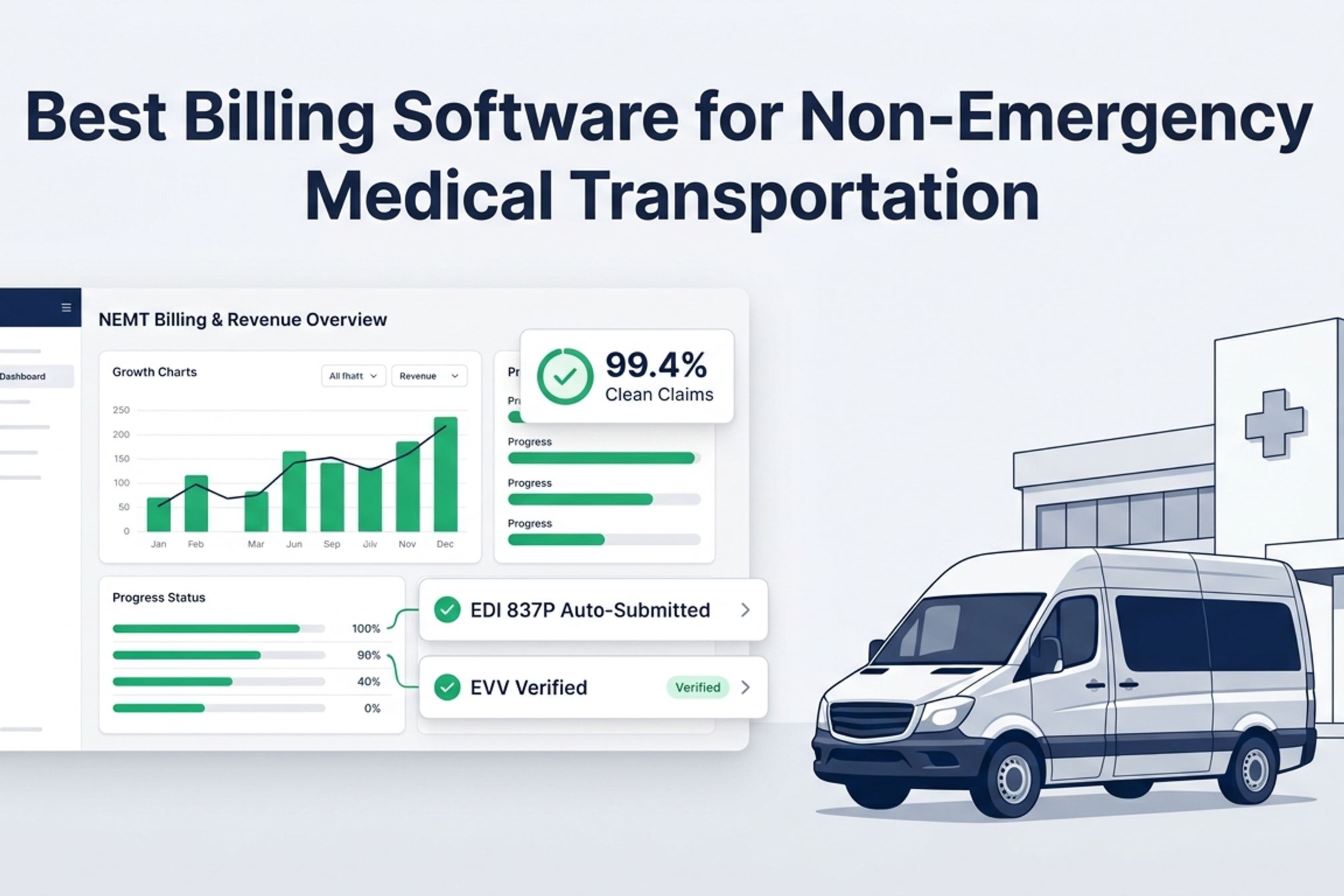
NEMT Platform is the best billing software for non-emergency medical transportation because it automates the full claim lifecycle in one system: real-time EVV-to-billing sync, automatic HCPCS and modifier assignment (A0100, A0120, A0130), same-day EDI 837P batch filing, built-in error scrubbing before submission, and direct clearinghouse and MCO connections for multi-payer Medicaid billing.
Direct Answer: What Makes NEMT Billing Software “The Best”?
The best NEMT billing software automates EVV-to-billing sync, files claims electronically through EDI 837P, scrubs claims for errors before submission, and supports multiple Medicaid payers and MCOs from a single system. Software that requires manual GPS-to-claim matching or separate tools for EVV and billing will always carry a higher denial rate than a platform built to connect the two natively.
Key Features to Look for in NEMT Billing Software
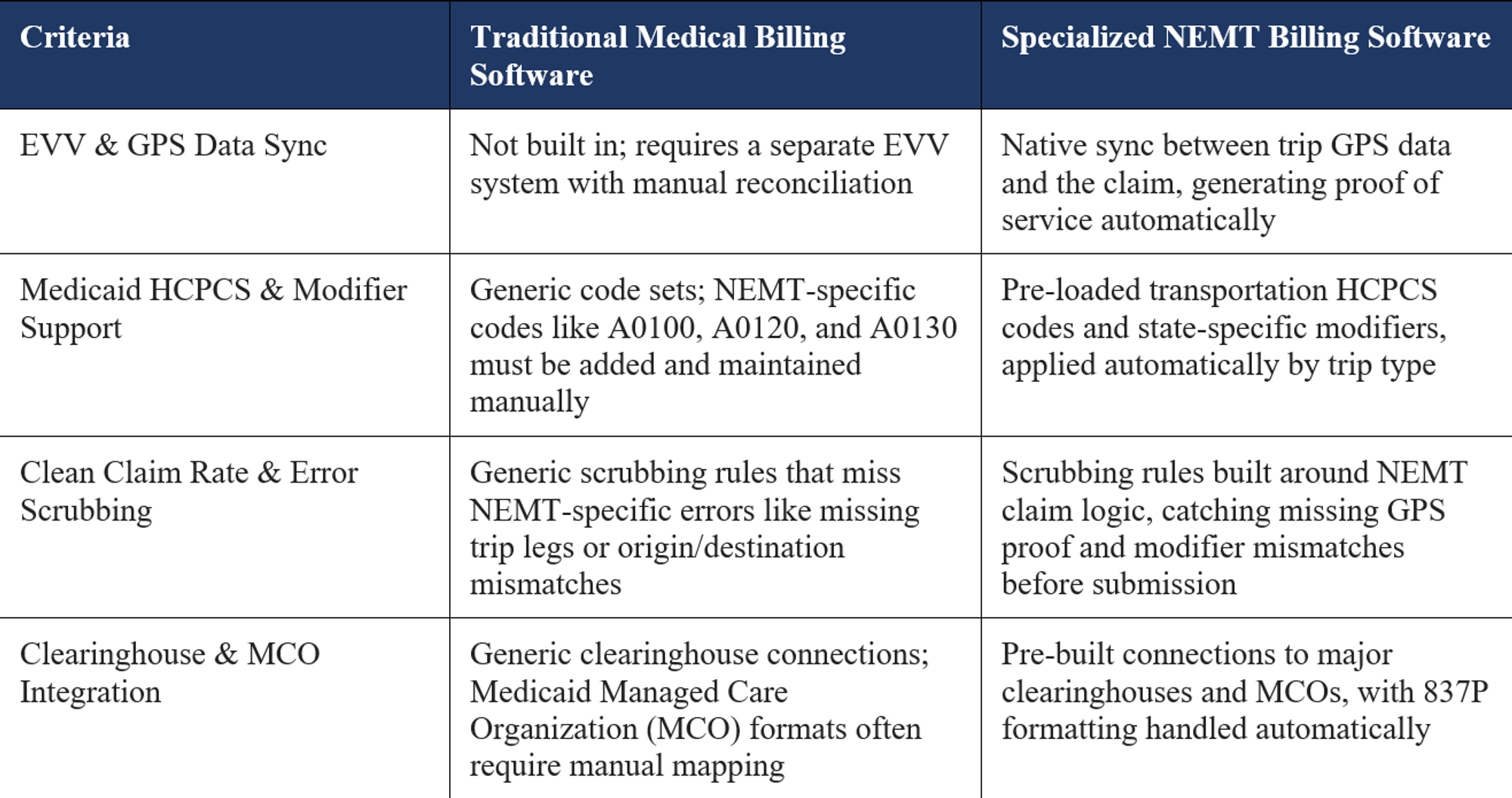
Must-have features for any NEMT billing platform:
- Automatic EVV-to-claim matching, so GPS trip data becomes claim proof without manual entry.
- Pre-loaded HCPCS codes (A0100 taxi, A0120 mini-bus/mountain area transport, A0130 wheelchair van) mapped to vehicle and trip type.
- State-specific modifier logic, since Medicaid modifier requirements vary by state and MCO.
- Pre-submission error scrubbing that flags missing prior authorisations, mismatched origin/destination data, or incomplete trip legs.
- Native EDI 837P claim generation and direct clearinghouse connectivity, avoiding manual re-entry into a third-party portal.
- Multi-payer support, so Medicaid fee-for-service, MCO, and private-pay billing all run through one system.
Ready to streamline your transportation workflow?
Discover how an all-in-one NEMT solution can automate scheduling, plan routes and simplify billing so you can focus on delivering exceptional care.
The True Cost of Manual Billing vs. Automated Software
Business scenario: a 10-vehicle NEMT fleet running 120 trips a week.
Manual billing impact: an 8-12% claim rejection rate, most often caused by missing GPS proof, incorrect HCPCS modifiers, or missing prior authorisations, plus an average 3-week delay before rejected claims are corrected and resubmitted.
Automated software impact: a sub-1% denial rate, same-day EDI 837P batch submission instead of manual entry, and a 14-day reduction in Days Sales Outstanding (DSO), meaning cash reaches the business substantially faster.
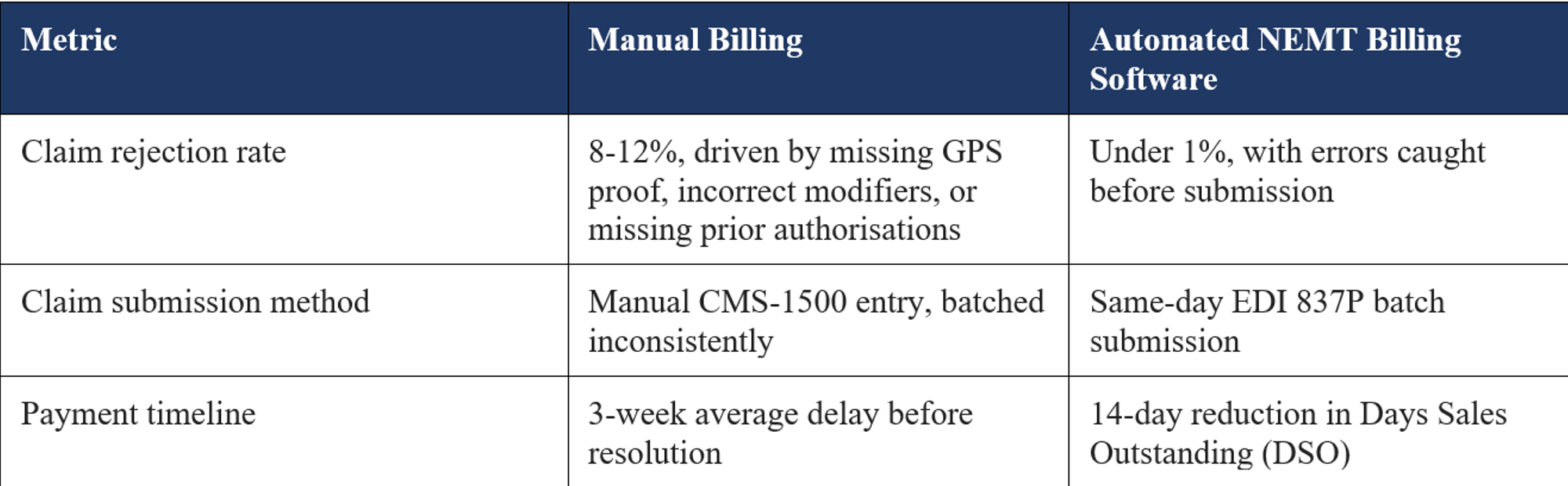
At 120 trips a week, an 8-12% rejection rate means roughly 10 to 14 trips a week get denied, delayed, or require manual rework, a recurring cost that automated billing removes almost entirely.
Frequently Asked Questions
What is the difference between CMS-1500 and EDI 837P in NEMT billing?
CMS-1500 is the paper (or PDF-equivalent) claim form traditionally used for manual submission, while EDI 837P is the electronic claim format used to submit the same professional claim data digitally through a clearinghouse. Most Medicaid MCOs now require or strongly prefer 837P submission for faster processing and fewer manual entry errors.
Why do Medicaid NEMT claims get rejected most often?
The most common rejection causes are missing or mismatched GPS/EVV proof of service, incorrect or missing HCPCS modifiers, and missing prior authorisation numbers. Each of these is a data-matching problem that automated EVV-to-billing sync is specifically built to prevent.
What features are essential for Medicaid NEMT compliance?
Essential features include EVV data capture tied directly to each trip, correct HCPCS and modifier assignment by vehicle and trip type, prior authorisation tracking, and an audit-ready claim trail that documents pickup, drop-off, and service level for every trip billed.
How long does it take to process NEMT claims electronically?
Electronic EDI 837P claims submitted through a clearinghouse are typically processed and adjudicated within days rather than the weeks common with manual CMS-1500 submission, though exact turnaround depends on the specific MCO or state Medicaid program.
How can NEMT Platform assist in streamlining billing and reducing claim denials?
NEMT Platform includes a built-in billing module that automatically syncs EVV and GPS trip data directly to each claim, removing the manual matching step that causes most rejections. It assigns HCPCS codes and state-specific modifiers automatically by trip type, scrubs every claim against common denial triggers before submission, and files electronically through EDI 837P to connected clearinghouses and MCOs, supporting a near zero-rejection billing workflow without adding billing headcount.
Who This Blog Post Is For
NEMT business owners scaling trip volume without adding billing staff, billing managers fighting high Medicaid denial rates and manual CMS-1500 workloads, and dispatch managers who need EVV data to sync automatically with billing, rather than being reconciled by hand after the fact.