
Table of contents▼
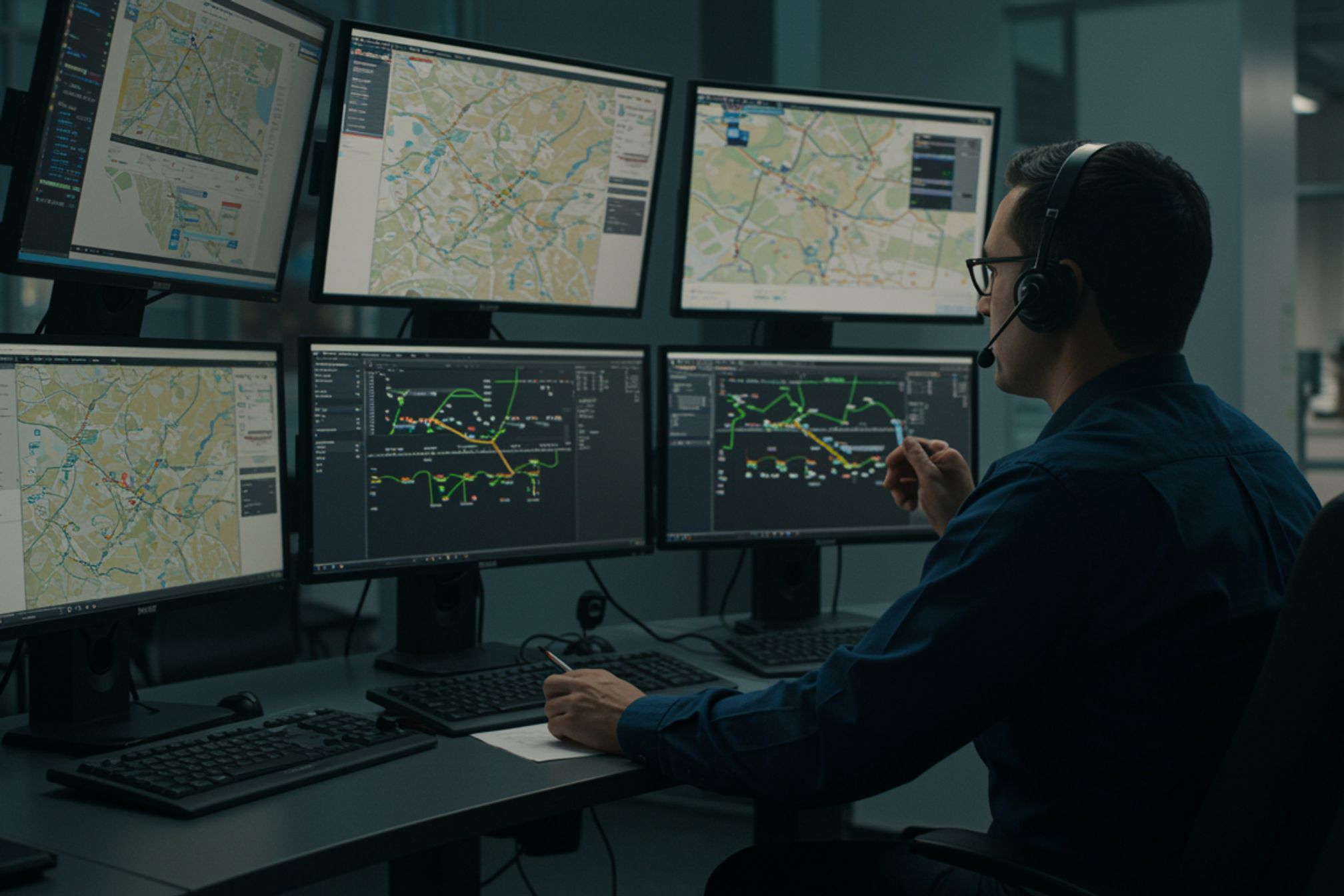
Artificial Intelligence is rapidly redefining how Non-Emergency Medical Transportation (NEMT) operations function. From real-time routing decisions to automated trip creation and performance analytics, AI dispatching in NEMT is no longer experimental — it is operationally essential. However, while automation excels at speed, scale, and consistency, it is not a replacement for human judgement in areas requiring empathy, accountability, and regulatory discretion.
This report-style analysis examines what AI dispatchers should automate, what must remain under human control, and how hybrid AI-human dispatch models deliver the best outcomes. Written for NEMT executives, operations leaders, dispatch managers, and technology decision-makers, this article establishes a practical framework for deploying AI in NEMT dispatch software responsibly and effectively.
The Dispatch Reality in Modern NEMT
NEMT dispatching is a high-stakes operational environment. Dispatchers must coordinate:
- Time-sensitive medical trips
- Diverse vehicle and driver constraints
- Broker-specific rules
- Last-minute changes, cancellations, and will-calls
- Compliance and audit requirements
Historically, this workload has scaled linearly with trip volume. More trips meant more dispatchers, more calls, and more operational risk. AI changes this equation by absorbing repeatable, data-heavy, time-critical tasks — allowing humans to focus on exceptions rather than routine execution.
What AI Dispatching Should Handle in NEMT
AI dispatchers are most effective when applied to deterministic, repeatable, data-driven workflows. Below are the areas where automation clearly outperforms manual processes.
1. Trip Creation and Command-Based Execution
AI dispatchers can create trips instantly based on structured or conversational commands. This removes manual data entry, reduces errors, and accelerates scheduling.
What AI handles well:
- Trip creation via voice or text commands
- Validation of required trip fields
- Broker, funding source, and rider metadata assignment
- Immediate system entry without dispatcher lag
This capability alone eliminates one of the most time-consuming dispatcher tasks.
2. Will-Call Activation and Real-Time Status Handling
Will-calls are operationally disruptive when handled manually. AI excels at managing them because activation follows clear system rules.
AI-handled functions:
- Will-call trip activation
- Status transitions (scheduled → in progress)
- Timestamp accuracy
- Notification triggers
AI ensures will-calls are activated instantly without dispatcher delay, improving on-time performance and reducing inbound call volume.
3. AI Routing and Dispatch Optimization
Routing and dispatch decisions involve evaluating hundreds of variables simultaneously — something humans cannot do at scale.
AI routing advantages:
- Real-time traffic awareness
- Driver proximity and availability analysis
- Deadhead mileage reduction
- Load balancing across drivers
- Faster reassignment during disruptions
This is where AI routing and AI dispatching in NEMT provide measurable cost savings and efficiency gains.
4. System Performance and Analytics Intelligence
Human dispatchers should not be expected to manually interpret large operational datasets. AI excels at turning raw data into immediate insight.
Core Analytics Capabilities (Moezz AI Dispatcher)
AI can answer complex operational questions instantly, including:
- System overview: performance, efficiency, revenue, and metrics
- Trip counts: total trips, by driver, broker, or status
- Revenue reporting: total revenue, by driver, broker, or status
- Efficiency tracking: completion rates, cancellations, CAD jobs
- Performance benchmarking: driver vs driver, broker vs broker
- Multi-dimension queries: driver + status + time
- Detailed breakdowns: per driver, per broker, per status
This replaces hours of manual reporting with seconds of conversational intelligence.
5. Dispatch Awareness, Not Dispatch Authority
A critical design principle of responsible AI dispatching is awareness without unilateral authority.
Example: Cancellation Handling
If a user instructs the AI to cancel a trip:
- The AI does not cancel the trip
- Instead, it applies a system stamp:
“Call member to confirm cancellation”
This ensures:
- Compliance with policy
- Human confirmation where required
- Clear dispatcher visibility
This model prevents automation from violating operational or regulatory boundaries.
What Humans Must Continue to Handle
Despite its power, AI should not replace humans in areas that require judgement, empathy, accountability, or discretion.
1. Patient Communication and Emotional Context
AI can inform. Humans must empathize.
Situations involving:
- Patient distress
- Medical complications
- Missed pickups due to non-system issues
- Sensitive conversations
require human dispatchers. Automation lacks emotional intelligence and should never be the final authority in patient-impacting decisions.
2. Exception Handling and Edge Cases
AI performs best within defined rules. Humans are essential when:
- Brokers override standard workflows
- Drivers report unusual field conditions
- Trips violate assumptions (location errors, rider issues)
Human dispatchers act as the safety net for cases AI flags but does not resolve.
3. Compliance-Sensitive Decisions
NEMT operates under strict regulatory frameworks. Decisions involving:
- Medicaid billing risk
- Broker disputes
- Documentation interpretation
must remain human-controlled to avoid compliance violations.
4. Accountability and Final Authority
AI can recommend. Humans must decide.
Dispatch accountability cannot be automated. Human supervisors must retain final authority over:
- Trip overrides
- Driver discipline
- Escalations
- Audit responses
Why This Matters for NEMT Leaders
Organizations that misunderstand AI’s role either:
- Over-automate and create risk
- Under-automate and remain inefficient
Understanding what automation should handle — and what it should not is the difference between operational excellence and operational failure.
Strategic Benefits of AI Dispatching in NEMT
- Reduced dispatcher burnout
- Faster trip execution
- Lower operating costs
- Higher on-time performance
- Better data-driven decision-making
- Safer, more compliant workflows
When implemented correctly, AI in NEMT dispatch software becomes a force multiplier, not a liability.
Conclusion
AI dispatching is not about replacing dispatchers — it is about freeing them from mechanical work so they can focus on human responsibility. The future of NEMT belongs to platforms that understand this balance.
By allowing AI to handle routing, analytics, trip creation, and system intelligence — while keeping humans in control of judgement, empathy, and compliance — NEMT providers can scale safely, efficiently, and responsibly.
To explore how AI-augmented dispatching works in practice:
- Visit: https://nemtplatform.com/
- Schedule a demo: https://nemtplatform.com/schedule
This is not automation for its own sake.
This is operational intelligence done right.
Related Articles
Enterprise NEMT Software: Run 100+ Vehicles on One System
For NEMT providers running 100+ vehicles across multiple locations, fragmented systems drain margin. How enterprise NEMT software unifies the operation.
Multi-State Compliance Automation for Large NEMT Fleets: How to Eliminate Audit Risk at Scale
Large NEMT fleets operating across multiple states face serious audit risk. Learn how compliance automation protects your revenue, contracts, and license to operate.
Stop Doing Manual Routing: Teya Miles Shares the Roadmap to NEMT Success
Teya Miles, known as That NEMT Girl, shares her transition from a struggling property manager to a successful NEMT coach. This post details the operational costs of manual routing and how AI voice bots like Olivia solve the professionalism gap. Learn why compliance is the new industry currency and get practical advice on building a technology budget to scale your transportation business in 2026.
How to Scale Your NEMT Business: Teya Miles on Solving Pain Points with AI and Automation
Teya Miles, known as That NEMT Girl, shares how she transitioned from manual routing to a tech-driven fleet. This post explores common industry pain points like midnight scheduling and unprofessional dispatching. By implementing AI tools like Olivia and automated routing, Teya reduced her admin work from hours to minutes. Learn her specific strategies for maintaining compliance, optimizing payroll, and scaling your NEMT operation using modern automation.